Early gas detection is crucial in many fields, including environmental protection, medical diagnosis and national defence. Graphene, the 'wonder-material' consisting of a two-dimensional layer of carbon atoms, has attracted much attention for its potential gas sensing applications.
When the surface of graphene is bared to certain chemicals, those chemicals either donate or withdraw electrons from graphene, causing a change in the electrical resistivity. Graphene is incredibly sensitive to this process, in fact it is so sensitive that just a single molecule of nitrogen dioxide can cause a measureable change. A graphene-based gas sensor would use these electrical changes to detect the target chemical.
However, it is not that simple. Gas sensors need to be exposed to the environment in order to detect the target species, but graphene is sensitive to such a wide variety of chemicals that its electrical resistivity changes significantly in ambient air alone. This makes it difficult to differentiate between the changes that are caused by the target gas and those caused by the natural environment.
In a new study, a group of scientists from NPL, Chalmers University of Technology and the US Naval Research Laboratory have used a novel technique to examine the effects of ambient air on graphene in a controlled environment in order to characterise its response.
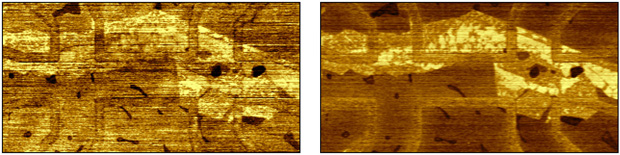
The researchers investigated the effects of nitrogen, oxygen, water vapour and nitrogen dioxide (in concentrations typically present in ambient air) on epitaxial graphene inside a controlled environmental chamber. All measurements were taken at NPL by applying Kelvin probe force microscopy whilst simultaneously performing transport (resistance) measurements. This novel combination gave researchers the unique ability to connect the local and global electronic properties together, a task that has proven to be difficult in the past.
The study, published in 2D Materials, experimentally showed that the combination of gases used does not fully replicate the effects of ambient air; even at concentrations higher than those found in the typical atmosphere, there is a large difference in graphene's response. This result contradicts past literature, which has mainly attributed the changes in graphene's electronic properties to these gases.
And it raises the question: "What mystery chemicals are causing this significant response?"
It is clear that, while graphene-based gas sensors have great potential, there is still a lot of research to be done. Further exploration is needed to find the missing link between the effects seen in controlled laboratories and the effects seen in ambient air. Researchers are also interested in studying methods to optimise the devices by narrowing the sensitivity to specific target species, such as chemical functionalisation.
Read the full paper here: Atmospheric doping effects in epitaxial graphene: correlation of local and global electrical studies
NPL
#Graphene
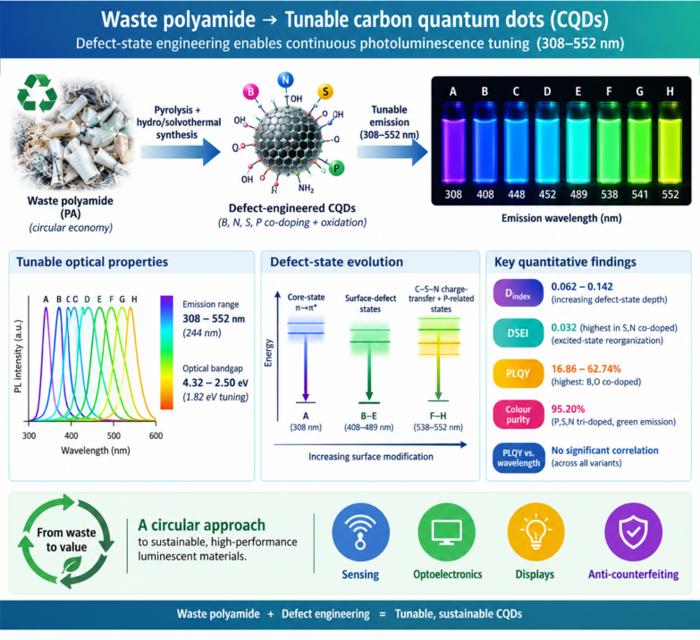
Waste polyamide-derived CQDs show continuous photoluminescence tuning from 308 to 552 nm through sequential defect-state engineering, with optical transition energies decreasing from 4.32 to 2.50 eV. @Christian Ebere Enyoh from Saitama University Carbon quantum dots (CQDs) are fluorescent carbon nanomaterials with potential applications in sensing, optoelectronics, displays, anti-counterfeiting, and environmental technologies. Their optical properties can be adjusted by modifying the carbon...
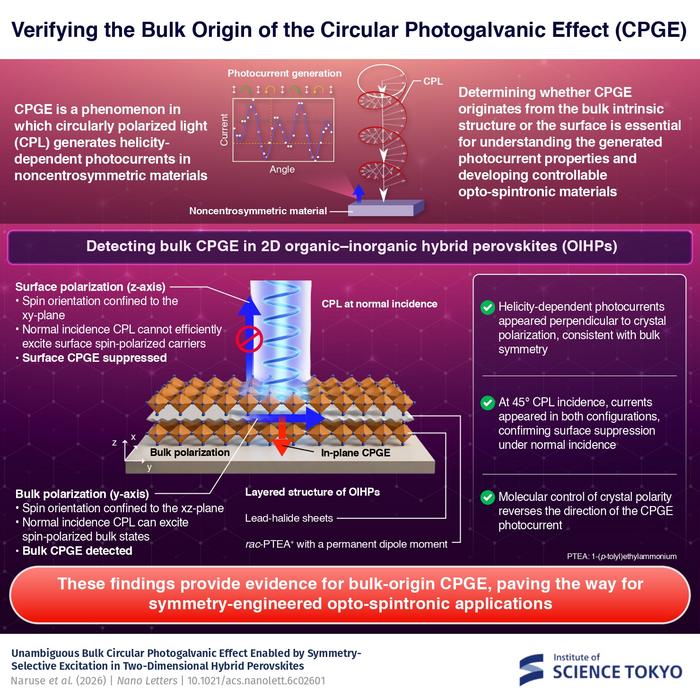
The researchers used circularly polarized light at normal incidence and found that helicity-dependent photocurrents appeared perpendicular to the crystal’s polarization but vanished when measured parallel to it, supporting a bulk origin of CPGE. @Institute of Science Tokyo The circular photogalvanic effect (CPGE), a phenomenon that generates helicity-dependent photocurrents in noncentrosymmetric materials, can originate purely from a crystal's internal structure without contribution from the...
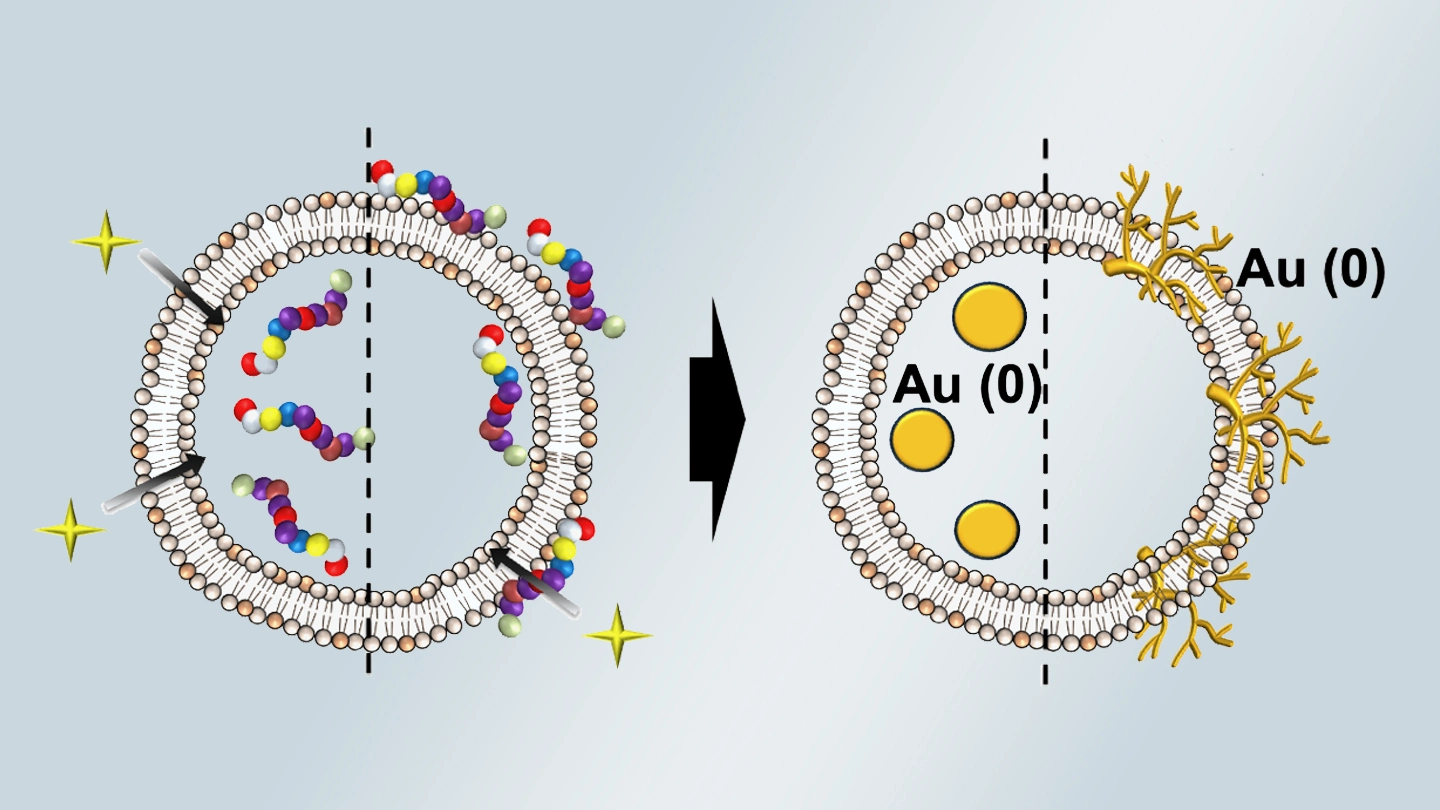
Summary of gold nanoparticle growth programming in liposome based on localization of biomineralization peptide The position of biomineralization peptides within liposomes can influence how gold nanoparticles grow, reports a research team from Institute of Science Tokyo. Peptides localized at the membrane interface promote branched structures, while those confined to the liposome interior favor spherical nanoparticles. The findings offer a new strategy for controlling nanoscale reaction...
