
Almost all electronic devices operate by using an electron charge controlled by electrical means. In addition to a charge, an electron has a spin as a magnetic property. A groundbreaking concept for information processing based on electron spins is proposed using electron spins in semiconductors.
Quantum computing enables us to exceed the speed of conventional computing and a spin transistor reduces energy consumption.
However, electron spins have yet to be used in realistic electronic devices except as part of magnetic devices for information storage. The reason is that spin polarization in a semiconductor is easily randomized, and consequently, it is difficult to transport spin polarization over a long distance.
An electron spin itself is a quantum spin angular momentum. Electrical transport and the manipulation of spin polarization are essential technologies if electron spins are to be employed in a device.
However, in actual materials, electron spins are randomized by the multiple scattering of electrons, resulting in spin depolarization in finite time. This phenomenon is called spin relaxation, and it results in spin polarization having a short transport length in a device. To realize spin functional devices, it is important to suppress spin relaxation and achieve more stable manipulation of electron spins.
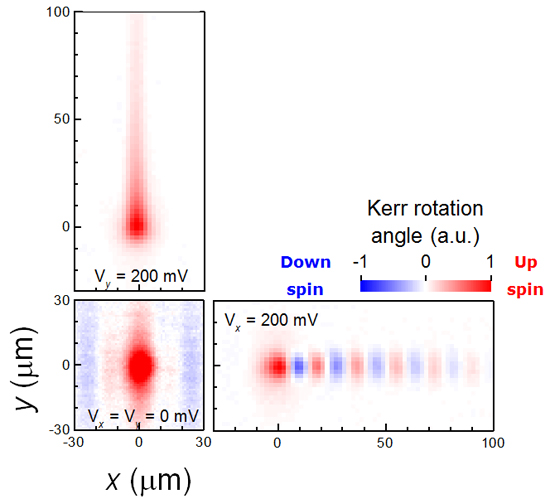
The research team has demonstrated long-distance spin transport by electrical means in a semiconductor quantum well, which is designed to increase spin lifetime. Furthermore, the research team has demonstrated that the spin precession speed of drifting electrons in semiconductor quantum wells can be controlled by applying an external gate voltage. These technological achievements combining spin transport and spin rotation will provide a way to manipulate spin polarization more stably in semiconductors and contribute to the realization of spin-based logic devices and computation.
The spatial distribution of electron spins in a semiconductor quantum well are measured by the magneto-optic Kerr effect. As shown in the figure, electron spins were transported directly over 100μm in a quantum well with in-plane electric field. In addition, in this quantum well, we found that electron spins propagate with (without) spin precession in the x(y) direction, reflecting the crystal orientation dependence of effective magnetic field.
Publication Details:
Authors: Y. Kunihashi, H. Sanada, H. Gotoh, K. Onomitsu, M. Kohda, J. Nitta, T. Sogawa
Title: Drift transport of helical spin coherence with tailored spin-orbit interactions
Journal: Nature Communications - DOI: 10.1038/ncomms10722
Tohoku University
#Semiconductors #Spintronics #QuantumComputing