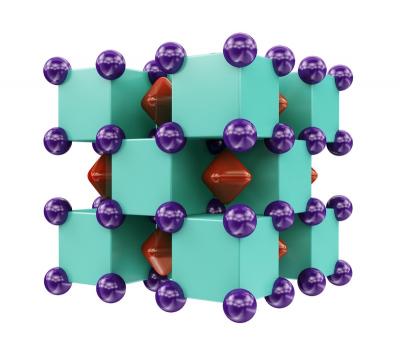
An international team of researchers have predicted two stable helium compounds -- NaHe and NaHeO
Although helium is the second most-abundant element (after hydrogen) in the universe, it doesn't play well with others. It is a member of a family of seven elements called the noble gases, which are called that because of their chemical aloofness -- they don't easily form compounds with other elements. Helium, widely believed to be the most inert element, has no stable compounds under normal conditions.
Now, an international team of researchers led by Skoltech's Prof. Artem R. Oganov (also a professor at Stony Brook University and head of Computational Materials Discovery laboratory at Moscow Institute of Physics and Technology) has predicted two stable helium compounds -- Na2He and Na2HeO. The scientists experimentally confirmed and theoretically explained the stability of Na2He. This work could hold clues about the chemistry occurring inside gas giant planets and possibly even stars, where helium is a major component. The work is published by Nature Chemistry.
The authors of the study used a crystal structure-predicting tool, the first-principles evolutionary algorithm called USPEX, to conduct a systematic search for stable helium compounds. They predicted the existence of Na2He, which was then successfully synthesized in a diamond anvil cell (DAC) experiment performed at the Carnegie Institution for Science in Washington by Prof.
Alexander F. Goncharov and his colleagues. The compound appeared at pressures of about 1.1 million times Earth's atmospheric pressure and is predicted to be stable at least up to 10 million times that.
"The compound that we discovered is very peculiar: helium atoms do not actually form any chemical bonds, yet their presence fundamentally changes chemical interactions between sodium atoms, forces electrons to localize inside cubic voids of the structure and makes this material insulating," says Xiao Dong, the first author of this work, who was a long-term visiting student in Oganov's laboratory at the time when this work was done.
Na2He is what's called an electride, which is a special type of an ionic salt-like crystal. It has a positively charged sublattice of sodium ions and another negatively charged sublattice formed of localized electron pairs. Because electrons are strongly localized, this material is an insulator, meaning that it cannot conduct the free-flowing electrons that make up an electric current.
The other predicted helium compound, Na2HeO, was found to be stable in the pressure range from 0.15 to 1.1 million atmospheres. It is also an ionic crystal with a structure similar to that of Na2He. However, in place of electron pairs, it has negatively charged oxygen in the form of O²?.
"This study shows how new surprising phenomena can be discovered by combination of powerful theoretical methods and state-of-the-art experiments. It shows that very weird chemical phenomena and compounds can emerge at extreme conditions, and the role of such phenomena inside planets needs to be explored," says Oganov.
A stable compound of helium and sodium at high pressure
Xiao Dong, Artem R. Oganov, Alexander F. Goncharov, Elissaios Stavrou, Sergey Lobanov, Gabriele Saleh, Guang-Rui Qian, Qiang Zhu, Carlo Gatti, Volker L. Deringer, Richard Dronskowski, Xiang-Feng Zhou, Vitali B. Prakapenka, Zuzana Konôpková, Ivan A. Popov, Alexander I. Boldyrev & Hui-Tian Wang
Nature Chemistry (2017) doi:10.1038/nchem.2716
Moscow Institute of Physics and Technology
#Chemistry

Researchers led by Professor Jaeyune Ryu at Seoul National University identified local pH near electrodes as a decisive variable in organic electrosynthesis. By designing a reactor that narrows electrode spacing and flows electrolyte to counterbalance acidic and alkaline zones, they raised selectivity for lactones and epoxides, feedstocks for biodegradable plastics, polyurethanes, adhesives, and epoxy resins, from about 16% to 97% using only oxygen and electricity, eliminating added peroxide…

Silver nanoparticles with diameters of ~10 nm deliver the best performance as electrocatalysts. The silver particles are sprayed onto the electrode together with a conductive carbon powder. The ideal mixture consists of 20 per cent by mass silver and 80 per cent by mass carbon powder. This image was taken using a transmission electron microscope (TEM). © HZB Via electrolysis, CO₂ can be reduced to CO, a raw material for further chemical products such as fuels. Within the GreenQuest Project,...

A flexible metal–organic framework developed by researchers from Institute of Science Tokyo enables the structural determination of large "beyond rule of 5" molecules from microgram-scale samples. Using APF-40 as a crystalline sponge, the researchers determined the structures of 12 pharmaceutical-related molecules, including the 899 Da drug molecule doramectin and trace ivermectin derivatives. The method could aid drug discovery, natural products research, and the characterization of rare...






