A flexible metal–organic framework developed by researchers from Institute of Science Tokyo enables the structural determination of large "beyond rule of 5" molecules from microgram-scale samples. Using APF-40 as a crystalline sponge, the researchers determined the structures of 12 pharmaceutical-related molecules, including the 899 Da drug molecule doramectin and trace ivermectin derivatives. The method could aid drug discovery, natural products research, and the characterization of rare compounds available only in very small quantities.
An Adaptable Porous Framework Extends Structural Determination to Beyond Rule of 5 (bRo5) Molecules
Drug discovery has traditionally followed the "rule of 5," which identifies chemical properties generally associated with good absorption of orally administered drugs, including a molecular weight below 500 daltons (Da). However, some pharmaceutical compounds fall outside these guidelines. Known as beyond rule of 5 (bRo5) molecules, these compounds can have larger, more complex structures while still exhibiting strong therapeutic activity and favorable pharmacological properties. Their size and structural complexity, however, make it difficult to characterize them using conventional methods, particularly when very small quantities are available.
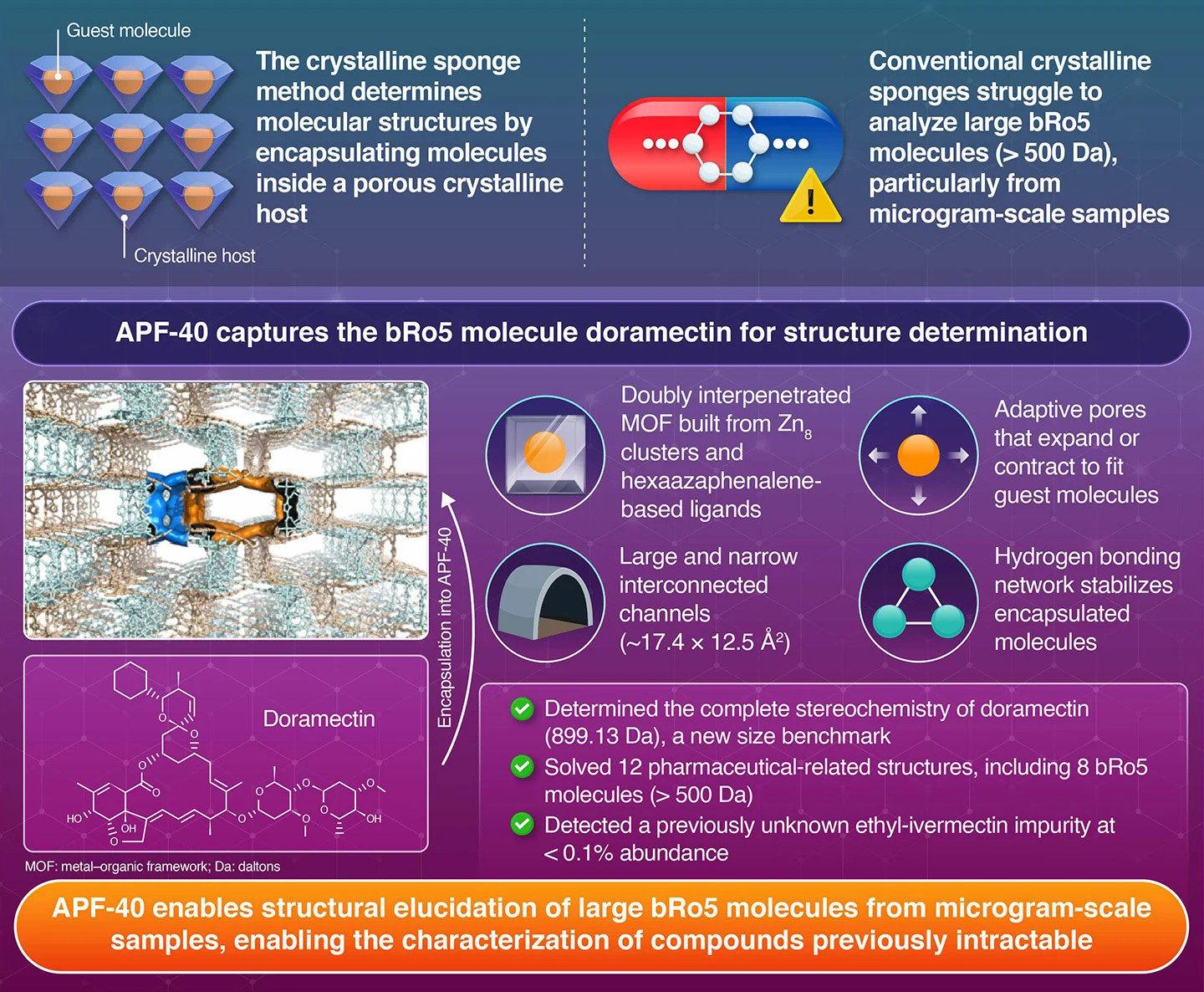
Now, researchers led by doctoral student Taichi Baba from the Department of Chemistry, Institute of Science Tokyo (Science Tokyo), Japan, have developed a flexible metal–organic framework, APF-40 (APF = adaptable porous framework), that enables structural analysis of large bRo5 molecules from microgram-scale samples. APF-40 acts as a crystalline sponge, trapping guest molecules within its porous structure and holding them in place, thereby enabling molecular structure determination by single-crystal X-ray diffraction analysis.
The research team included former graduate student Yu Tagami, former Assistant Professor Yuki Wada (current Director of TEKMOF Co., Ltd., Japan), Specially Appointed Associate Professor Pavel M. Usov, and Professor Masaki Kawano (also serves as Chief Scientific Officer of TEKMOF Co., Ltd.) from Science Tokyo, along with Associate Professor Arihiro Iwasaki from Chuo University in Japan. Their study was made available online on August 04, 2026, and published in Volume 148, Issue 32 of the Journal of the American Chemical Society on August 19, 2026.
"We have successfully extended the crystalline sponge method to the structural analysis of molecules larger than 500 Da using only microgram-scale samples, overcoming a long-standing limitation of the technique," highlights Baba.
The researchers synthesized APF-40 using a benzoate-substituted hexaazaphenalene ligand and Zn8 clusters, which form a doubly interpenetrated framework with channels about 1 nm wide. These include larger channels measuring 17.4 × 12.5 Å2, as well as smaller channels between the Zn8 clusters. Water molecules and dimethylammonium ions inside the channels form hydrogen-bonding networks that provide additional sites for guest molecules to interact with the framework. These interactions help APF-40 hold guest molecules securely inside its channels.
Using APF-40, the researchers successfully determined the structures of 12 pharmaceutical molecules, including eight bRo5 compounds with subtle differences in their chemical structures, such as methyl-to-ethyl, methoxy-to-hydroxy, and alkane-to-alkene modifications. The framework could expand or contract its pores to accommodate molecules of different sizes and shapes. When guest molecules were too small for the available pore space, they formed larger assemblies, known as dimers, through hydrogen bonding or coordination with zinc ions. This helped overcome the mismatch between the size of the molecules and the available pore space.
Notably, the researchers successfully determined the complete three-dimensional structure and stereochemistry of doramectin, a bRo5 pharmaceutical molecule with a molecular weight of 899 Da and 64 non-hydrogen atoms, a new size benchmark for molecules analyzed using the crystalline sponge method.
The researchers also combined high-performance liquid chromatography, mass spectrometry, nuclear magnetic resonance spectroscopy, and APF-40-based crystallographic analysis to examine trace compounds in a commercially available ivermectin sample. They identified several ivermectin derivatives, including a previously unknown derivative called ethyl-ivermectin, which was recovered as little as 100 µg.
Such a framework could provide researchers with a practical way to study large pharmaceutical molecules that are difficult to characterize using conventional methods. "The methodology could significantly expand the range of molecules accessible to crystallographic analysis and contribute to advances in drug discovery, natural products chemistry, and microscale molecular characterization," concludes Baba.
Reference
An Adaptable Porous Metal–Organic Framework for Structural Visualization of Beyond Rule of 5 Molecules on the Microgram Scale
Taichi Baba1, Yu Tagami1, Natsumi Watanabe2, Bun Chan3,4, Tomoki Nakagawa1, Yiying Zhu1, Arihiro Iwasaki2*, Pavel M. Usov1, Yuki Wada1,5*, and Masaki Kawano1,5*
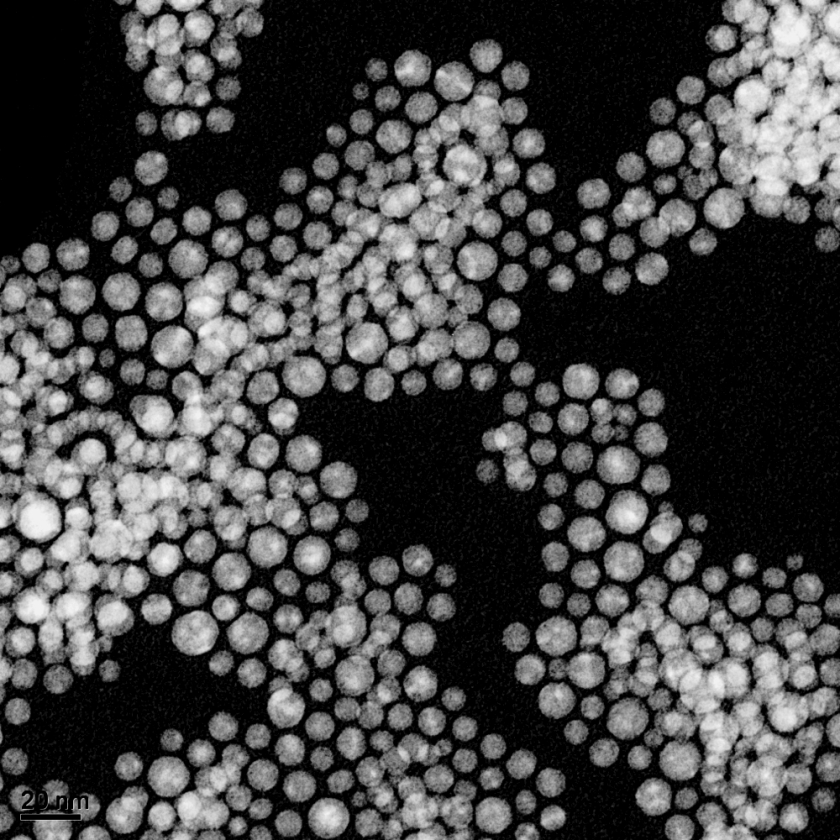
Silver nanoparticles with diameters of ~10 nm deliver the best performance as electrocatalysts. The silver particles are sprayed onto the electrode together with a conductive carbon powder. The ideal mixture consists of 20 per cent by mass silver and 80 per cent by mass carbon powder. This image was taken using a transmission electron microscope (TEM). © HZB Via electrolysis, CO₂ can be reduced to CO, a raw material for further chemical products such as fuels. Within the GreenQuest Project,...
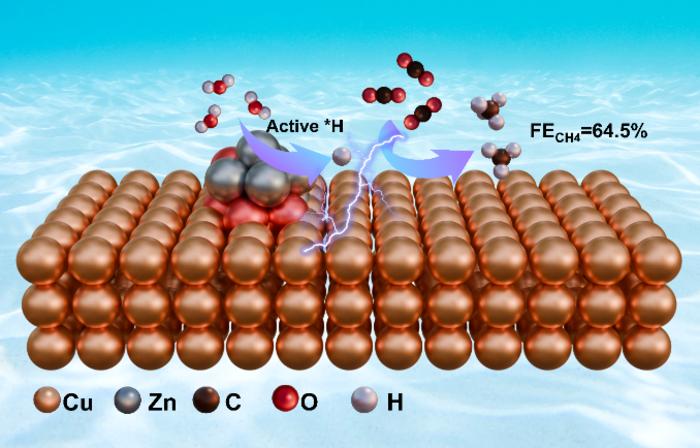
image: CuZn800@C was constructed via solvothermal method and utilizes the high-temperature volatility of zinc to prepare through calcination at different temperatures, which displays a high methane Faradaic efficiency of 64.5% and a remarkable partial current density of -551.3 mA/cm2 at -1.7 V vs. RHE, along with excellent stability. Zn and Cu form a tandem reaction system. Zn sites promote water splitting to provide protons, while Cu sites reduce the energy barrier for *CO hydrogenation....
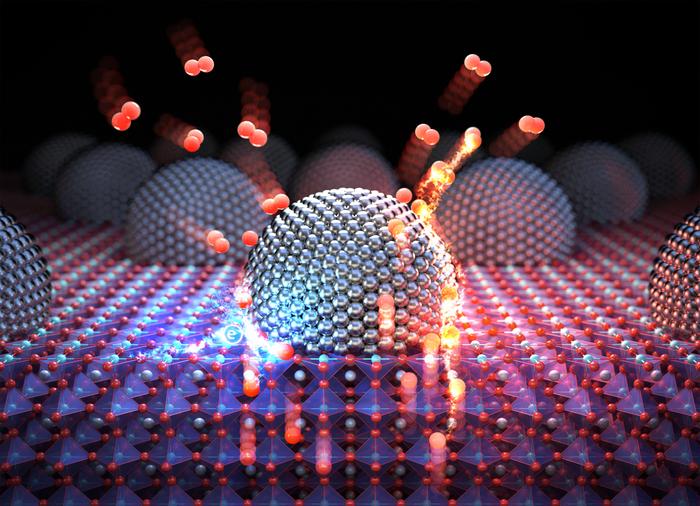
A joint team from SNU, KAIST, and KBSI has identified the distinct reaction sites of silver nanocatalysts in solid oxide cells. During electricity generation the catalyst–electrode interface dominates, while during hydrogen production the nanoparticle surface is key. The finding enables new design principles for higher-efficiency green hydrogen and clean power systems. Published in Energy & Environmental Science.
