Physicists at the University of Sydney have found a 'quantum hack' that should allow for enormous efficiency gains in quantum computing technologies.
As scientists at IBM, Google, Microsoft and universities across the world seek to scale-up quantum technology to make a practical quantum computer, finding ways to do computations within an acceptable error threshold is a big technological problem.
The building blocks of quantum machines - quantum bits, or qubits - are prone to interference from their surrounding environments, leading them to decohere and lose their quantum properties. Allowing for this through error correction is vital to the successful scale-up of quantum technologies.
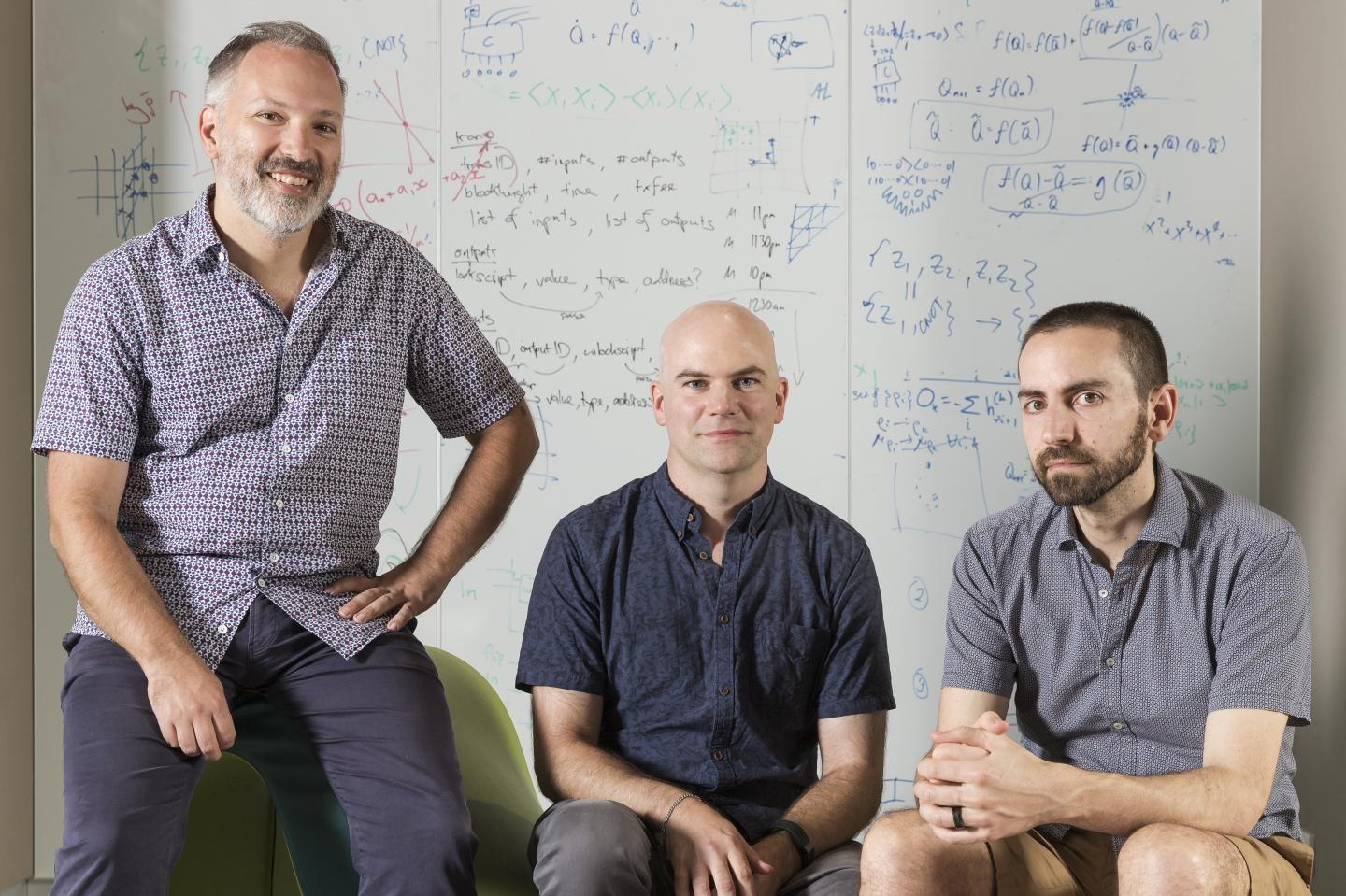
The theoretical breakthrough from the team of David Tuckett, Professor Stephen Bartlett and Associate Professor Steven Flammia allows for a 400 percent gain in the amount of interference noise a quantum computing system can theoretically sustain while retaining its fidelity.
"This is achieved by tailoring our quantum decoder to match the properties of the noise experienced by the qubits," said Associate Professor Flammia.
"In that sense, we are 'hacking' the generally accepted coding for error correction," Professor Bartlett said.
The research is published this week in the top-tier journal Physical Review Letters. It forms part of Mr Tuckett's work as a PhD candidate at the University.
At present the rule-of-thumb threshold for fidelity in a qubit architecture is about 1 percent. This means at least 99 percent of a system's qubits need to retain information and coherence for relevant periods of time in order to do any useful computations.
This real-world threshold of 1 percent comes from a theoretical approach where ideal hardware should allow for 10.9 percent error threshold. The drop in tolerance comes from 'noise' in using real-world machines.
Assuming ideal hardware, the work of the Sydney quantum team, which is based at the University of Sydney Nano Institute, has an error correction threshold of up to 43.7% - a fourfold improvement on the current theoretical basis for error correction.
This means fewer physical qubits could be required for a single quantum logic gate - or basic quantum circuit - that can perform a useful calculation.
This new approach should be applicable in any quantum system - whether the qubits rely on superconductors, trapped ions, semiconductors, or topological structures (should they need them).
Experimental scientists now need to apply this 'quantum hack' to real-world systems to see how it flows through using 'noisy' hardware.
Ultrahigh Error Threshold for Surface Codes with Biased Noise
David K. Tuckett, Stephen D. Bartlett, and Steven T. Flammia
Phys. Rev. Lett. 120, 050505 – Published 31 January 2018
DOI:https://doi.org/10.1103/PhysRevLett.120.050505
University of Sydney Nano Institute
#QuantumComputing #QuantumMechanics