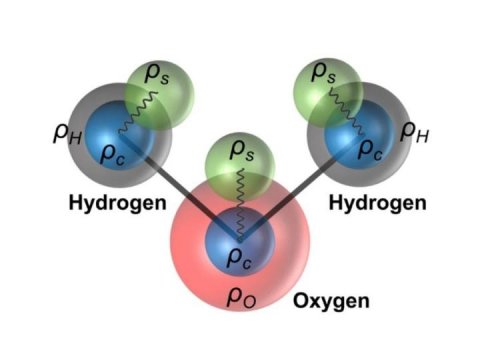
Interactions with water dominate how drug molecules bind to targets, but it's tricky to model these interactions, limiting the accuracy of drug design. In a recent paper in The Journal of Chemical Physics, from AIP Publishing, William A. Goddard III and Saber Naserifar from the California Institute of Technology describe their novel approach to building a new description of water (known as a force field) and demonstrate its accuracy.
Goddard, a professor of chemistry and applied physics, was "flabbergasted" by the results. "The description we get fits nearly all properties of water unbelievably accurately, far better than any previous force field," he said.
Quantum mechanics can only describe accurately small systems, so our understanding of liquid water relies on simulations using force fields. Despite decades of work, current force fields fail to describe simultaneously all properties of water. "One force field might give the correct density and vaporization of water, but could be 100 degrees off the melting point," said Goddard. "It sounds pretty bad, but it is all we've had."
These incomplete models restrict drug design and limit our understanding of industrial solvent reactions, fueling scientists to investigate some of water's anomalous characteristics. For example, it has been suggested that when water is supercooled to low temperatures it may exist as both a high- and low-density liquid, an anomaly that could be understood much better if a good force field for water were available.
Unlike previous force fields, Goddard and Naserifar focused on modeling the individual interactions of water. Working "backward," they first considered long distance interactions, and then added charges and polarization dynamics. "Previous force fields didn't allow charges to move around, this is an important advance," said Goddard. Also, for strong hydrogen bonds, the team utilized recently published, highly accurate, water dimer calculations.
"We used high-quality quantum mechanics for each interaction individually -- long-range, short-range, hydrogen bonding, polarization -- put it all together, tested it and found it was unbelievably accurate," said Goddard. "Predicting a melting point for a liquid within 0.2 kelvin. ... That's unheard of!"
Their new force field only failed on one property: calculating how fast particles spread, or the diffusion constant. Goddard and Naserifar are "puzzled" by the irregularity, but remain excited by what their force field has achieved. They're keen to use it to investigate the anomalous properties of water, and to see if it improves drug design accuracy.
The quantum mechanics-based polarizable force field for water simulations
Saber Naserifar, William A. Goddard. T
The Journal of Chemical Physics, 2018; 149 (17): 174502
DOI: 10.1063/1.5042658
Contact information:
William A. Goddard, III
Professor of Chemistry, Materials Science, and Applied Physics at Caltech
URL: http://www.wag.caltech.edu/
California Institute of Technology (Caltech)
#Chemistry #Physics #QuantumMechanics
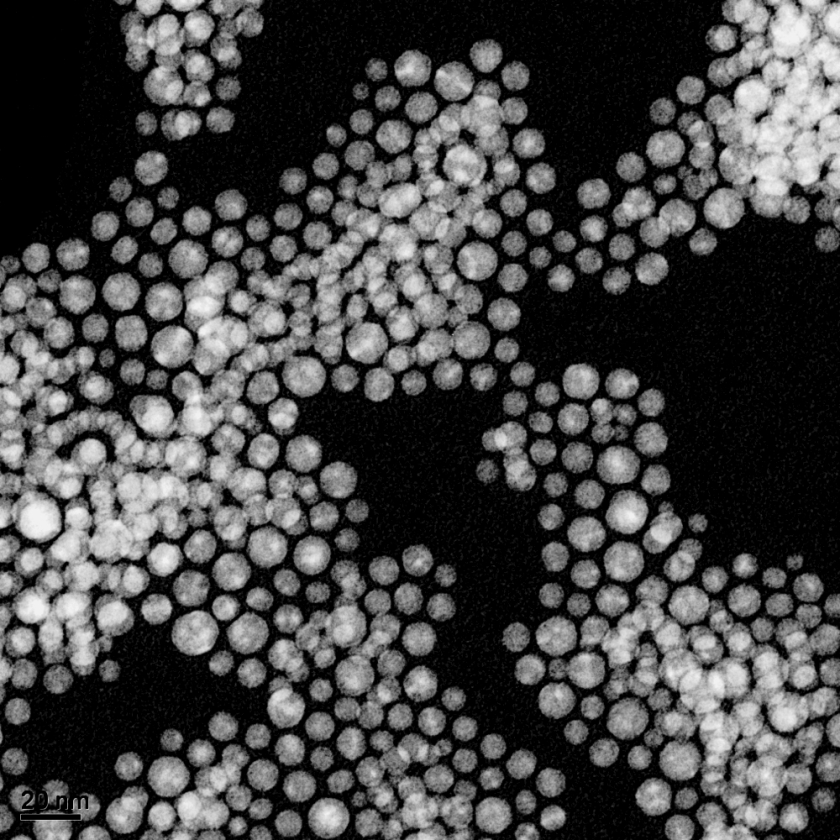
Silver nanoparticles with diameters of ~10 nm deliver the best performance as electrocatalysts. The silver particles are sprayed onto the electrode together with a conductive carbon powder. The ideal mixture consists of 20 per cent by mass silver and 80 per cent by mass carbon powder. This image was taken using a transmission electron microscope (TEM). © HZB Via electrolysis, CO₂ can be reduced to CO, a raw material for further chemical products such as fuels. Within the GreenQuest Project,...
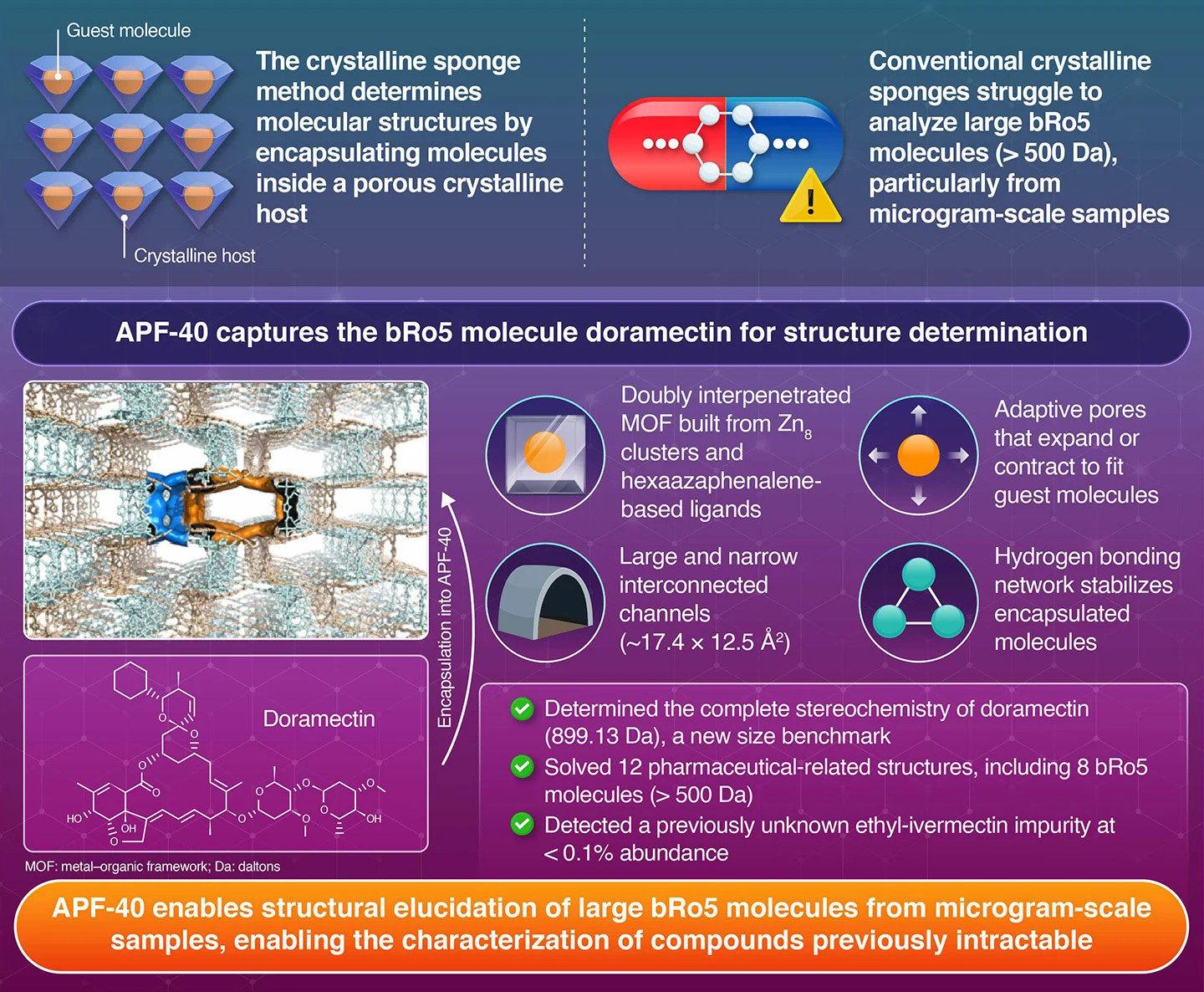
A flexible metal–organic framework developed by researchers from Institute of Science Tokyo enables the structural determination of large "beyond rule of 5" molecules from microgram-scale samples. Using APF-40 as a crystalline sponge, the researchers determined the structures of 12 pharmaceutical-related molecules, including the 899 Da drug molecule doramectin and trace ivermectin derivatives. The method could aid drug discovery, natural products research, and the characterization of rare...
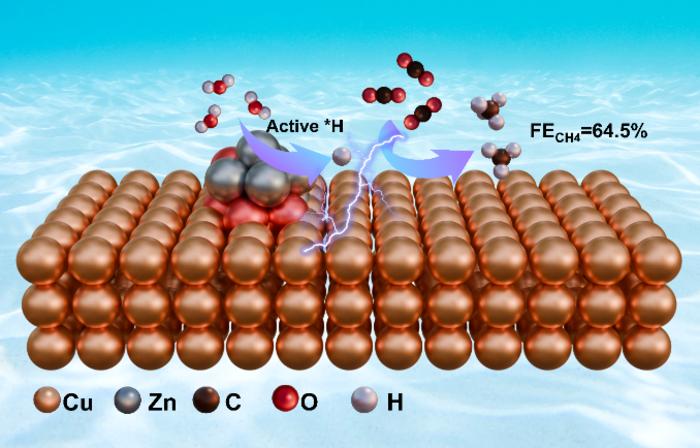
image: CuZn800@C was constructed via solvothermal method and utilizes the high-temperature volatility of zinc to prepare through calcination at different temperatures, which displays a high methane Faradaic efficiency of 64.5% and a remarkable partial current density of -551.3 mA/cm2 at -1.7 V vs. RHE, along with excellent stability. Zn and Cu form a tandem reaction system. Zn sites promote water splitting to provide protons, while Cu sites reduce the energy barrier for *CO hydrogenation....
