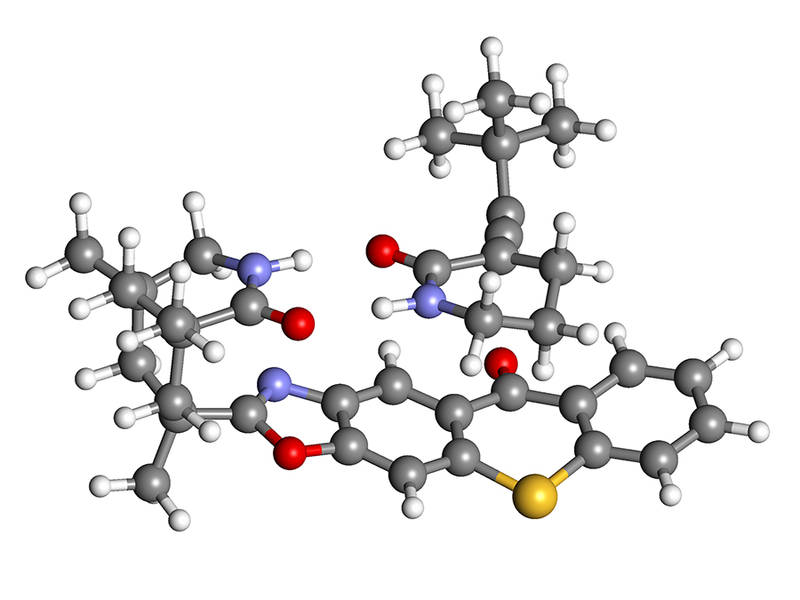
Enantiomeric molecules resemble each other like right and left hands. Both variants normally arise in chemical reactions. But frequently only one of the two forms is effectual in biology and medicine. Hitherto, completely converting this mixture into the desired enantiomer was deemed impossible. Deploying a photochemical method, a team from the Technical University of Munich (TUM) has now achieved this feat.
Producing active ingredients with very specific properties -- antibacterial characteristics, for example -- is not always so easy. The reason: many of these organic compounds are chiral. They have two mirror-image forms, so-called enantiomers.
This small difference can be consequential because the two enantiomers can have different properties. While one has a healing effect, the other might be ineffective or even cause unwanted side effects.
Saving time, energy and resources
"For a long time, researchers around the world have been seeking ways to selectively synthesize only the desired enantiomer from a racemate," explains Prof. Thorsten Bach, holder of the Chair of Organic Chemistry at the Technical University of Munich. However, this has been very difficult, since chemical reactions usually produce both molecule variants.
Together with his team, the researcher has now developed a method with which the desired enantiomer can be obtained from a racemate, the mixture of both enantiomers, in high concentrations of up to 97 percent.
Rather than painstakingly extracting the unwanted mirror-molecules from the mixture, the researchers use a photochemical reaction to transform them into the desired end product. "That saves time, energy and resources because all the molecules are used and you do not need to throw away half of them," explains Bach.
A catalyst for the "right" compounds
The secret of the transformation is a special photochemical catalyst. Originally, the thioxanthone sensitizer was developed for [2 + 2] photocycloadditions. The dye is itself chiral and therefore specifically converts only one of the enantiomers to the other. In the span of a few minutes, the equilibrium shifts in favor of the desired molecule. The undesirable mirror images disappear.
The chemists have successfully tested their new method on various molecular mixtures from the allene structural class. "We could thus demonstrate that selective and efficient catalysis to prepare enantiopure compounds from racemates is fundamentally possible," said Bach.
Catalytic deracemization of chiral allenes by sensitized excitation with visible light
Alena Hölzl-Hobmeier, Andreas Bauer, Alexandre Vieira Silva, Stefan M. Huber, Christoph Bannwarth, Thorsten Bach.
Nature, 2018; 564 (7735): 240
DOI: 10.1038/s41586-018-0755-1
Contact information:
Prof. Dr. Thorsten Bach
Chair of Organic Chemistry in Technical University of Munich
thorsten.bach@ch.tum.de
Tel. + 49-89-28913330
URL: http://www.professoren.tum.de/en/bach-thorsten/
Technical University of Munich (TUM)
#Chirality #Molecules

Researchers led by Professor Jaeyune Ryu at Seoul National University identified local pH near electrodes as a decisive variable in organic electrosynthesis. By designing a reactor that narrows electrode spacing and flows electrolyte to counterbalance acidic and alkaline zones, they raised selectivity for lactones and epoxides, feedstocks for biodegradable plastics, polyurethanes, adhesives, and epoxy resins, from about 16% to 97% using only oxygen and electricity, eliminating added peroxide…

Silver nanoparticles with diameters of ~10 nm deliver the best performance as electrocatalysts. The silver particles are sprayed onto the electrode together with a conductive carbon powder. The ideal mixture consists of 20 per cent by mass silver and 80 per cent by mass carbon powder. This image was taken using a transmission electron microscope (TEM). © HZB Via electrolysis, CO₂ can be reduced to CO, a raw material for further chemical products such as fuels. Within the GreenQuest Project,...

A flexible metal–organic framework developed by researchers from Institute of Science Tokyo enables the structural determination of large "beyond rule of 5" molecules from microgram-scale samples. Using APF-40 as a crystalline sponge, the researchers determined the structures of 12 pharmaceutical-related molecules, including the 899 Da drug molecule doramectin and trace ivermectin derivatives. The method could aid drug discovery, natural products research, and the characterization of rare...






