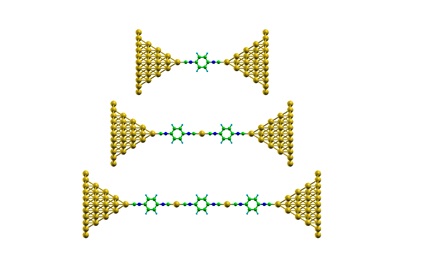
The fabrication of electronic components usually follows a top-down pathway in specialized physical laboratories. Using special carving tools in clean rooms, scientists are capable of fabricating structures reaching only a few nanometers. However, atomic precision remains very challenging and usually requires special microscopes such as an Atomic Force Microscope (AFM) or a Scanning Tunneling Microscope (STM). Chemists on the other hand routinely achieve a tour de force: They can synthesize large numbers of molecules that are all exactly identical. But synthesizing a single molecule with atomic precision and monitoring this assembly process remains a formidable challenge.
A research team from Empa, the University of Basel and the University of Oviedo has now succeeded in doing just that: The researchers synthesized chain-shaped molecules between two microscopically small gold tips. Each molecule is created individually. The properties of the resulting molecule can be monitored and documented in real time during synthesis.
Micro-manufactory between gold tips
Anton Vladyka, Jan Overbeck and Mickael Perrin work at Empa's "Transport at Nanoscale Interfaces" laboratory, headed by Michel Calame. For their experiments, they used a technique called mechanically controllable break junction (MCBJ). A gold bridge only a few nanometers thin is slowly stretched in a reagent solution until it breaks. Individual molecules can attach themselves to the fracture tips of the nano-bridge and undergo chemical reactions.
Empa researchers dipped the gold tips in a solution of 1,4-diisocyanobenzene (DICB), a molecule with strong electrical dipoles at both ends. These highly charged ends readily bond with gold atoms. The result: When the bridge is torn apart, a DICB molecule detaches individual gold atoms from the contact and thus builds a molecular chain. Each DICB molecule is followed by a gold atom, followed by another DICB molecule, a gold atom, and so on.
High success rate
What is remarkable: the molecular assembly was not dependent on any coincidences, but worked highly reproducible - even at room temperature. The researchers repeatedly opened and closed the gold bridge to better understand the process. In 99 out of 100 trials identical molecular chains of gold and DICB were formed. By monitoring the electrical conductivity between the gold contacts the researchers were even able to determine the length of the chain. Up to three chain links can be detected. If four or more chain links are formed, the conductivity is too low and the molecule remains invisible during this experiment.
Basis for chemical and physical analyses
This new method allows researchers to produce electrically conductive molecules as unique specimens and to characterize them using a variety of methods. This opens up completely new possibilities to change the electrical properties of individual molecules directly ("in situ") and to adjust them with atomic precision. This is considered a crucial step towards the further miniaturization of electronic components. At the same time, it offers deep insights into transport processes at the atomic level. "In order to discover new properties in molecular assemblies, we must first be able to build these molecular structures in a reproducible manner," says Michel Calame. "This is exactly what we have now achieved."
In-situ formation of one-dimensional coordination polymers in molecular junctions
Anton Vladyka, Mickael L. Perrin, Jan Overbeck, Rubén R. Ferradás, Víctor García-Suárez, Markus Gantenbein, Jan Brunner, Marcel Mayor, Jaime Ferrer & Michel Calame
Nature Communications volume 10, Article number: 262 (2019)
DOI: 10.1038_s41467-018-08025-9
Contact information:
Michel Calame
Titular Professor of Physics in University of Basel
michel.calame@unibas.ch
Tel: +41 (0)61 207 3697
Fax: +41 (0)61 207 3784
URL: Nanoscale Hybrid Electronic Systems
Swiss Federal Laboratories for Materials Science and Technology (EMPA)
#Molecules #MolecularSystems

Researchers led by Professor Jaeyune Ryu at Seoul National University identified local pH near electrodes as a decisive variable in organic electrosynthesis. By designing a reactor that narrows electrode spacing and flows electrolyte to counterbalance acidic and alkaline zones, they raised selectivity for lactones and epoxides, feedstocks for biodegradable plastics, polyurethanes, adhesives, and epoxy resins, from about 16% to 97% using only oxygen and electricity, eliminating added peroxide…

Silver nanoparticles with diameters of ~10 nm deliver the best performance as electrocatalysts. The silver particles are sprayed onto the electrode together with a conductive carbon powder. The ideal mixture consists of 20 per cent by mass silver and 80 per cent by mass carbon powder. This image was taken using a transmission electron microscope (TEM). © HZB Via electrolysis, CO₂ can be reduced to CO, a raw material for further chemical products such as fuels. Within the GreenQuest Project,...

A flexible metal–organic framework developed by researchers from Institute of Science Tokyo enables the structural determination of large "beyond rule of 5" molecules from microgram-scale samples. Using APF-40 as a crystalline sponge, the researchers determined the structures of 12 pharmaceutical-related molecules, including the 899 Da drug molecule doramectin and trace ivermectin derivatives. The method could aid drug discovery, natural products research, and the characterization of rare...






