Auburn University Department of Physics
Physicists at Auburn University have used flashes of laser light to bring order to tiny electrically charged “islands” inside a crystal. The discovery helps answer a decades-old question about how the material organizes itself and shows how light could be used to control its behavior — a step toward exploring new technologies for processing and storing information.
The research was led by Wencan Jin, the Thomas and Jean Walter Endowed Associate Professor in Auburn’s Department of Physics, and graduate student Mohamed Kandil. Their study, “Optical Poling of a Quantum Ferroelectric Metal across the Order-Disorder Phase Transition,” was selected as an Editors’ Suggestion in Physical Review Letters. Collaborators at Japan’s National Institute of Advanced Industrial Science and Technology grew the crystals used in the experiments.
The team studied a modified form of strontium titanate, a single crystal material with an unusual combination of electrical properties. It allows electrons to move through it while also containing tiny islands with distinct positive and negative sides. These islands, known as polar nanoregions, can point in different directions or line up in an organized pattern. Understanding what makes them line up could help scientists explain the material’s behavior and find new ways to control it.
For decades, researchers have debated how that organization begins. Do atoms shift together to create the polarized state, or do tiny polar islands already exist and simply line up as the material cools? Picture the difference between forming a crowd and getting people already in a crowd to face the same direction. Telling these possibilities apart is difficult because the islands are so small and their signals so faint.
To see what was happening, the Auburn team built a highly sensitive laser-based measurement system. By examining how the crystal changed incoming light, the researchers could track the islands’ alignment as they repeatedly warmed and cooled the sample. At higher temperatures, the islands pointed in disordered directions. As the crystal cooled, they settled into preferred orientations. The results provided strong evidence that the islands were already present before they lined up.
The team then showed that light itself could make the islands align. Brief laser pulses brought order to regions that would otherwise remain disorganized at warmer temperatures, and an optical measurement allowed the researchers to detect the resulting pattern. The alignment lasted only a picosecond, that is, 10-12 second, but demonstrating that it could be created and read using light opens possibilities for investigating extremely fast ways to handle information.
Getting the experiment to work took years of persistence. The project began at the 2023 American Physical Society March Meeting, where Jin connected with researchers in Japan who could grow the crystals. The Auburn team then spent nearly a year improving its equipment before detecting the islands’ faint optical signal. Even then, another challenge remained: capturing the fleeting moment when laser light brought them into alignment.
“The breakthrough came in 2025, when Mohamed finally observed the disordered polar regions becoming aligned under laser illumination,” Jin said. “Seeing that signal emerge was a thrilling moment for the team.”
For Kandil, the study marks his first publication and the culmination of three years of experimental work. “This experiment has truly been Mohamed’s odyssey,” Jin said. “It took him three years of dedication to complete the work and achieve his first publication.”
The findings give researchers both a clearer explanation of how this material organizes itself and a new way to explore behavior that is difficult to observe. By using light to detect and control these tiny, rapidly changing regions, the Auburn team is opening a window into materials whose hidden electrical patterns could help inspire future technologies.
Reference
Optical Poling of a Quantum Ferroelectric Metal across the Order-Disorder Phase Transition
Mohamed Kandil, Yasuhide Tomioka, Yafei Ren, Ryan Comes, Isao H. Inoue, and Wencan Jin
Cornell researchers found that applying voltage to a four-layer graphene stack slides the layers between atomic stacking arrangements, reversibly switching the material between nonmagnetic and magnetic states. The effect, reported in Nature Nanotechnology, exploits weak van der Waals bonds rather than breaking chemical bonds, and the resulting state persists after voltage is removed.
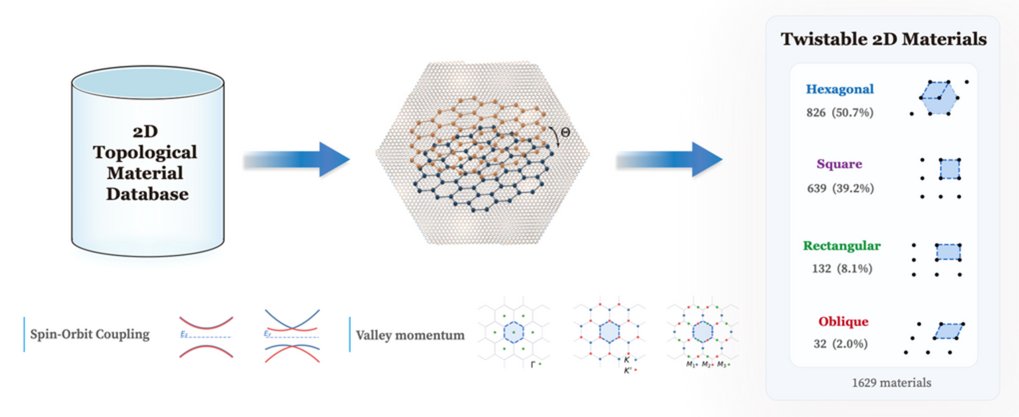
Two new studies catalog nearly 9,000 two-dimensional materials and identify 61 semimetals and 1,568 insulators suited to twistronics, the stacking and rotating of atomically thin layers to engineer narrow electronic bands. The work maps topological electronic structures, predicts promising twisted bilayers such as tin diselenide and hafnium disulfide, and confirms several candidates can be grown in bulk and exfoliated into working devices, giving researchers a systematic route to designer…
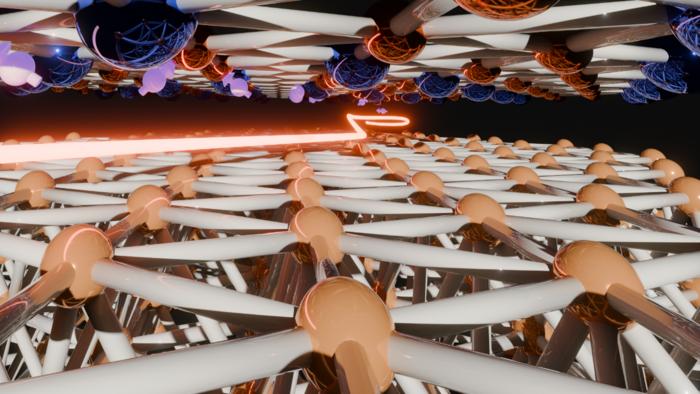
Researchers at the University of Osaka have directly observed a heavy-fermion state forming at the interface between a one-atom-thick ytterbium-copper (YbCu₂) layer and a copper crystal, using intense synchrotron light to probe electron behavior. They identified two distinct states, one confined to the two-dimensional layer and another extending into the three-dimensional substrate, arising from hybridization between localized Yb 4f and mobile conduction electrons.






