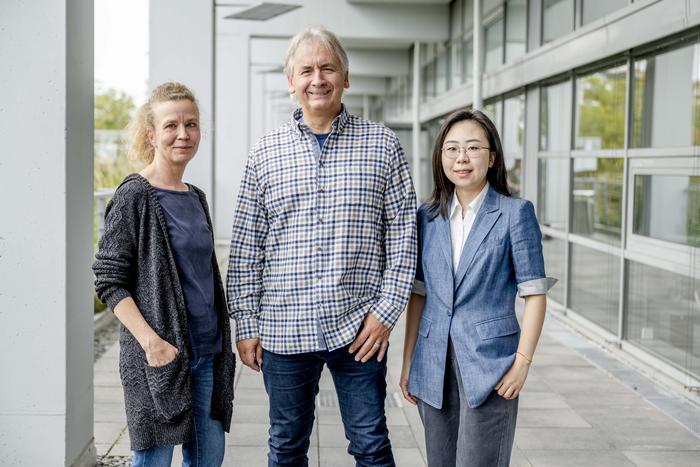
How an inhibitor can help us understand biocatalysts
Zinc occurs naturally in many biocatalysts, where it is needed for the reaction mechanism. This metal ion binds to reactive groups of certain molecular components—the amino acids— of the enzyme. “Yet through this same bond, zinc can block biocatalysts,” explains Dr. Jifu Duan, first author of the current study. “It can also bind non-specifically to sites required for proton binding.”
Researchers at Ruhr University Bochum have examined how zinc affects the production of hydrogen by [FeFe]-hydrogenases—and made an interesting discovery. “Although we were able to see in crystal structures that zinc binds to various sites of the [FeFe]-hydrogenases, the interaction at only one very specific location resulted in inhibition,” says Duan. Notably, this point is in the direct vicinity of the previously known proton transport pathway of the hydrogenases.
Zinc blocks a proton-transporting pendulum
The team around Duan and Professor Thomas Happe was able to demonstrate that the binding of zinc and other metal ions blocks very specific amino acids, namely two histidines on the surface of [FeFe]-hydrogenases. Histidines in enzymes are known for binding protons, but their role in [FeFe]-hydrogenases was previously unexplored. When the researchers replaced one of these histidines with another amino acid, the biocatalyst remained highly active but became insensitive to zinc. However, when they replaced the other histidine, the [FeFe]-hydrogenase could only very slowly produce hydrogen.
By using various methods—protein crystallography, hydrogen production tests, electrochemistry, and molecular simulations—the team could demonstrate that one of these two histidines forms a sort of pendulum. When it swings to the surface of the enzyme, it can receive a proton from the other histidine; when it swings towards the interior of the enzyme, it transfers the proton to a known proton transport pathway. This pendulum also has a fixed fulcrum, which is another amino acid that the researchers only noticed by closely analyzing the crystal structures.
Has the evolution of the protein pendulum led to particularly efficient hydrogenases?
Today, we are aware of many different groups of [FeFe]-hydrogenases—but only those in Group A appear to achieve the particularly high production rates that make these biocatalysts so exciting and also of interest for biotechnological applications. “We looked for our pendulum in other groups of [FeFe]-hydrogenases as well, but it appears to be only present in Group A,” says Happe. “We believe that the two histidines are responsible for their swift capture of protons, and thus their high level of activity.”
In the course of evolution, this could have led to the specialization of this group of hydrogenases. This insight could help us to better understand the molecular mechanisms of other hydrogenases and, perhaps, develop biocatalysts that are better suited for bio-based industrial processes. However, the results are also important for understanding the H2 metabolism in living organisms that plays an important role for many ecosystems.
Reference
A Histidine-Mediated, Pendulum-Like Proton Transport Mechanism is Required for the High Catalytic Activity of [FeFe]-Hydrogenases
Jifu Duan, Zhaoya Yang, Oliver Lampret, Federica Arrigoni, Lukas van Impel, Feng Zheng, Julian Kleinhaus, Ulf-Peter Apfel, Claudio Greco, Luca De Gioia, Eckhard Hofmann, Anja Hemschemeier, and Thomas Happe
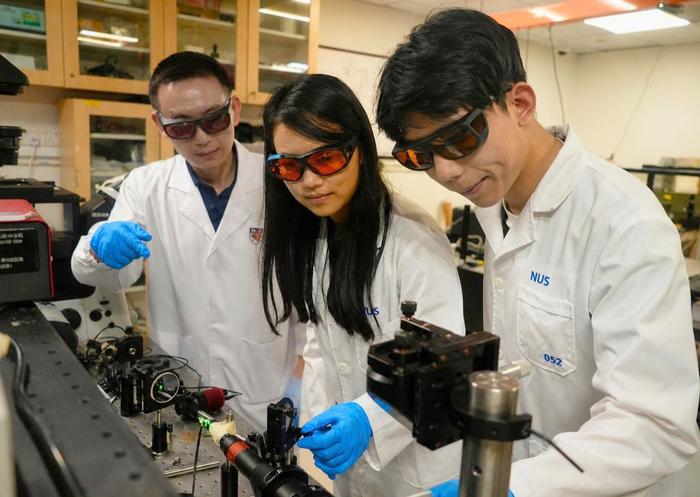
Researchers at NUS CDE have introduced DELINE, a fluorescence-based imaging method that maps individual reaction events across working electrocatalyst surfaces, revealing differences that conventional averaged measurements hide. Applied to gold and copper during water dissociation and nitrate reduction, the technique exposed a kinetic compensation trade-off: regions responding more strongly to applied voltage often have slower baseline rates.
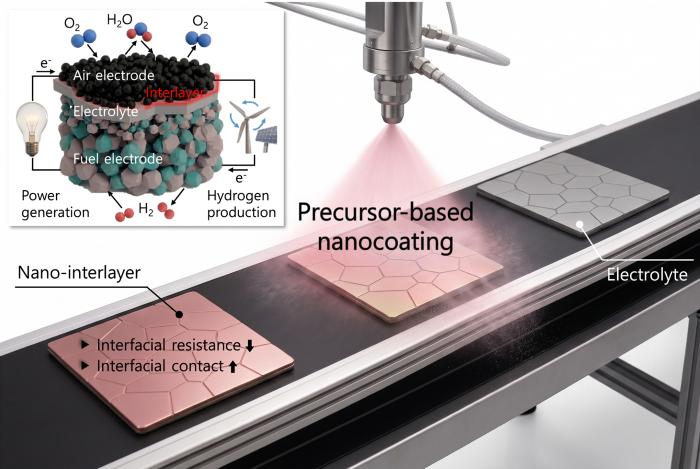
A Sungkyunkwan University team led by Professor Wonyoung Lee has tackled interfacial contact resistance in protonic ceramic electrochemical cells by quantifying how contact coverage between electrolyte and electrode governs performance. Using electrostatic spray deposition to add a dense nanometer-scale interlayer, the cells achieved higher efficiency and durability in both power generation and hydrogen production, remained stable under rapid temperature changes, and operated directly on…
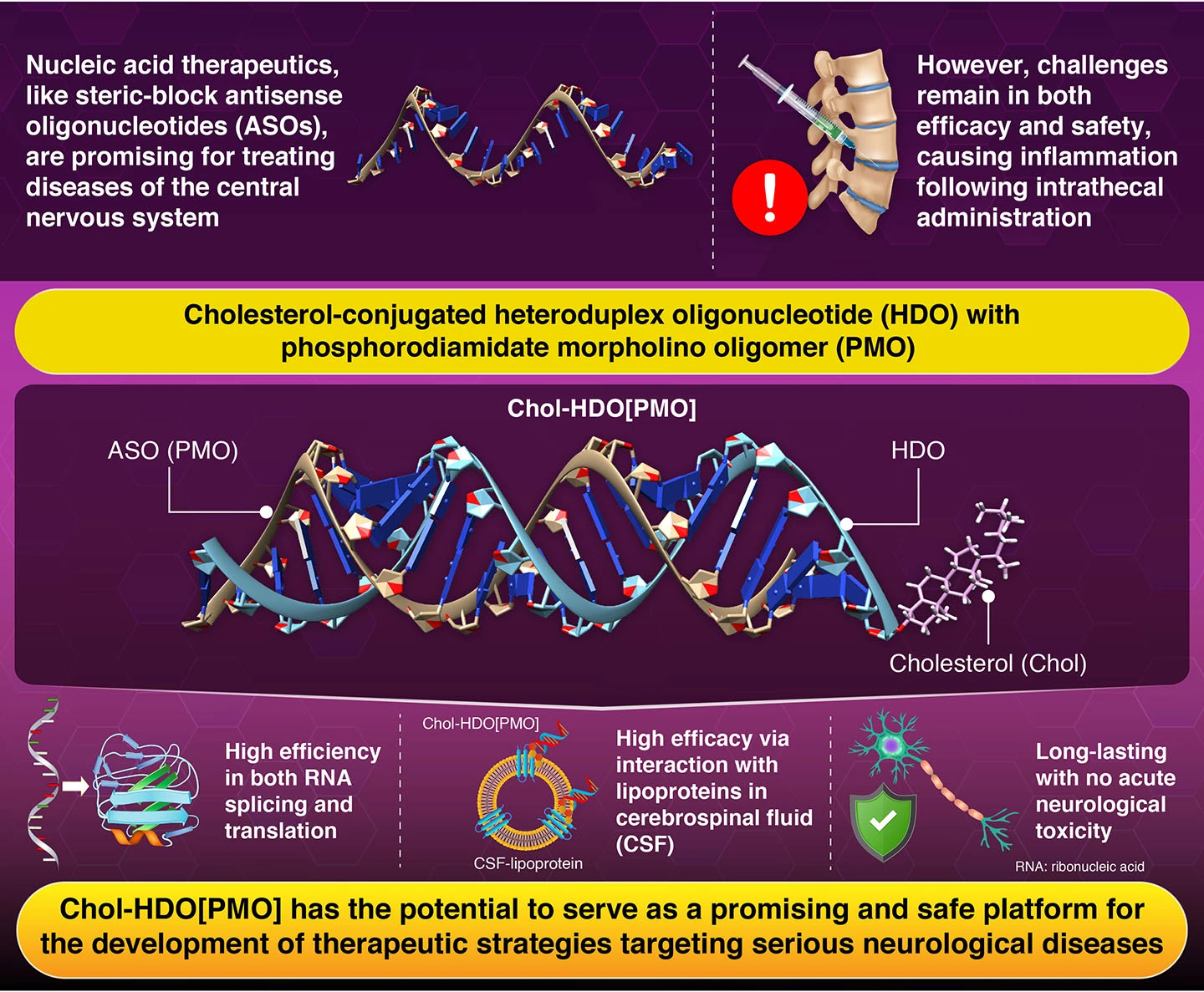
Researchers at the Institute of Science Tokyo have developed Chol-HDO[PMO], a cholesterol-conjugated heteroduplex oligonucleotide pairing a phosphorodiamidate morpholino oligomer with complementary RNA. Delivered into cerebrospinal fluid, it silenced or modulated target genes in mice with up to 16-fold greater potency than conventional antisense designs, and the effect was long lasting. It avoided acute neurotoxicity, weight loss and immune reactions.
This week in nanotech
$110M raised
9 funding rounds · 58 deals tracked
New products
 Orion Sputtering Deposition SystemsAJA International Featured
 Ti-WCMBN Nanomaterialia Featured
 GiiiGii
Market insights
Last 30 days: Quantum Technologies drew the most money: $3.17B.
Money raised per month