Advanced Institute for Materials Research (AIMR), Tohoku University
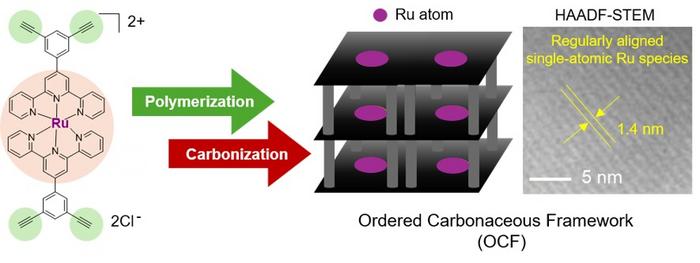
Ruthenium (Ru) is a valuable metal used in catalysts to speed up chemical reactions in many industrial processes. It can help improve efficiency and reduce the energy needed for chemical production. However, because it is rare and expensive, scientists are looking for ways to make better use of it.
One promising approach is to use individual ruthenium atoms instead of larger metal particles, allowing more of the metal to take part in chemical reactions. The challenge, however, is finding a way to include large numbers of these atoms in a single catalyst.
To address this challenge, researchers at Tohoku University, working with the University of Tsukuba, Kyoto University, and The University of Osaka, have developed a new method for producing ruthenium single-atom catalysts. The durable, highly selective catalyst can convert harmful carbon dioxide (CO₂) into formic acid, which is a valuable raw material for many industries.
The findings were published in Angewandte Chemie International Edition on September 3, 2026.
"Single-atom catalysts can make better use of valuable metals by allowing more atoms to take part in chemical reactions," explains Associate Professor Takeharu Yoshii from the Advanced Institute for Materials Science (WPI-AIMR), Tohoku University. "However, when large amounts of ruthenium are used, the atoms tend to stick together, making it difficult to keep them separated. We developed a new way to hold individual ruthenium atoms in place within a carbon material, even at high concentrations."
To create the catalyst, the researchers designed molecules with a more flexible structure than those used in earlier methods, allowing them to better accommodate ruthenium atoms. The team then heated them to form an organized, porous carbon material. Using this method, they achieved a ruthenium content of up to 11% by weight, compared with typically less than 2% in conventional ruthenium single-atom catalysts.
The researchers also tested how well the new catalyst could convert CO₂ into formic acid. It achieved over 99% selectivity, meaning that very few unwanted byproducts were formed. Even after repeated use, the catalyst maintained its high performance, with no signs of the metal atoms clumping together or damage to the carbon structure.
This method could help researchers develop more efficient catalysts while making better use of limited metal resources. Building on these findings, the team plans to explore whether the same approach could be used with other precious metals, such as platinum, palladium, and iridium.
Reference
Polypyridyl Coordination Motifs as Precursors for Ordered Carbonaceous Frameworks Toward High-Density Ru Single-Atom Catalysts
Koki Chida, Tan‐Hao Shi, Takeharu Yoshii, Yuichiro Hayasaka, Yu Gao, Hao Zhang, Nikolay Kosinov, Shigehisa Akine, Kazuhide Kamiya, Kaining Li, Yoshifumi Kondo, Yasutaka Kuwahara, Tomoki Ogoshi, and Hirotomo Nishihara
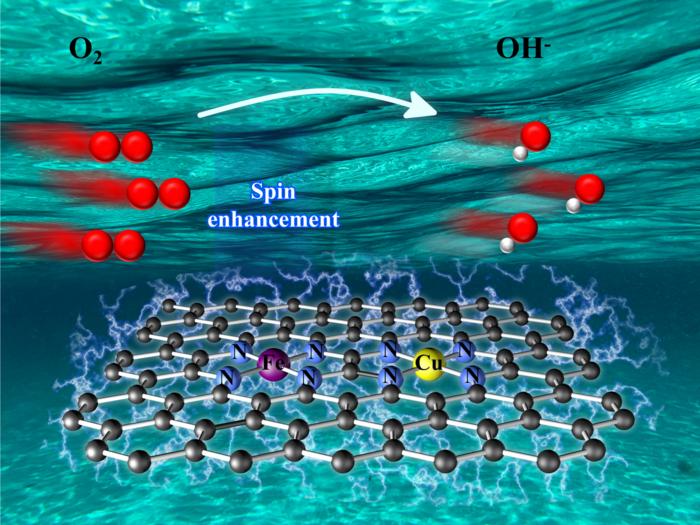
Researchers have developed an FeCu dual-single-atom catalyst in which spatially adjacent CuN4 sites tune the spin state of neighboring FeN4 centers, boosting oxygen adsorption and activation for the oxygen reduction reaction. The catalyst achieved a half-wave potential of 0.88 V versus RHE and outperformed commercial Pt/C in zinc-air battery tests.
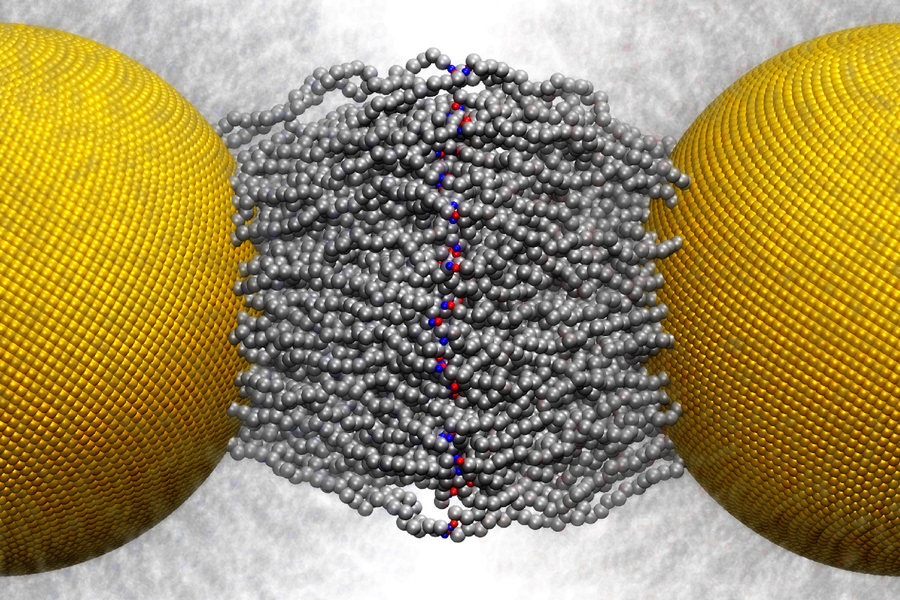
Researchers have shown that super-flexible connector molecules, rather than rigid ones, can tune how nanoparticles pack into larger structures. By varying ligand chain length, particle size and electric charge, the team assembled nanoparticles into crystal lattices never seen before and controlled the number of bonds each particle forms.
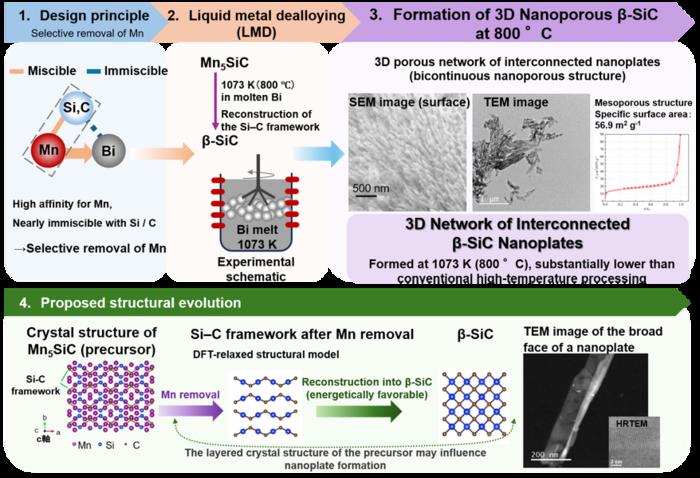
Researchers at Tohoku University have formed crystalline β-SiC at just 800°C using liquid metal dealloying, a technique previously limited to metals and intermetallics. Immersing a layered Mn5SiC precursor in molten bismuth selectively dissolves manganese, leaving a silicon-carbon framework that reorganizes into nanoporous β-SiC with interconnected nanoscale plates. First-principles calculations confirm the rearrangement is energetically favorable.
This week in nanotech
$9M raised
1 funding round · 22 deals tracked
New products
 Nion-compatible In Situ STEM Holders for Electrical BiasingHummingbird Scientific Featured
 Ti-WCMBN Nanomaterialia Featured
 Hold Down & Release Mechanisms (HDRM) REACT – 5KN, 15KN and 35KN space qualified resettable mechanismsARQUIMEA
Market insights
Last 30 days: Quantum Technologies was the busiest vertical: 59 of 192 events (31%).
Money raised per month
Behind the deal
Who led Sandia National Laboratories’s $3.4M Grant?
See the investors with Insights Pro →