
Focusing a tailored laser beam through transparent glass can create a tiny spot inside the material. Researchers at Tohoku University have reported on a way to use this small spot to improve laser material processing, boosting processing resolution.
Their findings were published in the journal Optics Letters on March 1,2024.
Laser machining, like drilling and cutting, is vital in industries such as automotive, semiconductors, and medicine. Ultra-short pulse laser sources, with pulse widths from picoseconds to femtoseconds, enable precise processing at scales ranging from microns to tens of microns. But recent advancements demand even smaller scales, below 100 nanometers, which existing methods struggle to achieve.
The researchers focused on a laser beam with radial polarization, known as a vector beam. This beam generates a longitudinal electric field at the focus, producing a smaller spot than conventional beams.
Scientists have identified this process as promising for laser processing. However, one drawback is that this field weakens inside the material due to light refraction at the air-material interface, limiting its use.
"We overcame this employing an oil immersion objective lens - something commonly found in biological microscopes - for laser processing glass substrates," exclaims Yuichi Kozawa, an associate professor at Tohoku University's Institute for Multidisciplinary Research for Advanced Materials (IMRAM) and co-author of the paper. "Because the immersion oil and glass have nearly identical refractive indices, the light that passes through them does not bend."
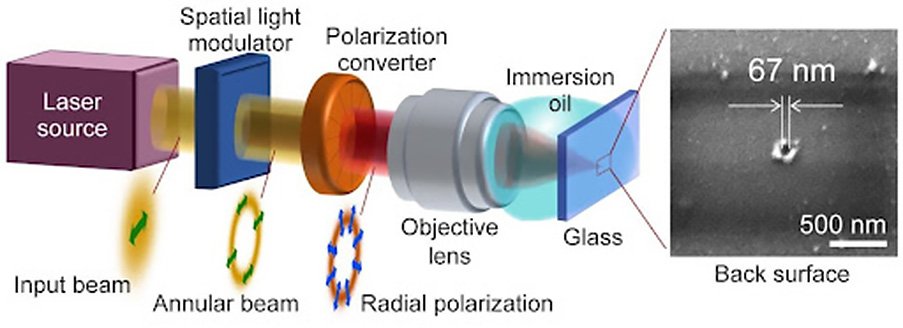
Further examination of the radially polarized beam behavior when focused with an annular shape revealed that the longitudinal field is greatly enhanced. This enhancement occurs because of total reflection at high converging angles on the back surface between the glass and air. By using an annular-shaped radially polarized beam, Kozawa and his colleagues created a small focal spot.
From there, they applied this method to laser process a glass surface with an ultra-short pulse laser beam. A single shot of the converted pulse on the back surface of a glass substrate created a hole with a diameter of 67 nanometers, about 1/16 of the laser beam's wavelength.
"This breakthrough enables direct material processing with enhanced precision using the enhanced longitudinal electric field," adds Kozawa. "It offers a simple approach to realize processing scales below 100 nm and opens new possibilities for laser nano-processing in various industries and scientific fields."
Reference
Laser nanoprocessing via an enhanced longitudinal electric field of a radially polarized beam
Yukine Tsuru, Yuichi Kozawa, Yuuki Uesugi, and Shunichi Sato
https://opg.optica.org/ol/fulltext.cfm?uri=ol-49-6-1405&id=547563
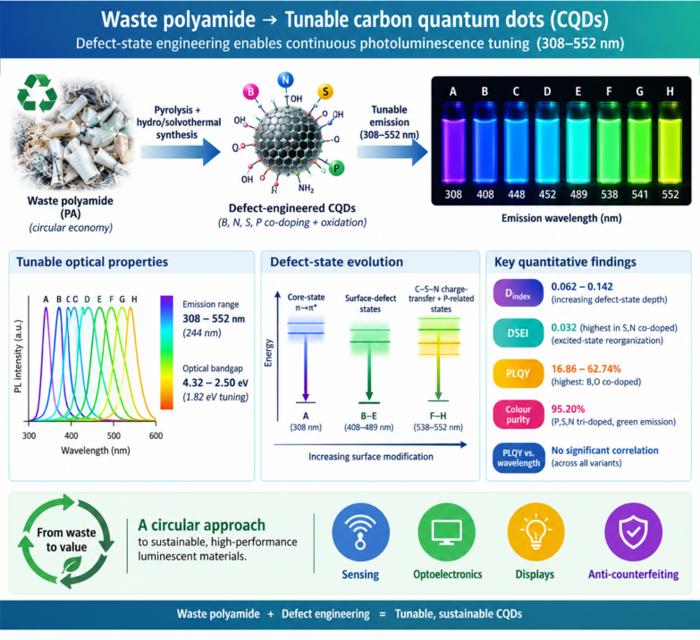
Waste polyamide-derived CQDs show continuous photoluminescence tuning from 308 to 552 nm through sequential defect-state engineering, with optical transition energies decreasing from 4.32 to 2.50 eV. @Christian Ebere Enyoh from Saitama University Carbon quantum dots (CQDs) are fluorescent carbon nanomaterials with potential applications in sensing, optoelectronics, displays, anti-counterfeiting, and environmental technologies. Their optical properties can be adjusted by modifying the carbon...
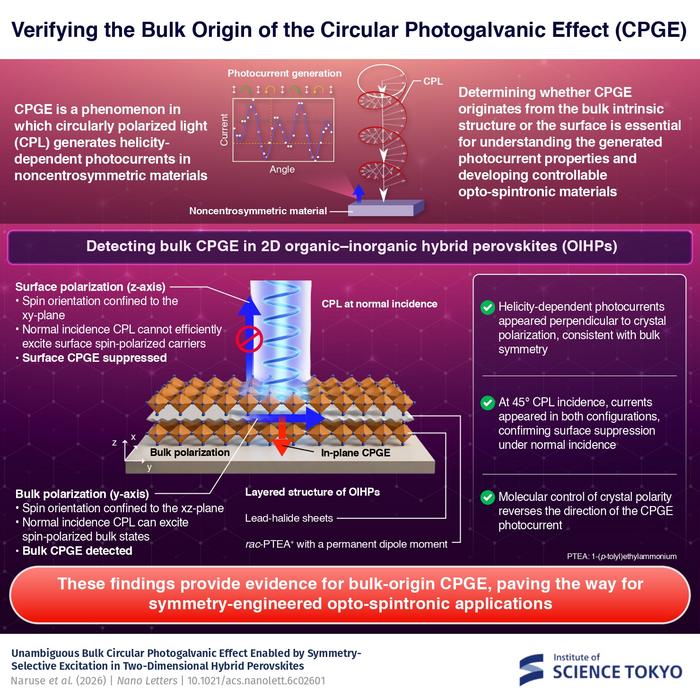
The researchers used circularly polarized light at normal incidence and found that helicity-dependent photocurrents appeared perpendicular to the crystal’s polarization but vanished when measured parallel to it, supporting a bulk origin of CPGE. @Institute of Science Tokyo The circular photogalvanic effect (CPGE), a phenomenon that generates helicity-dependent photocurrents in noncentrosymmetric materials, can originate purely from a crystal's internal structure without contribution from the...
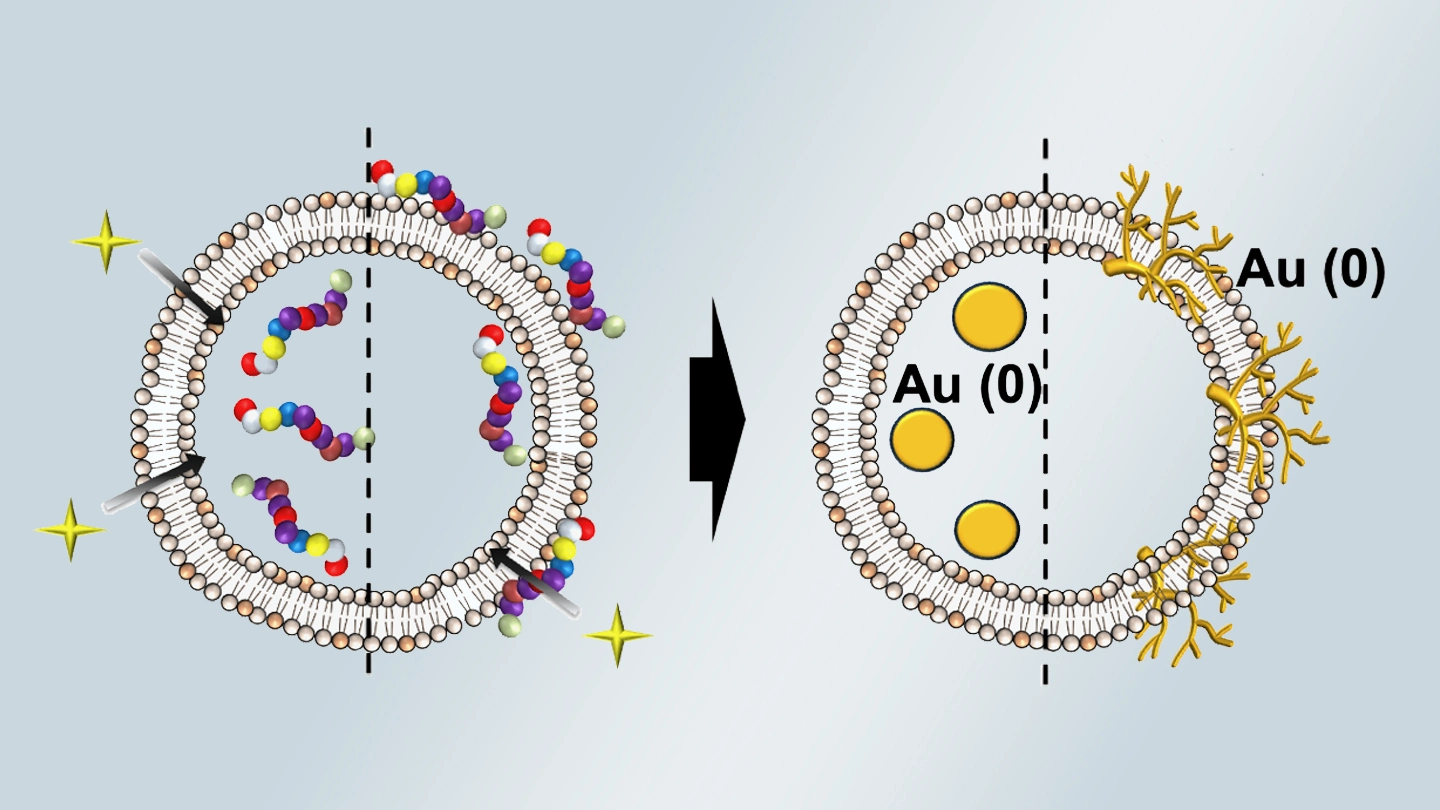
Summary of gold nanoparticle growth programming in liposome based on localization of biomineralization peptide The position of biomineralization peptides within liposomes can influence how gold nanoparticles grow, reports a research team from Institute of Science Tokyo. Peptides localized at the membrane interface promote branched structures, while those confined to the liposome interior favor spherical nanoparticles. The findings offer a new strategy for controlling nanoscale reaction...
