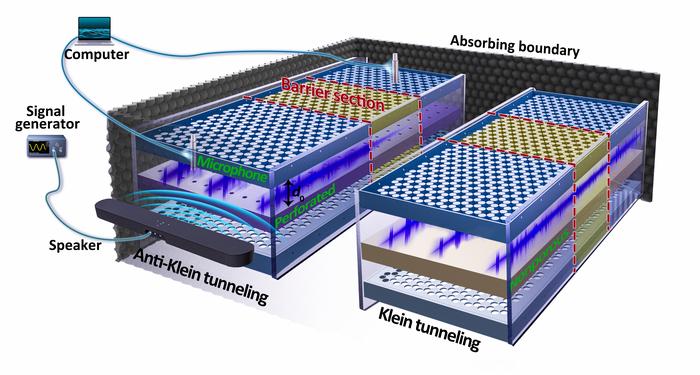
In a groundbreaking experiment, researchers from Tianjin University, Zhejiang University, Northeastern University and University of Science and Technology of China have directly observed anti-Klein tunneling (AKT)—a quantum paradox where chiral particles are entirely reflected instead of passing through an energy barrier. This long-sought quantum-like behavior is realized not with electrons, but with engineered sound waves in a custom-designed bilayer phononic crystal.
Klein tunneling (KT), first proposed in 1929, refers to the paradoxical ability of massless relativistic particles to pass through energy barriers with no reflection, defying classical expectations. Its theoretical counterpart, anti-Klein tunneling, suggests that massive chiral particles—particles whose wave functions carry handedness—can be completely reflected by such barriers due to destructive interference. While KT has been demonstrated in systems such as graphene and photonic crystals, AKT had remained elusive in experimental settings.
To realize AKT, the research team designs a bilayer phononic crystal system that mimics the quantum band structure of bilayer graphene. This system supports the emergence of massive chiral phonons, which act as acoustic analogs of massive Dirac fermions. By carefully tuning the intralayer and interlayer coupling strengths—controlled mechanically through structural parameters—the researchers construct an acoustic potential barrier that allows or blocks phonon transmission.
The experiment uses a pump-probe acoustic setup to measure wave propagation across the barrier. In the bilayer configuration, the sound wave decays exponentially within the barrier region, resulting in vanishing transmission—a clear signature of AKT. When the same structure is adjusted to form a monolayer configuration, the phonons pass through the barrier without reflection, confirming the presence of KT. The team also demonstrates that by varying the layer thickness, they can continuously tune the phonon transport from total reflection (AKT) to perfect transmission (KT), revealing a controllable transition path between these regimes.
“This system mirrors deep quantum phenomena using sound,” says Professor Ying Li of Zhejiang University, co-corresponding author of the study. “It’s an elegant and accessible way to study fundamental physics.”
Phononic crystals offer unique advantages over traditional electronic systems: they operate at macroscopic scales, have low energy loss, and allow real-time structural tuning. These features make them ideal platforms for topological wave manipulation, reconfigurable acoustic devices, and quantum-inspired simulations without relying on electrons or extreme conditions.
The discovery of anti-Klein tunneling in a classical system also opens up new possibilities in wave-based computation, acoustic signal routing, and the design of functional metamaterials that harness quantum analogs for practical applications.
“This research not only confirms a fundamental theoretical prediction, but also provides a versatile experimental platform for future exploration,” adds Professor Qian Ding from Tianjin University, another co-corresponding author of the study.
As advances in microstructure fabrication and high-resolution acoustic detection continue, phononic systems like this one are poised to become powerful tools for probing the quantum–classical boundary and engineering next-generation wave-based technologies.
Reference
Observation of anti-Klein tunneling of chiral phonons
Hongzhu Li, Yang Liu, Qian Ding, Tianzhi Yang, Chenglin Han, Mengxin He, Jian-Hua Jiang , Ying Li
https://www.sciencedirect.com/science/article/abs/pii/S2095927325005390
Science China Press
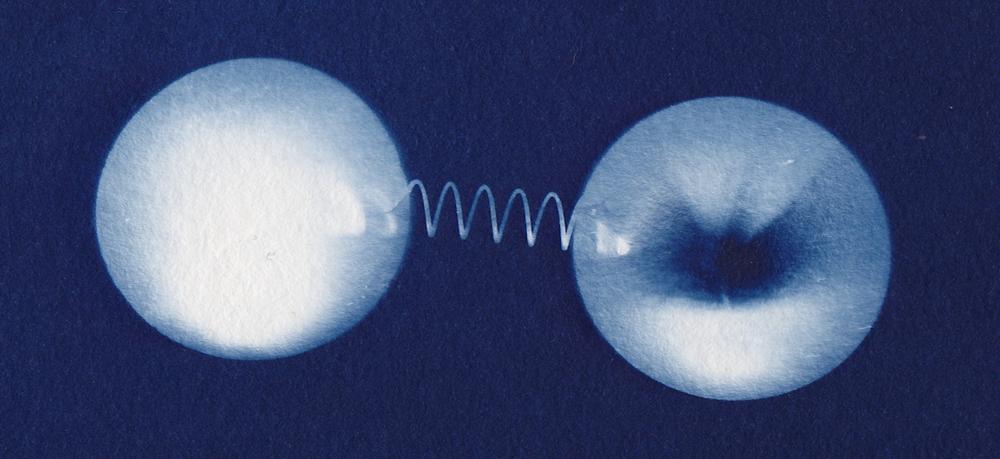
Researchers from the CMS collaboration at DESY and the University of Hamburg have detected an unexpected excess of top quark-antiquark pairs at very low energies. This effect was first observed in the 2016 data and has been further reinforced by the analyses of 2017 and 2018 data. The results suggest that top quarks and their antiparticles may be able to combine into a short-lived bound state known as ‘toponium’. Until now, it was considered virtually impossible that such bonds could be obser...
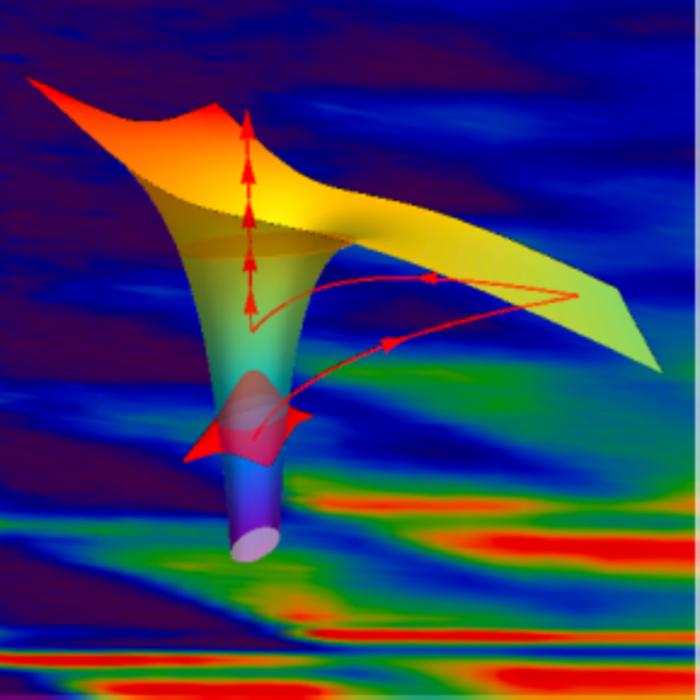
Researchers have succeeded in unraveling for the first time the mystery of the 'electron tunneling' process, a core concept in quantum mechanics, and confirmed it through experiments. This study was published in the international journal Physical Review Letters and is attracting attention as a key to unlocking the long-standing mystery of 'electron tunneling,' which has remained unsolved for over 100 years.
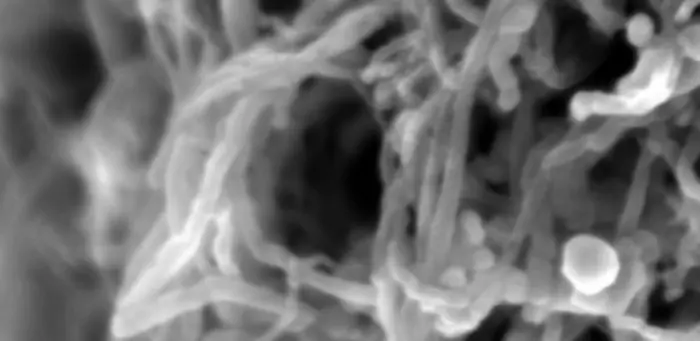
In the new study, the researchers demonstrated that anodic polarization of graphite in an electrochemical cell induces the formation of likely oxidized graphene sheets that spontaneously self-assemble into fullerenes and hollow spheres. The final product was characterized using scanning electron microscopy (SEM), atomic force microscopy (AFM), high-resolution transmission electron microscopy (HRTEM), mass spectrometry (MALDI-TOF), and visible ultraviolet spectroscopy (UV-Vis).
This week in nanotech
$558.4M raised
5 funding rounds · 34 deals tracked
New products
 Ti-WCMBN Nanomaterialia Featured
 DLS-1 Mass Spectrometer for Fusion Gas AnalysisHiden Analytical Featured
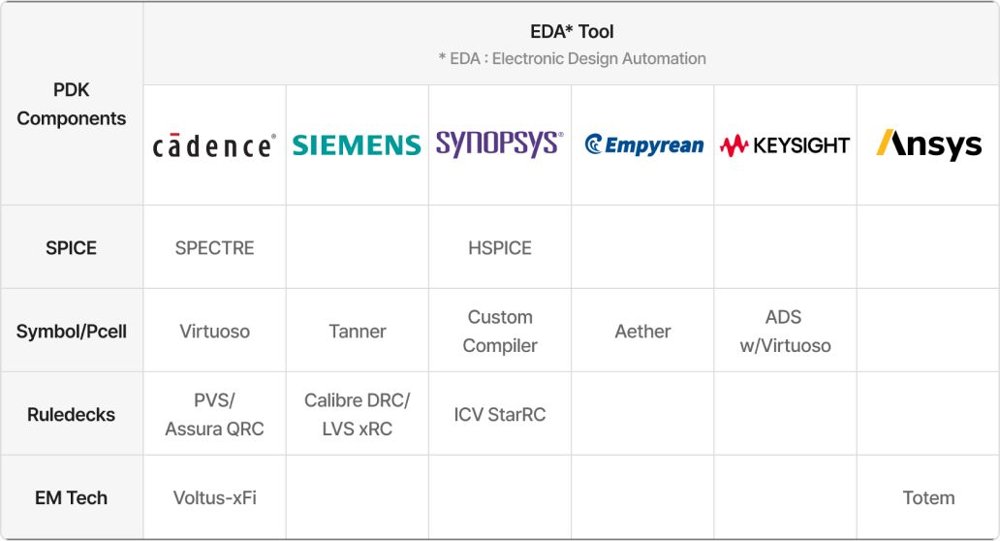 PDK (Process Design Kit)DB HiTek
Market insights
Last 30 days: Quantum Technologies drew the most money: $2.15B.
Money raised per month