National Institute for Materials Science
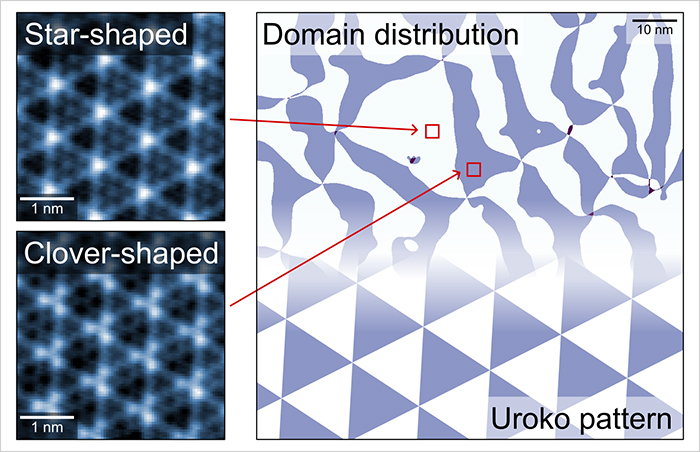
A research team consisting of NIMS and the Tokyo University of Science observed charge density waves (CDWs) within Niobium diselenide (NbSe2)—a layered compound—at cryogenic temperatures and discovered that they form alternating triangular domains characterized by two distinctive star-shaped and clover-shaped CDW structures. This domain structure was found to be consistent with a theoretical prediction made about four decades ago.
NbSe2—a layered superconducting compound—is often used in basic research on quantum phenomena. It is therefore important to understand the physical properties of NbSe2 in detail at cryogenic temperatures. These include the unique property it possesses to exhibit both superconductivity and CDWs (i.e., periodic modulations in electron density within the compound) and the interplay between them. Ascertaining these interactions will require the identification of a precise CDW domain structure within NbSe2. Previous research had found that CDWs within NbSe2 appeared to have two types of domains characterized by star-shaped and clover-shaped CDW structures. However, the distribution of these two domains remained undetermined due to a lack of quantitative techniques capable of accurately elucidating them.
This research team captured high-resolution images of CDWs within NbSe2 using a scanning tunneling microscope (STM) capable of imaging crystalline surfaces with atomic-level resolution. The team then succeeded in clearly imaging the distribution patterns of the domains characterized by star-shaped and clover-shaped CDW structures by numerically determining the displacement of CDW modulations relative to the atomic lattice observed. The resulting image revealed that both domains had triangular shapes and were arranged in an alternating pattern similar to urokomon, a decorative motif resembling the scales of a fish or reptile often found in traditional Japanese art and crafts. This was the first-ever observation of the CDW domain structure since its existence was theoretically predicted in the 1980s.
These results are expected to advance the understanding of CDWs within NbSe2 and other related compounds and facilitate high-temperature superconductor research by providing new insights into the relationship between CDWs and superconductivity. In addition, they may promote basic research on quantum phenomena in systems in which these compounds can be used as building blocks.
Reference
Visualization of Alternating Triangular Domains of Charge Density Waves in 2H−NbSe2 by Scanning Tunneling Microscopy
Shunsuke Yoshizawa, Keisuke Sagisaka, and Hideaki Sakata
https://journals.aps.org/prl/abstract/10.1103/PhysRevLett.132.056401
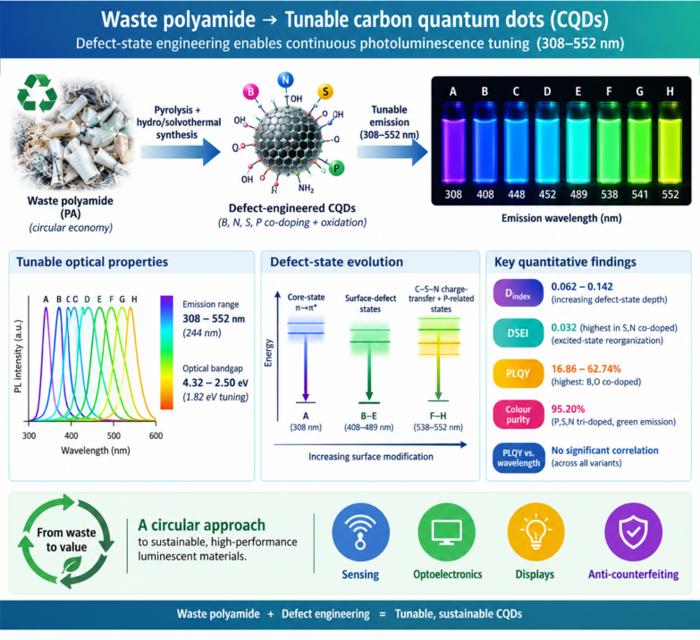
Waste polyamide-derived CQDs show continuous photoluminescence tuning from 308 to 552 nm through sequential defect-state engineering, with optical transition energies decreasing from 4.32 to 2.50 eV. @Christian Ebere Enyoh from Saitama University Carbon quantum dots (CQDs) are fluorescent carbon nanomaterials with potential applications in sensing, optoelectronics, displays, anti-counterfeiting, and environmental technologies. Their optical properties can be adjusted by modifying the carbon...
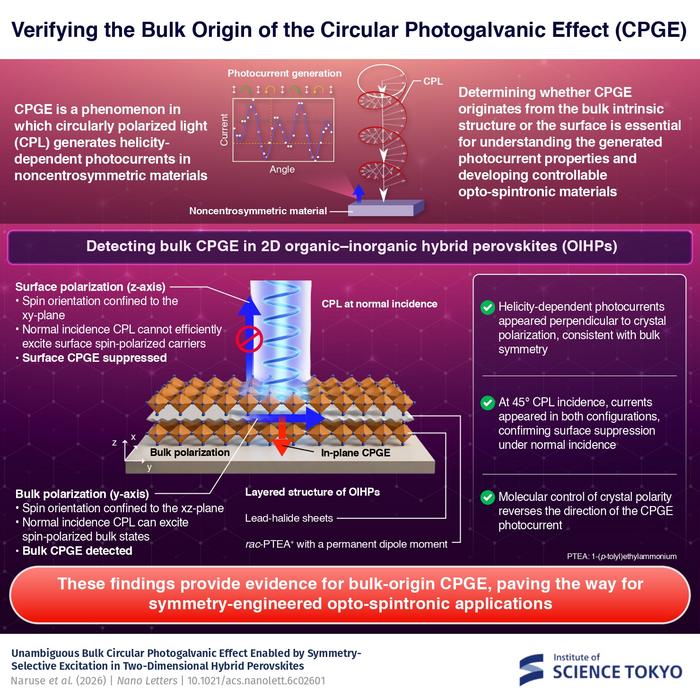
The researchers used circularly polarized light at normal incidence and found that helicity-dependent photocurrents appeared perpendicular to the crystal’s polarization but vanished when measured parallel to it, supporting a bulk origin of CPGE. @Institute of Science Tokyo The circular photogalvanic effect (CPGE), a phenomenon that generates helicity-dependent photocurrents in noncentrosymmetric materials, can originate purely from a crystal's internal structure without contribution from the...
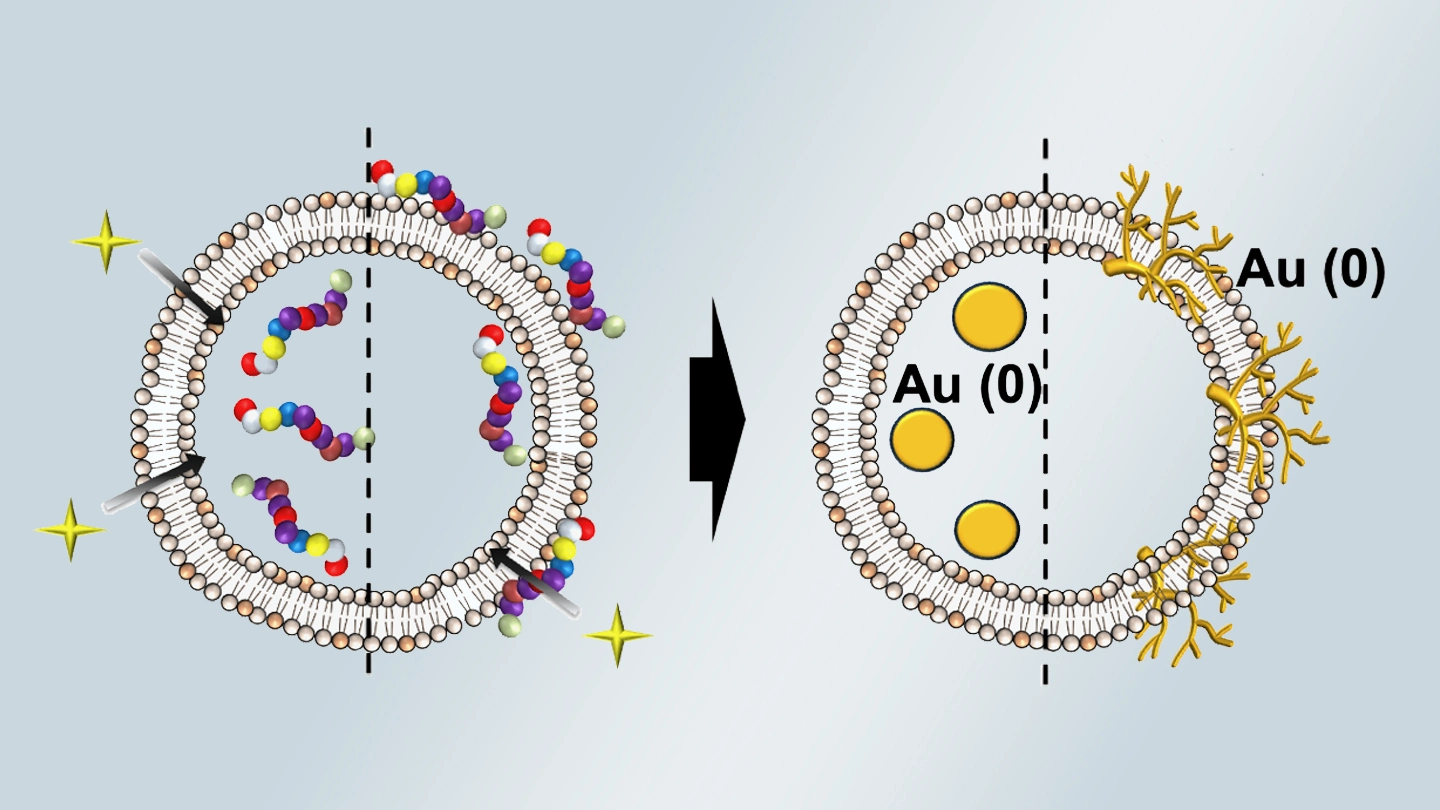
Summary of gold nanoparticle growth programming in liposome based on localization of biomineralization peptide The position of biomineralization peptides within liposomes can influence how gold nanoparticles grow, reports a research team from Institute of Science Tokyo. Peptides localized at the membrane interface promote branched structures, while those confined to the liposome interior favor spherical nanoparticles. The findings offer a new strategy for controlling nanoscale reaction...
