University of Basel
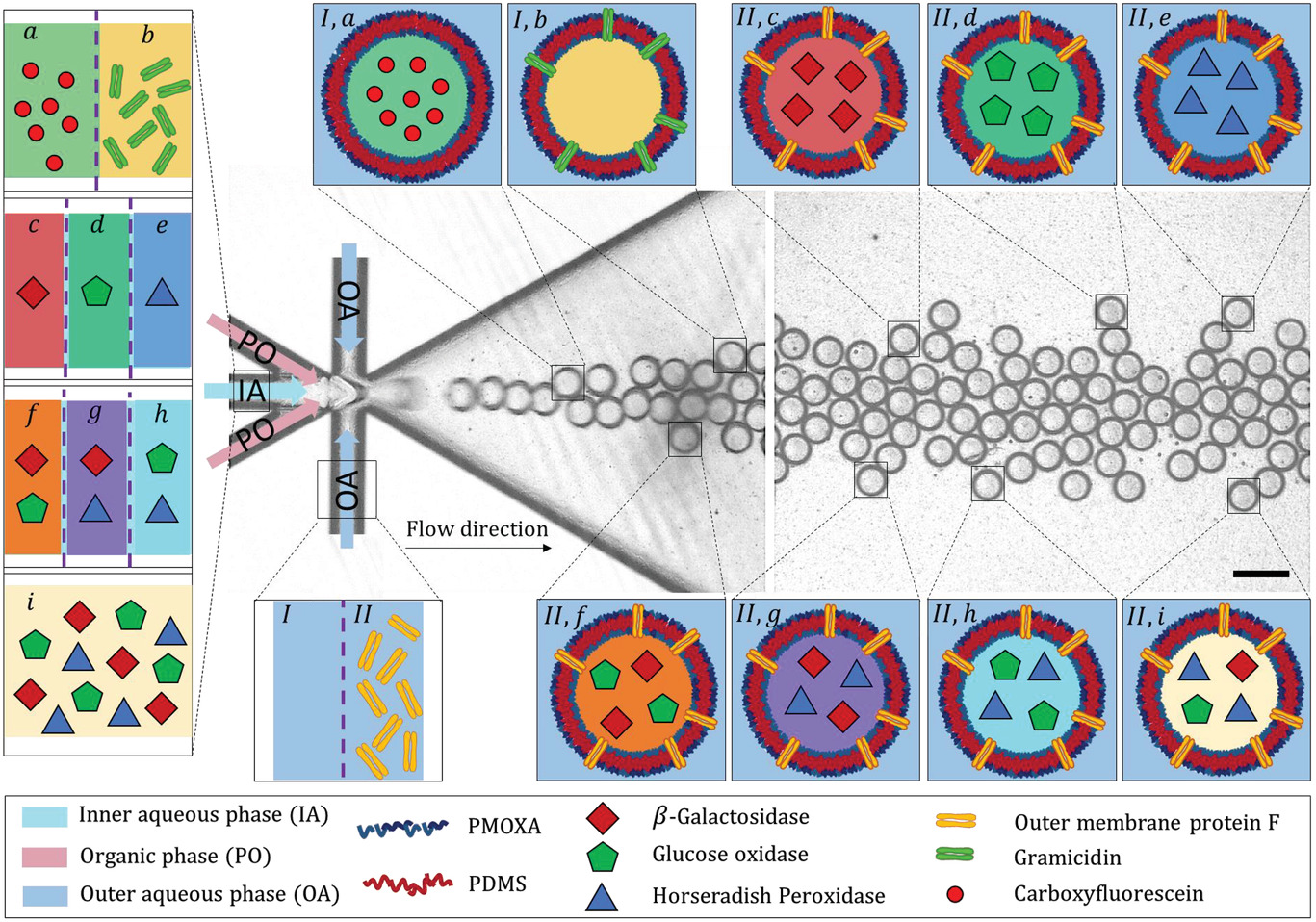
Researchers at the University of Basel have developed a precisely controllable system for mimicking biochemical reaction cascades in cells. Using microfluidic technology, they produce miniature polymeric reaction containers equipped with the desired properties. This "cell on a chip" is useful not only for studying processes in cells, but also for the development of new synthetic pathways for chemical applications or for biological active substances in medicine.
In order to survive, grow and divide, cells rely on a multitude of different enzymes that catalyze many successive reactions. Given the complexity of processes in living cells, it is impossible to determine when specific enzymes are present at what concentrations and what their optimum proportions are relative to one another. Instead, researchers use smaller, synthetic systems as models in order to study these processes. These synthetic systems simulate the subdivision of living cells into separate compartments.
Close similarity to natural cells
Now, the team led by Professors Cornelia Palivan and Wolfgang Meier from the Department of Chemistry at the University of Basel has developed a new strategy for producing these synthetic systems. Writing in the journal Advanced Materials, the researchers describe how they create various synthetic miniature reaction containers, known as vesicles, which -- taken as a whole -- serve as models of a cell.
"Unlike in the past, this is not based on the self-assembly of vesicles," explains Wolfgang Meier. "Rather, we've developed efficient microfluidic technology in order to produce enzyme-loaded vesicles in a controlled manner." The new method allows the researchers to tweak the size and composition of the different vesicles so that various biochemical reactions can take place inside them without influencing one another -- like in the different compartments of a cell.
In order to manufacture the desired vesicles, the scientist feed the various components into tiny channels on a silicon-glass chip. On this chip, all of the microchannels come together at a junction. If the conditions are configured correctly, this arrangement produces an aqueous emulsion of uniformly sized polymer droplets that are formed at the point of intersection.
The researchers used the newly developed microfluidic platform to produce three different types of vesicles with a uniform size but different cargoes: β-galactosidase (red vesicle), glucose oxidase (green vesicle) or horseradish peroxidase (blue). The water-soluble enzymes gradually convert the starting product into the final colored product Resorufin, which -- like all of the intermediates -- enters the surrounding solution via selective channels in the vesicle membranes.
Precise control
The polymer membrane of the vesicles acts as an outer shell and encloses an aqueous solution. During production, the vesicles are filled with different combinations of enzymes. As first author Dr. Elena C. dos Santos explains, this technique provides some key advantages: "The newly developed method allows us to produce tailor-made vesicles and to precisely adjust the desired combination of enzymes inside."
Proteins incorporated into the membrane act as pores and allow the selective transport of compounds into and out of the polymer vesicles. The pore sizes are designed to allow the passage of only specific molecules or ions, thereby enabling the separate study of cellular processes that take place closely alongside one another in nature.
"We were able to show that the new system offers an excellent foundation for studying enzymatic reaction processes," explains Cornelia Palivan. "These processes can be optimized to boost the production of a desired final product. What's more, the technology allows us to examine specific mechanisms that play a role in metabolic diseases or that affect the reaction of certain drugs in the body."
Contact
Wolfgang Meier
Department of Chemistry
University of Basel
wolfgang.meier@unibas.ch
Reference
Combinatorial Strategy for Studying Biochemical Pathways in Double Emulsion Templated Cell‐Sized Compartments
Elena C. dos Santos, Andrea Belluati, Danut Necula, Dominik Scherrer, Claire E. Meyer, Riccardo P. Wehr, Emanuel Lörtscher, Cornelia G. Palivan, Wolfgang Meier
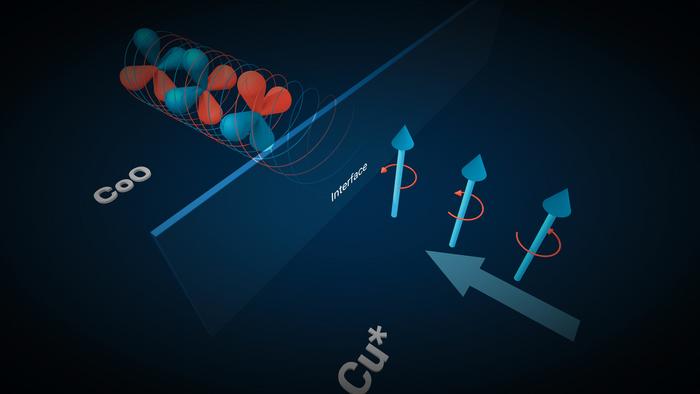
Researchers at Johannes Gutenberg University Mainz (JGU) are the first to directly utilize orbital currents without the need for conversion of the orbital current into a spin current. “We have thus realized the first purely orbitronic device approach,” said Dr. Christin Schmitt, a scientist in the research group of Professor Mathias Kläui at the JGU Institute of Physics. Orbitronics is a promising technology for future memory devices, as it could enable the realization of large-scale storage...
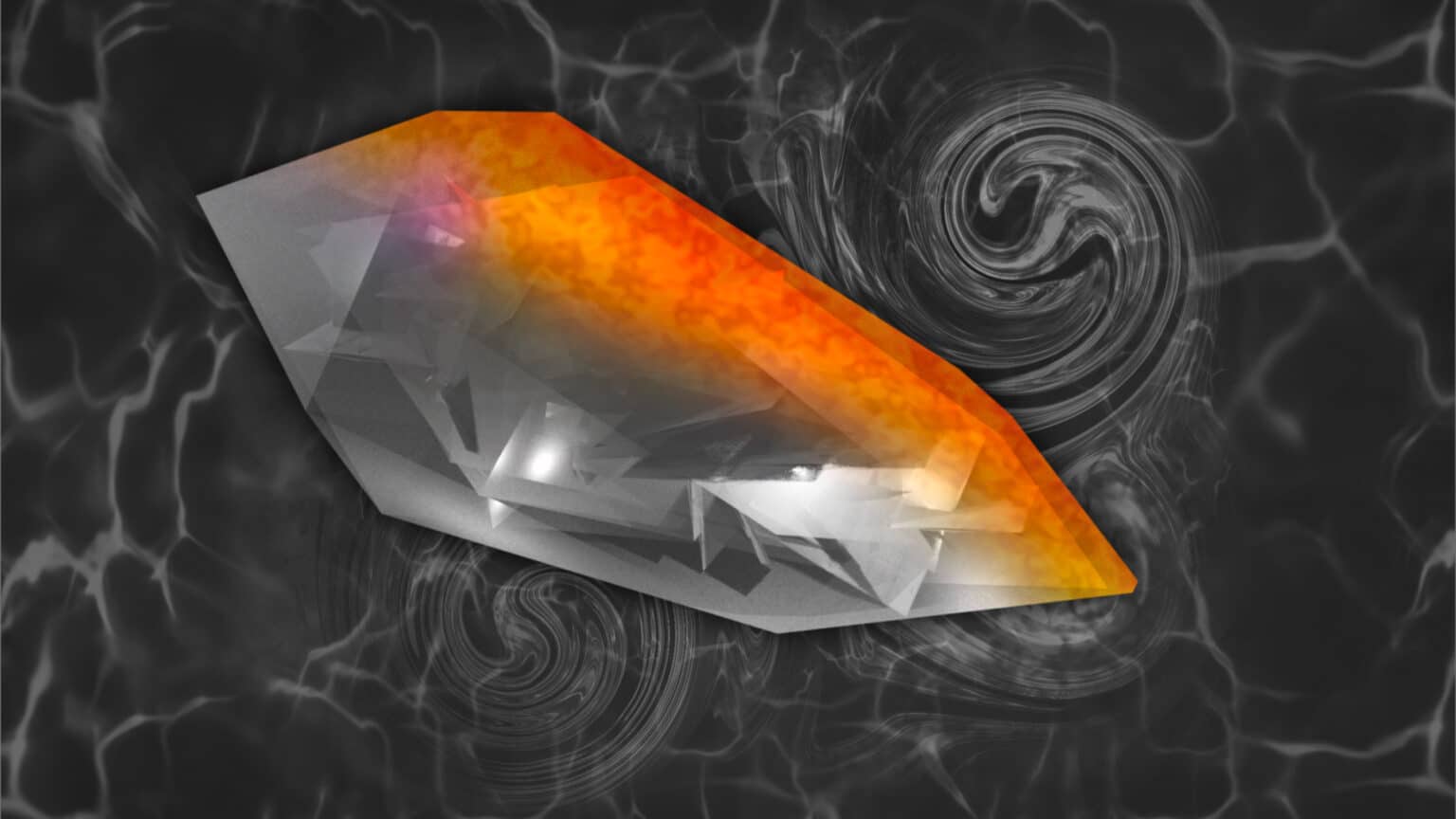
In a new study, an international group of researchers has found that chiral phonons can create orbital current without needing magnetic elements – in part because chiral phonons have their own magnetic moments. Additionally, this effect can be achieved in common crystal materials. The work has potential for the development of less expensive, energy-efficient orbitronic devices for use in a wide array of electronics. All electronic devices are based upon the charge of an electron, and electron...
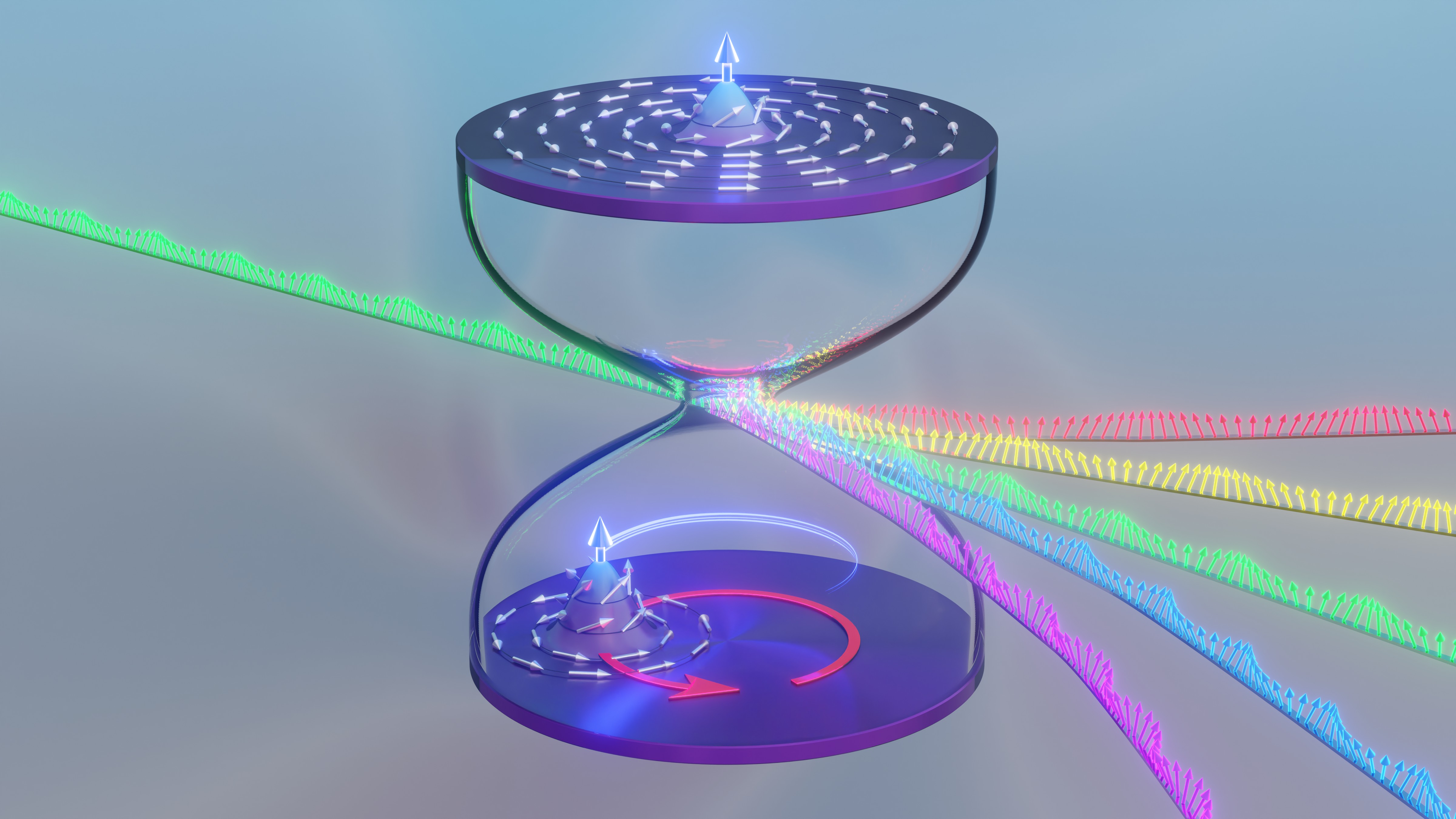
Researchers at the Helmholtz-Zentrum Dresden-Rossendorf (HZDR) have uncovered previously unobserved oscillation states – so-called Floquet states – in tiny magnetic vortices. Unlike earlier experiments, which required energy-intensive laser pulses to create such states, the team in Dresden discovered that a subtle excitation with magnetic waves is sufficient. This finding not only raises fundamental questions in basic physics but could also eventually serve as a universal adapter bridging ele...
