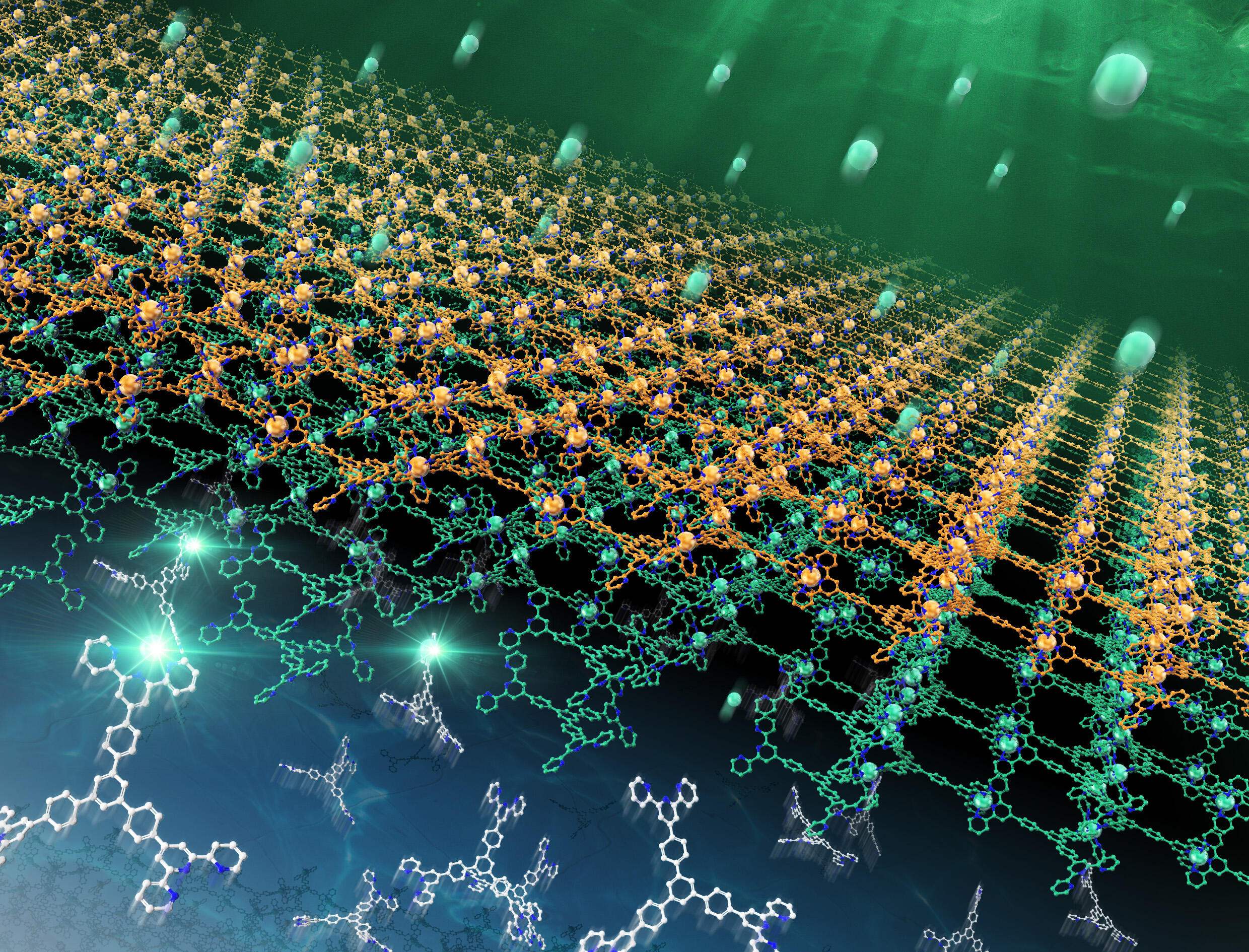
Molecular 2D materials find immense applications in materials science, owing to their wide structural variety and easy controllability. Establishing a simple and efficient method for their synthesis is, therefore, important. Now, scientists from Japan present a simple method for synthesizing heterolayer coordination nanosheets, a promising 2D material, shedding light on how certain chemical coordination reactions occur at liquid-liquid interfaces. Their method could help develop novel 2D materials with applications in optoelectronic devices.
The past few decades have witnessed a great amount of research in the field of two-dimensional (2D) materials. As the name implies, these thin film-like materials are composed of layers that are only a few atoms thick. Many of the chemical and physical properties of 2D materials can be fine-tuned, leading to promising applications in many fields, including optoelectronics, catalysis, renewable energy, and more.
Coordination nanosheets are one particularly interesting type of 2D material. The "coordination" refers to the effect of metallic ions in these molecules, which act as coordination centers. These centers can spontaneously create organized molecular dispositions that span multiple layers in 2D materials. This has attracted the attention of materials scientists due to their favorable properties. In fact, we have only begun to scratch the surface regarding what heterolayer coordination nanosheets - coordination nanosheets whose layers have different atomic composition - can offer.
In a recent study published first on June 13, 2022, and featured on the front cover of Chemistry--A European Journal, a team of scientists from Tokyo University of Science (TUS) and The University of Tokyo in Japan reported a remarkably simple way to synthesize heterolayer coordination nanosheets. Composed of the organic ligand, terpyridine, coordinating iron and cobalt, these nanosheets assemble themselves at the interface between two immiscible liquids in a peculiar way. The study, led by Prof. Hiroshi Nishihara from TUS, also included contributions from Mr. Joe Komeda, Dr. Kenji Takada, Dr. Hiroaki Maeda, and Dr. Naoya Fukui from TUS.
To synthesize the heterolayer coordination nanosheets, the team first created the liquid-liquid interface to enable their assembly. They dissolved tris(terpyridine) ligand in dichloromethane (CH2Cl2), an organic liquid that does not mix with water. They then poured a solution of water and ferrous tetrafluoroborate, an iron-containing chemical, on top of the CH2Cl2. After 24 hours, the first layer of the coordination nanosheet, bis(terpyridine)iron (or "Fe-tpy"), formed at the interface between both liquids.
Following this, they removed the iron-containing water and replaced it with cobalt-containing water. In the next few days, a bis(terpyridine)cobalt (or "Co-tpy") layer formed right below the iron-containing one at the liquid-liquid interface.
The team made detailed observations of the heterolayer using various advanced techniques, such as scanning electron microscopy, X-ray photoelectron spectroscopy, atomic force microscopy, and scanning transmission electron microscopy. They found that the Co-tpy layer formed neatly below the Fe-tpy layer at the liquid-liquid interface. Moreover, they could control the thickness of the second layer depending on how long they left the synthesis process run its course.
Interestingly, the team also found that the ordering of the layers could be swapped by simply changing the order of the synthesis steps. In other words, if they first added a cobalt-containing solution and then replaced it with an iron-containing solution, the synthesized heterolayer would have cobalt coordination centers on the top layer and iron coordination centers on the bottom layer. "Our findings indicate that metal ions can go through the first layer from the aqueous phase to the CH2Cl2 phase to react with terpyridine ligands right at the boundary between the nanosheet and the CH2Cl2 phase," explains Prof. Nishihara. "This is the first ever clarification of the growth direction of coordination nanosheets at a liquid/liquid interface."
Additionally, the team investigated the reduction-oxidation properties of their coordination nanosheets as well as their electrical rectification characteristics. They found that the heterolayers behaved much like a diode in a way that is consistent with the electronic energy levels of Co-tpy and Fe-tpy. These insights, coupled with the easy synthesis procedure developed by the team, could help in the design of heterolayer nanosheets made of other materials and tailored for specific electronics applications. "Our synthetic method could be applicable to other coordination polymers synthesized at liquid-liquid interfaces," highlights Prof. Nishihara. "Therefore, the results of this study will expand the structural and functional diversity of molecular 2D materials."
With eyes set on the future, the team will keep investigating chemical phenomena occurring at liquid-liquid interfaces, elucidating the mechanisms of mass transport and chemical reactions. Their findings can help expand the design of 2D materials and, hopefully, lead to better performance of optoelectronic devices, such as solar cells.
Reference
Chemically Laminated 2D Bis(terpyridine)metal Polymer Films: Formation Mechanism at the Liquid–Liquid Interface and Redox Rectification
Joe Komeda, Dr. Kenji Takada, Dr. Hiroaki Maeda, Dr. Naoya Fukui, Takuya Tsuji, Prof. Dr. Hiroshi Nishihara
https://chemistry-europe.onlinelibrary.wiley.com/doi/10.1002/chem.202202127
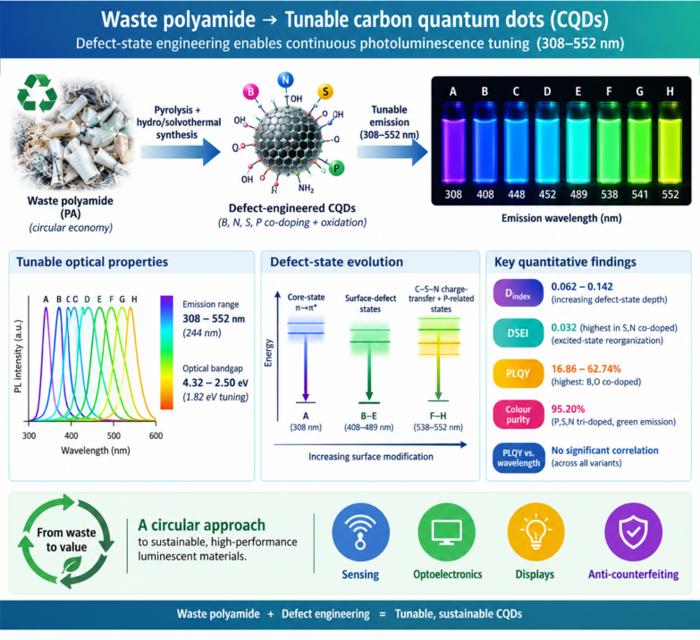
Waste polyamide-derived CQDs show continuous photoluminescence tuning from 308 to 552 nm through sequential defect-state engineering, with optical transition energies decreasing from 4.32 to 2.50 eV. @Christian Ebere Enyoh from Saitama University Carbon quantum dots (CQDs) are fluorescent carbon nanomaterials with potential applications in sensing, optoelectronics, displays, anti-counterfeiting, and environmental technologies. Their optical properties can be adjusted by modifying the carbon...
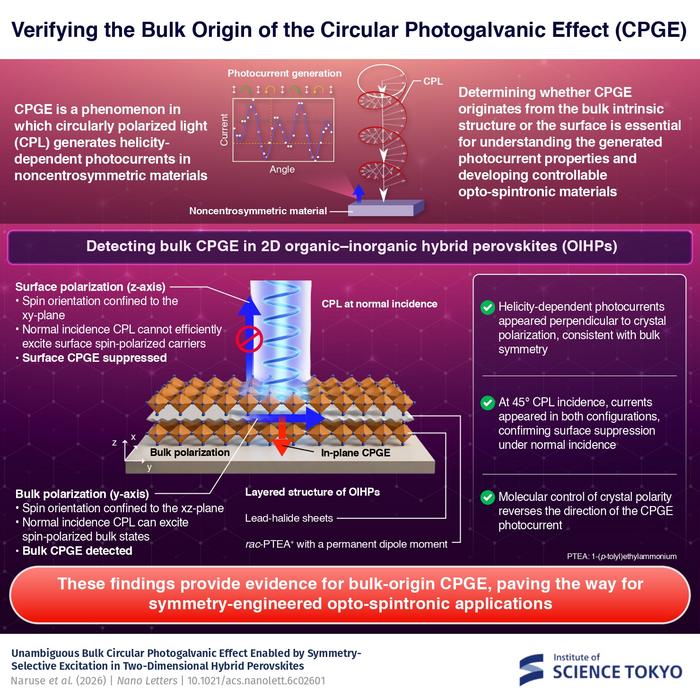
The researchers used circularly polarized light at normal incidence and found that helicity-dependent photocurrents appeared perpendicular to the crystal’s polarization but vanished when measured parallel to it, supporting a bulk origin of CPGE. @Institute of Science Tokyo The circular photogalvanic effect (CPGE), a phenomenon that generates helicity-dependent photocurrents in noncentrosymmetric materials, can originate purely from a crystal's internal structure without contribution from the...
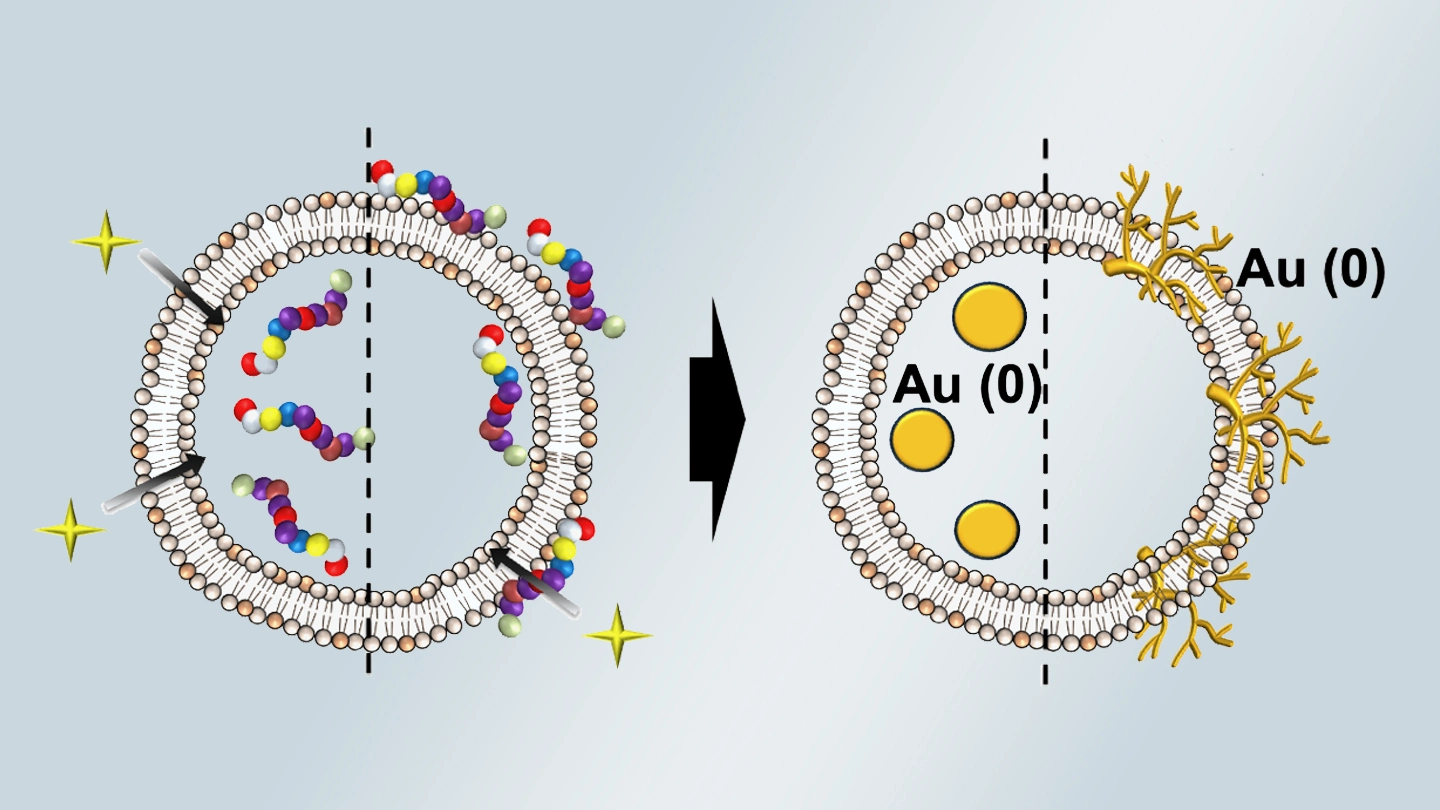
Summary of gold nanoparticle growth programming in liposome based on localization of biomineralization peptide The position of biomineralization peptides within liposomes can influence how gold nanoparticles grow, reports a research team from Institute of Science Tokyo. Peptides localized at the membrane interface promote branched structures, while those confined to the liposome interior favor spherical nanoparticles. The findings offer a new strategy for controlling nanoscale reaction...
