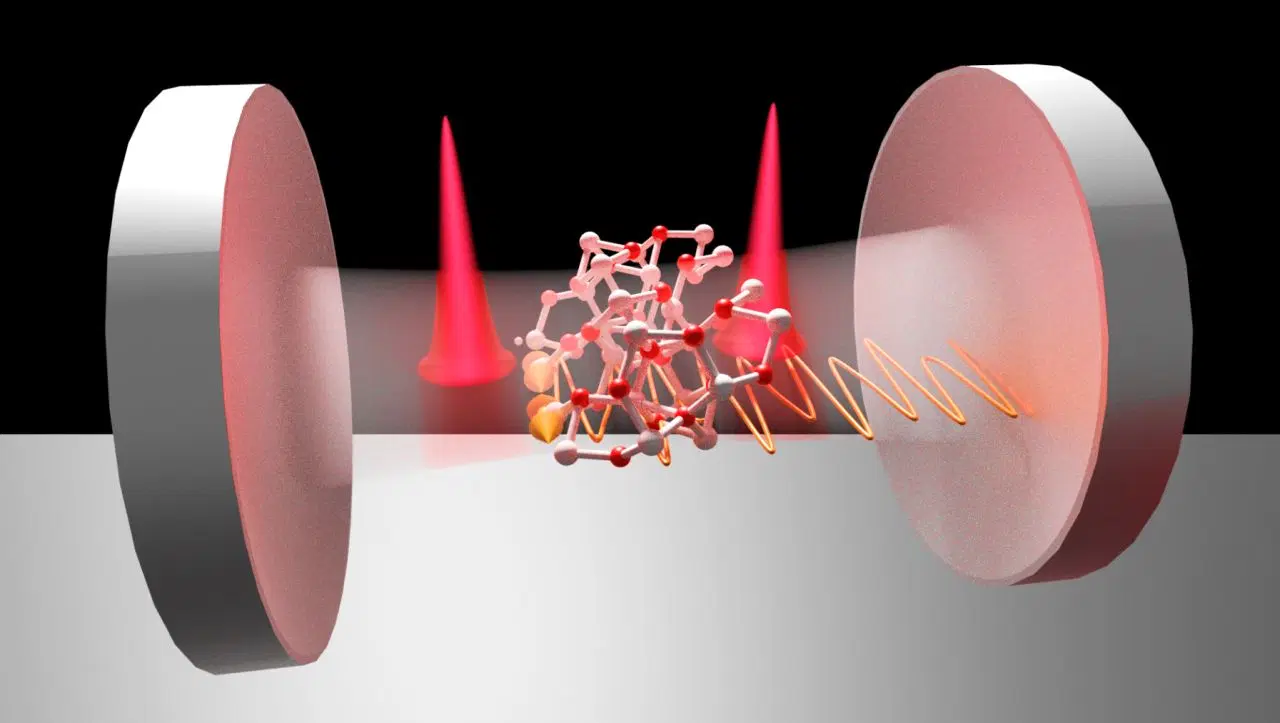
Stable packets of light waves – called optical solitons – are emitted in ultrashort-pulse lasers as a chain of light flashes. These solitons often combine into pairs with very short temporal separation. Introducing atomic vibrations in the terahertz range, researchers at the Universities of Bayreuth and Wrocław have now solved the puzzle of how these temporal links are formed. They report on their discovery in Nature Communications. The dynamics of the coupled light packets can be used to measure atomic vibrations as characteristic "fingerprints" of materials in an extremely fast manner.
In ultrashort-pulse lasers, optical solitons can form particularly tight spatial and temporal bonds. These are also called ultrashort "soliton molecules" because they are stably coupled to each other, similar to the chemically bonded atoms of a molecule. The research group in Bayreuth used a widely used solid-state laser made of a sapphire crystal doped with titanium atoms to find out how this coupling occurs. First, a single leading flash of light stimulates the atoms in the sapphire's crystal lattice to instantly vibrate. These characteristic motion oscillates in the terahertz range and decays again within a few picoseconds (a picosecond corresponds to a trillionth of a second). In this extremely short time span, the refractive index of the crystal changes. When a second flash of light immediately follows and catches up with the first, it senses this change: it is not only slightly affected by the atomic vibrations, but can also stably be bound to the preceding soliton. A "soliton molecule" is born.
"The mechanism we discovered is based on the physical effects of Raman scattering and self-focusing. It explains a variety of phenomena that have puzzled science since the invention of titanium-sapphire lasers over 30 years ago. What is particularly exciting about the discovery is that we can now exploit the dynamics of solitons during their generation in the laser cavity to scan atomic bonds in materials extremely rapidly. The entire measurement of a so-called intracavity Raman spectrum now takes less than a thousandth of a second. These findings may help to develop particularly fast chemically sensitive microscopes that can be used to identify materials. In addition, the coupling mechanism opens up new strategies to control light pulses by atomic motions and, conversely, to generate unique material states by light pulses," explains junior professor Dr. Georg Herink, head of the study and junior professor of ultrafast dynamics at the University of Bayreuth.
In parallel with the analysis of experimental data, the researchers have succeeded in developing a theoretical model for soliton dynamics. The model allows to explain the observations obtained in experiments and to predict novel effects of atomic vibrations on the dynamics of solitons. The interactions of solitons in optical systems and their applications for high-speed spectroscopy are currently being investigated in the DFG research project FINTEC at the University of Bayreuth.
Reference
Intracavity Raman scattering couples soliton molecules with terahertz phonons
Alexandra Völkel, Luca Nimmesgern, Adam Mielnik-Pyszczorski, Timo Wirth & Georg Herink
