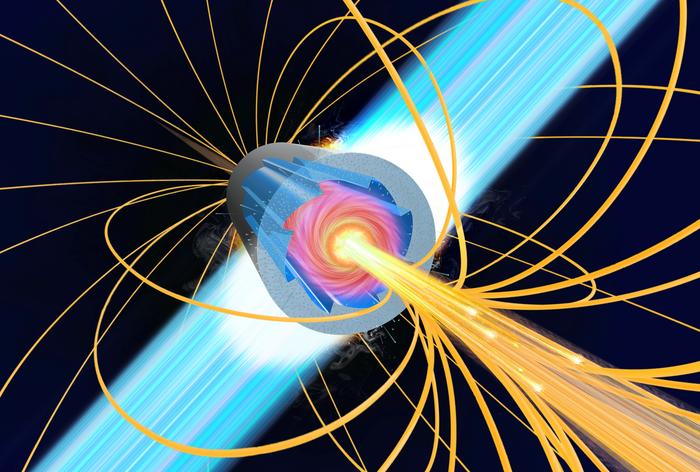
Researchers at The University of Osaka have developed a novel method for generating ultrahigh magnetic fields via laser-driven implosions of blade-structured microtubes. This method achieves field strengths approaching one megatesla—a breakthrough in compact, high-field plasma science.
Ultrastrong magnetic fields approaching the megatesla regime—comparable to those found near strongly magnetized neutron stars or astrophysical jets—have now been demonstrated in theory using a compact, laser-driven setup. A team led by Professor Masakatsu Murakami at The University of Osaka has proposed and simulated a unique scheme that uses micron-sized hollow cylinders with internal blades to achieve these field levels.
The technique—called bladed microtube implosion (BMI)—relies on directing ultra-intense, femtosecond laser pulses at a cylindrical target with sawtooth-like inner blades. These blades cause the imploding plasma to swirl asymmetrically, generating circulating currents near the center. The resulting loop current self-consistently produces an intense axial magnetic field exceeding 500 kilotesla, approaching the megatesla regime. No externally applied seed field is required.
This mechanism stands in stark contrast to traditional magnetic compression, which relies on amplifying an initial magnetic field. In BMI, the field is generated from scratch—driven purely by laser-plasma interactions. Moreover, as long as the target incorporates structures that break cylindrical symmetry, high magnetic fields can still be robustly generated. The process forms a feedback loop in which flows of charged particles—composed of ions and electrons—strengthen the magnetic field, which in turn confines those flows more tightly, further amplifying the field.
“This approach offers a powerful new way to create and study extreme magnetic fields in a compact format,” says Prof. Murakami. “It provides an experimental bridge between laboratory plasmas and the astrophysical universe.”
Potential applications include:
Simulations were conducted using the fully relativistic EPOCH code on the SQUID supercomputer at The University of Osaka. A supporting analytic model was also constructed to reveal the fundamental scaling laws and target optimization strategies.
Reference
Gigagauss magnetic field generation by bladed microtube implosion
D. Pan, M. Murakami
https://pubs.aip.org/aip/pop/article/32/7/072107/3352417/Gigagauss-magnetic-field-generation-by-bladed
University of Osaka

“There are a lot of different simulation methods that make different approximations, and they all provide slightly different results,” said Thomas Wolf. “The excitement is that this data can be used to unambiguously evaluate simulations.”
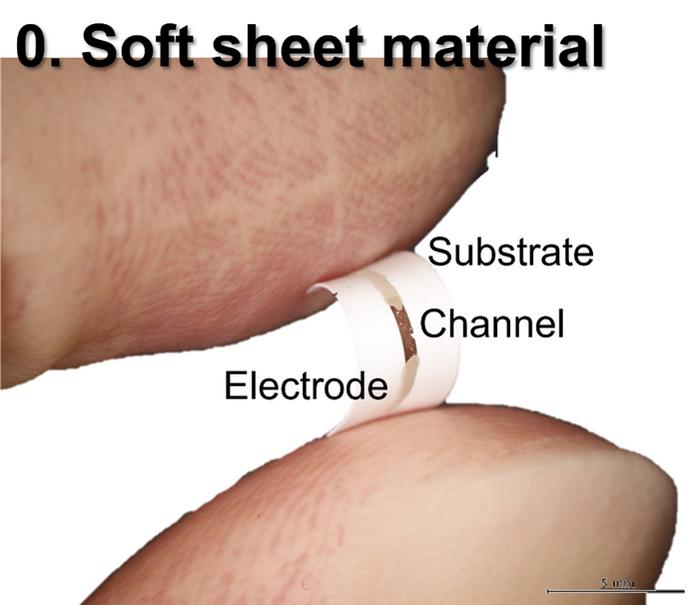
Led by Assistant Professor Kou Li, a research group in Chuo University, Japan, has developed chemically enriched photo-thermoelectric (PTE) imagers using semiconducting carbon nanotube (CNT) films, resulting in the achievement of enhanced response intensity and noise reduction, that enables efficient remote and on-site inspections.
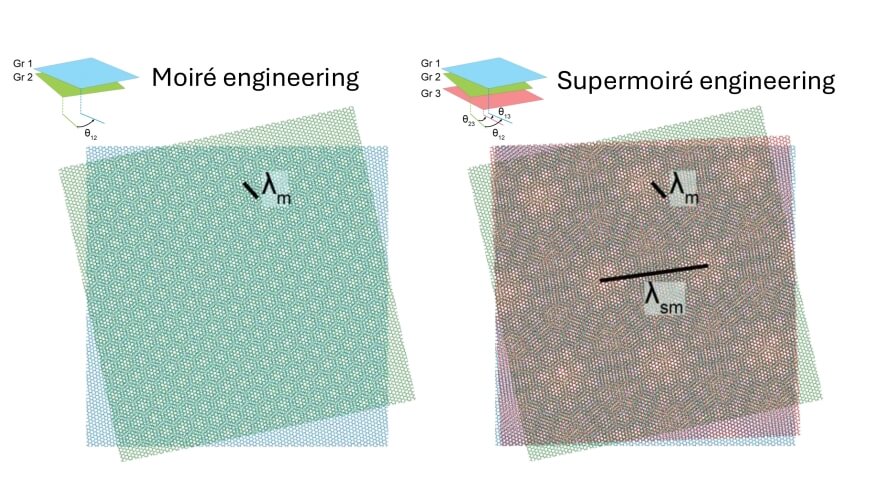
Stacking and twisting two graphene layers forms a moiré pattern, enabling superconductivity. Adding a third, differently twisted layer creates supermoiré patterns, altering electron flow. Harvard SEAS researchers, led by Yonglong Xie and Andrew Pierce, used a 100-nanometer resolution microscope to probe trilayer graphene. Published in Science, their findings reveal novel electronic states, highlighting supermoiré patterns’ role in engineering tunable materials for quantum tech and electronics.
This week in nanotech
$281.1M raised
6 funding rounds · 36 deals tracked
New products
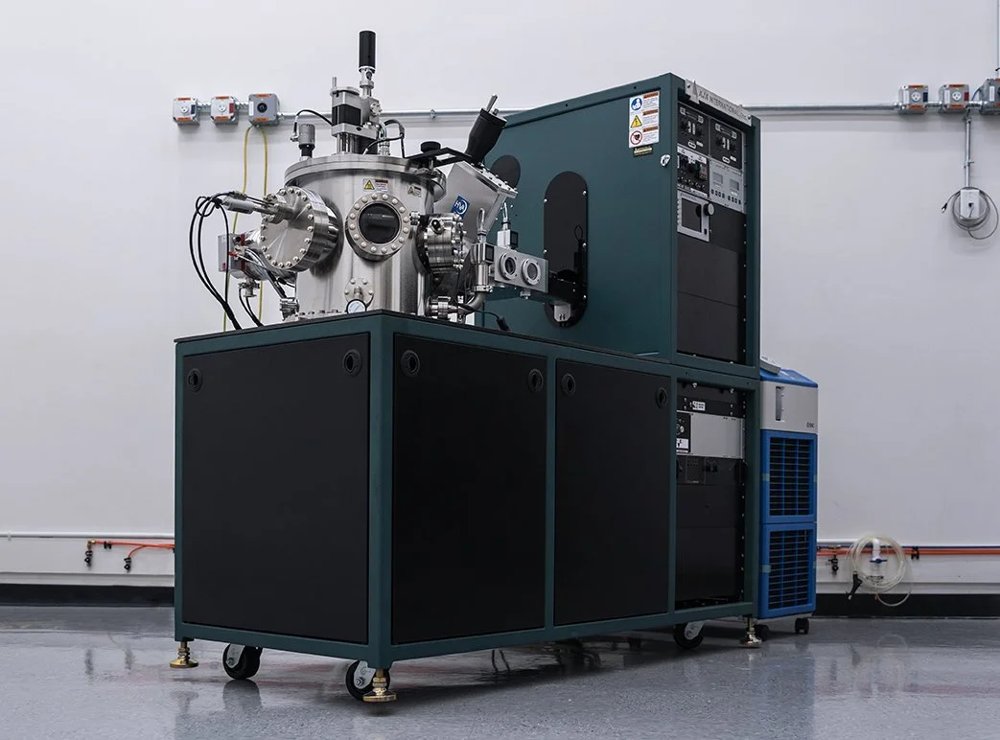 Orion Sputtering Deposition SystemsAJA International Featured
 Ti-WCMBN Nanomaterialia Featured
 Aether®Lam Research
Market insights
Last 30 days: Quantum Technologies drew the most money: $3.17B.
Money raised per month