The theory of relativity works well when you want to explain cosmic-scale phenomena - such as the gravitational waves created when black holes collide. Quantum theory works well when describing particle-scale phenomena - such as the behavior of individual electrons in an atom. But combining the two in a completely satisfactory way has yet to be achieved. The search for a "quantum theory of gravity" is considered one of the significant unsolved tasks of science.
This is partly because the mathematics in this field is highly complicated. At the same time, it is tough to perform suitable experiments: One would have to create situations in which phenomena of both the relativity theory play an important role, for example, a spacetime curved by heavy masses, and at the same time, quantum effects become visible, for example the dual particle and wave nature of light.
At the TU Wien in Vienna, Austria, a new approach has now been developed for this purpose: A so-called "quantum simulator" is used to get to the bottom of such questions: Instead of directly investigating the system of interest (namely quantum particles in curved spacetime), one creates a "model system" from which one can then learn something about the system of actual interest by analogy. The researchers have now shown that this quantum simulator works excellently. The findings of this international collaboration involving physicists from the University of Crete, Nanyang Technological University, and FU Berlin are now published in the scientific journal Proceedings of the National Academy of Sciences (PNAS).
Learning from one system about another
The basic idea behind the quantum simulator is simple: Many physical systems are similar. Even if they are entirely different kinds of particles or physical systems on different scales that, at first glance, have little to do with each other, these systems may obey the same laws and equations at a deeper level. This means one can learn something about a particular system by studying another.
"We take a quantum system that we know we can control and adjust very well in experiments," says Prof. Jörg Schmiedmayer of the Atomic Institute at TU Wien. "In our case, these are ultracold atomic clouds held and manipulated by an atom chip with electromagnetic fields". Suppose you properly adjust these atomic clouds so that their properties can be translated into another quantum system. In that case, you can learn something about the other system from the measurement of the atomic cloud model system - much like you can learn something about the oscillation of a pendulum from the oscillation of a mass attached to a metal spring: They are two different physical systems, but one can be translated into the other.
The gravitational lensing effect
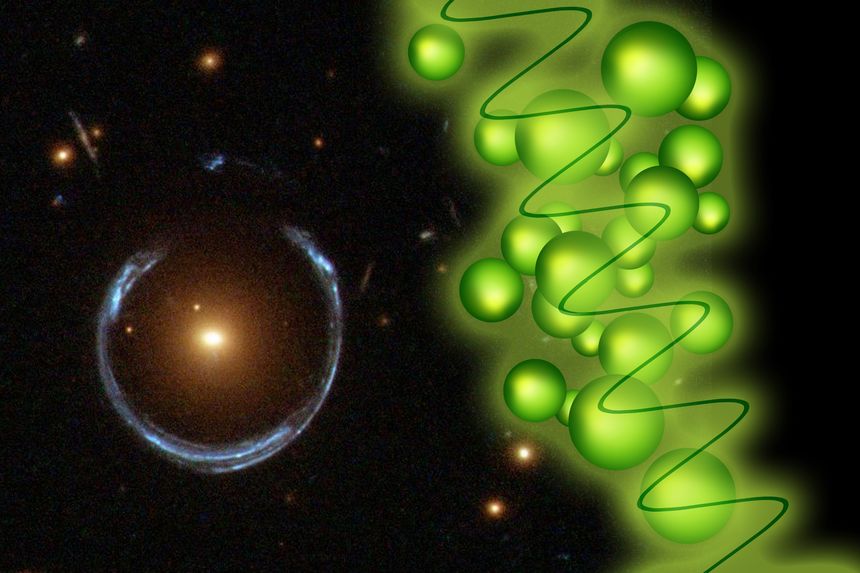
"We have now been able to show that we can produce effects in this way that can be used to resemble the curvature of spacetime," says Mohammadamin Tajik of the Vienna Center for Quantum Science and Technology (VCQ) - TU Wien, first author of the current paper. In the vacuum, light propagates along a so-called "light cone". The speed of light is constant; at equal times, the light travels the same distance in each direction. However, if the light is influenced by heavy masses, such as the sun's gravitation, these light cones are bent. The light's paths are no longer perfectly straight in curved spacetimes. This is called "gravitational lens effect".
The same can now be shown in atomic clouds. Instead of the speed of light, one examines the speed of sound. "Now we have a system in which there is an effect that corresponds to spacetime curvature or gravitational lensing, but at the same time, it is a quantum system that you can describe with quantum field theories," says Mohammadamin Tajik. "With this, we have a completely new tool to study the connection between relativity and quantum theory."
A model system for quantum gravity
The experiments show that the shape of light cones, lensing effects, reflections, and other phenomena can be demonstrated in these atomic clouds precisely as expected in relativistic cosmic systems. This is not only interesting for generating new data for basic theoretical research - solid-state physics and the search for new materials also encounter questions that have a similar structure and can therefore be answered by such experiments.
"We now want to control these atomic clouds better to determine even more far-reaching data. For example, interactions between the particles can still be changed in a very targeted way," explains Jörg Schmiedmayer. In this way, the quantum simulator can recreate physical situations that are so complicated that they cannot be calculated even with supercomputers.
The quantum simulator thus becomes a new, additional source of information for quantum research - in addition to theoretical calculations, computer simulations, and direct experiments. When studying the atomic clouds, the research team hopes to come across new phenomena that may have been entirely unknown up to now, which also take place on a cosmic, relativistic scale - but without a look at tiny particles, they might never have been discovered.
Reference
Experimental observation of curved light-cones in a quantum field simulator
Mohammadamin Tajik, Marek Gluza, Nicolas Sebe, Philipp Schüttelkopf, Federica Cataldini, João Sabino, Frederik Møller, Si-Cong Ji, Sebastian Erne, Giacomo Guarnieri, Spyros Sotiriadis, Jens Eisert, Jörg Schmiedmayer
Quantinuum reported third quarter 2026 financial results and raised its 2026 revenue outlook after landing its largest cloud agreement. The company also unveiled a roadmap for its Nexus developer platform.
IonQ reported record third quarter revenue of $173.8 million, up 336 percent year over year, and raised full year 2026 guidance to $505 to $515 million on 110 percent quantum computing growth. Backlog more than doubled to $1.2 billion, with demand led by Superion 256 system deployments, including NVIDIA's first on-premise quantum computer. The company also advanced to Stage C of DARPA's Quantum Benchmarking Initiative and acquired Elisity to extend quantum security.
IonQ announced a partnership with QuantumCT, Connecticut's statewide quantum initiative, which will purchase access to IonQ's trapped-ion quantum computers for state organizations. The contract includes more than 150 hours of cloud runtime.
This week in nanotech
$10.2M raised
1 funding round · 13 deals tracked
New products
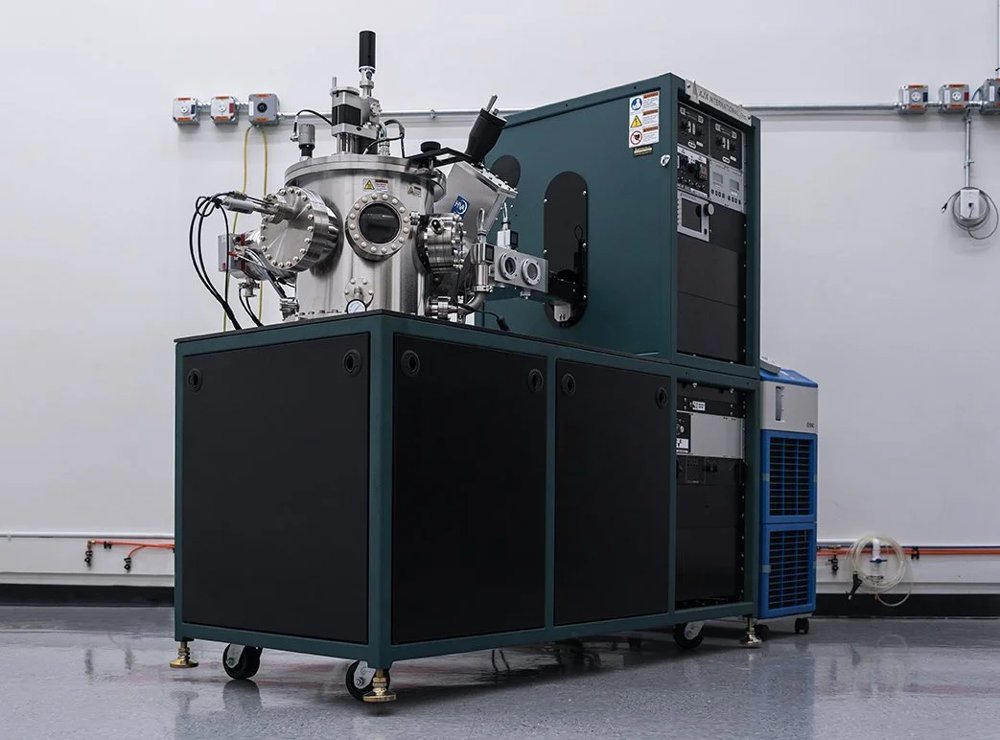 Orion Sputtering Deposition SystemsAJA International Featured
 Nion-compatible In Situ STEM Holders for Electrical BiasingHummingbird Scientific Featured
 Hold Down & Release Mechanisms (HDRM) REACT – 5KN, 15KN and 35KN space qualified resettable mechanismsARQUIMEA
Market insights
Last 30 days: Quantum Technologies was the busiest vertical: 52 of 174 events (30%).
Money raised per month