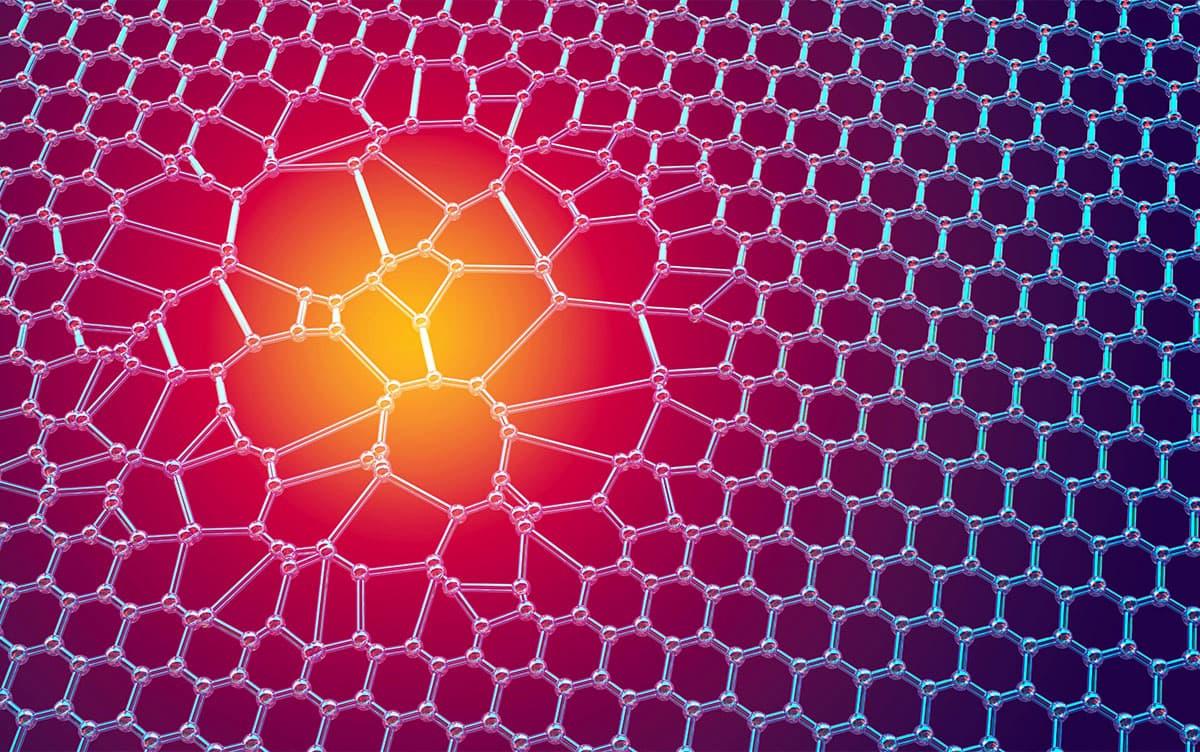
A research group led by University of Tsukuba observed the cooperative behavior of polaron quasiparticles formed by the collective interaction of electrons and lattice vibrations around color centers in diamond crystals. This discovery was achieved by irradiating diamond crystals containing color center with ultrashort laser pulses and precisely analyzing the resulting reflectance changes.
The presence of nitrogen (N) as an impurity in a diamond crystal can lead to the formation of a vacancy (V) adjacent to a carbon atom, resulting in the creation of a N-V (NV) center. This center considerably influences diamond coloration and constitutes a lattice defect referred to as a color center. NV centers exhibit exceptional sensitivity to environmental variations, including changes in temperature and magnetic fields, through corresponding alterations in their quantum state. This remarkable property can be harnessed to develop a high-sensitivity, high-spatial-resolution sensor. Notably, the energy levels of the electrons within an NV center either shift or split owing to distortion of the crystal lattice surrounding the center. However, the interaction mechanism between the involved electrons and lattice vibrations which accompany this distortion is not completely understood.
Herein, researchers implemented extremely thin sheets (nanosheets) comprising density-controlled NV centers in close proximity to the surfaces of high-purity diamond crystals. These sheets were irradiated by pulsed laser to investigate the lattice vibrations of the involved diamond. The findings revealed a substantial amplification in the amplitude of the lattice vibrations (by a factor of ~13), despite the relatively low density of the NV centers compared to other defects. Subsequently, the charge state of the NV centers was computed through first-principles calculations, revealing a biased distribution of positive and negative charges.
A polaron quasiparticle, which is characterized by a free carrier accompanied by a "phonon cloud," exists in several forms. Notably, the polaron type proposed by Fröhlich almost 70 years ago is believed to not exist in diamonds. However, this investigation demonstrated the emergence of Fröhlich polarons from NV centers throughout the involved nanosheet. Overall, these findings evoke new prospects for quantum sensing based on NV centers that utilize polarons.
Reference
Cooperative dynamic polaronic picture of diamond color centers
Takuto Ichikawa, Junjie Guo, Paul Fons, Dwi Prananto, Toshu An & Muneaki Hase
https://www.nature.com/articles/s41467-024-51366-x
University of Tsukuba
When it comes to materials for quantum sensors, diamond is the best game in town, said Gregory Fuchs, professor of applied and...

Diamond is known for its outstanding thermal conductivity. This makes the material ideal for cooling electronic components with high...

A nitrogen-vacancy (NV) center is a defect in the crystal structure of diamond, where a nitrogen atom replaces a carbon atom in the...
