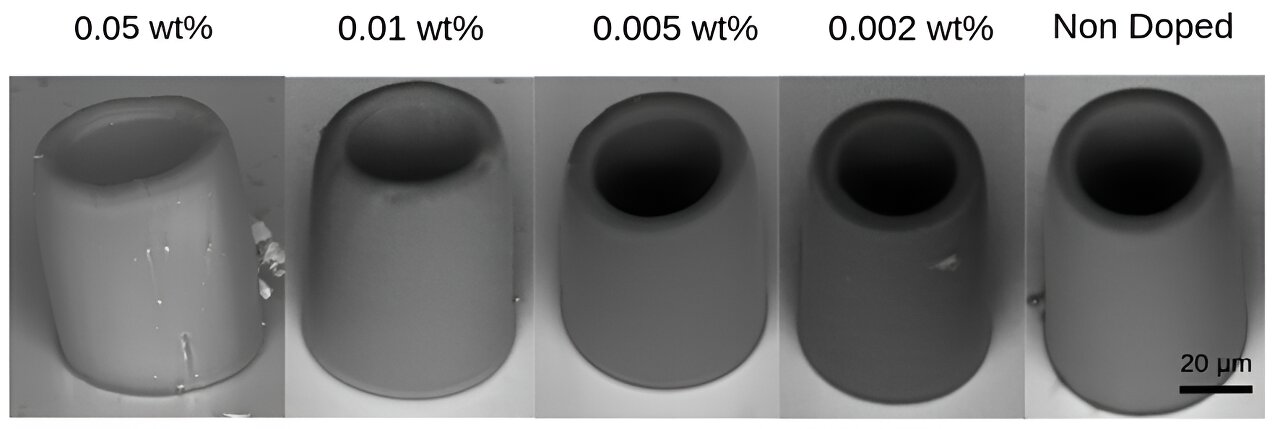
A nitrogen-vacancy (NV) center is a defect in the crystal structure of diamond, where a nitrogen atom replaces a carbon atom in the diamond lattice and a neighboring site in the lattice is vacant. This and other fluorescent defects in diamond, known as color centers, have attracted researchers' attention owing to their quantum properties, such as single-photon emission at room temperature and with long coherence time. Their many applications include quantum information encoding and processing, and cell marking in biological studies.
in diamond is technically difficult, and nanodiamonds with color centers have been embedded in custom-designed structures as a way of integrating these quantum emitters into photonic devices. A study conducted at the University of São Paulo's São Carlos Institute of Physics (IFSC-USP) in Brazil has established a method for this, as described in an article published in the journal Nanomaterials.
"We demonstrated a method of embedding fluorescent nanodiamonds in microstructures designed for this purpose, using two-photon polymerization [2PP]," Cleber Mendonça, a professor at IFSC-USP and last author of the article, told Agência FAPESP. "We studied the ideal concentration of nanodiamond in the photoresist to achieve structures with at least one fluorescent NV center and good structural and optical quality." The photoresist is a light-sensitive material used in the fabrication process to transfer nanoscale patterns to the substrate.
Mendonça and his group have made extensive use of 2PP to fabricate three-dimensional microstructures. Simply put, 2PP is a direct laser writing technique in which a high-intensity laser beam is focused on a light-sensitive polymer resin that has not yet solidified to produce the microstructure of interest.
In the study, a nanodiamond solution in deionized water was added to the mixture of monomers that comprised the photoresist, and after all the requisite physicochemical procedures had been completed, microfabrication was performed by submitting the sample to pulses from a powerful titanium-sapphire laser controlled by dedicated software to define the exact coordinates of the beam.
"Fluorescence and Raman spectroscopy measurements were used to confirm the presence and location of the nanodiamonds, while absorbance measurements assessed scattering losses at higher concentrations. Our results show the feasibility of fabricating microstructures embedded within fluorescent nanodiamonds via 2PP for photonics and quantum technology applications," the authors write in the article.
Reference
Integrating Fluorescent Nanodiamonds into Polymeric Microstructures Fabricated by Two-Photon Polymerization
Filipe A. Couto, Marcelo B. Andrade, Adriano J. G. Otuka, Sebastião Pratavieira, Sergio R. Muniz and Cleber R. Mendonça
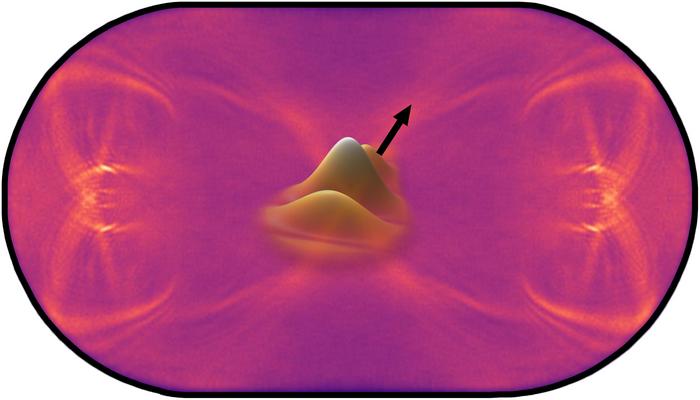
A quantum "wave packet" (in the middle) launched from the same kind of starting point behaves differently. Even after bouncing around for a very long time, faint filament-like patterns (bright glow) are still visible, a tattoo tracing back to its early history. This lingering imprint is the "quantum birthmark" described in the study. Credit: Joonas Keski-Rahkonen, Tampere University Even the most chaotic quantum systems keep a permanent mark of their own past – a "quantum birthmark" – that...
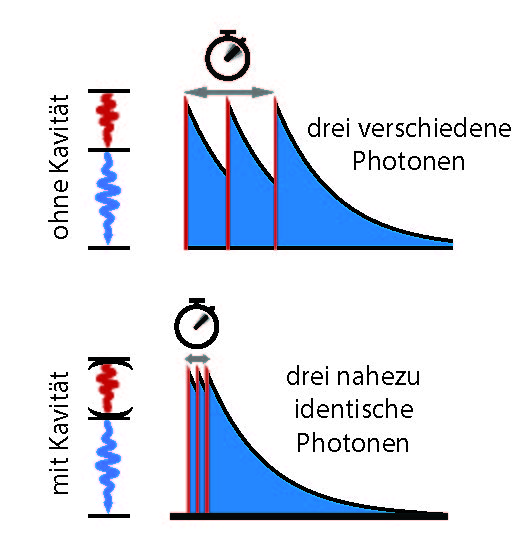
Illustration (University of Basel, Timon Baltisberger): Biexziton decay can generate photons of very high quality if the system is specifically controlled using an optical cavity. Under these conditions, 90 per cent of the photons are indistinguishable. Working in close collaboration, researchers from Paderborn University, the University of Basel and Ruhr University Bochum have made a significant breakthrough in the field of quantum communication. In their recently published paper in the...
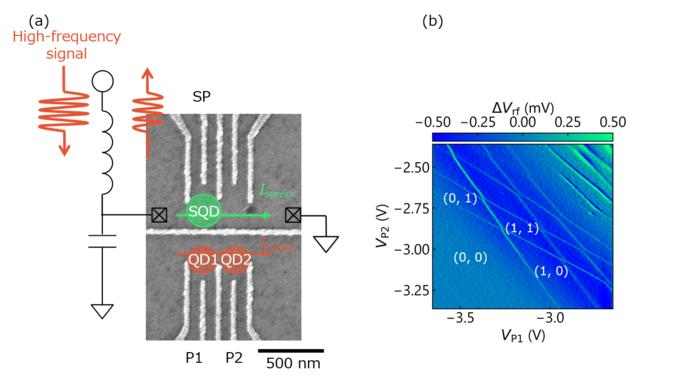
(a) The structure of the gate electrodes on the ZnO device used in the experiment in this paper. (b) The charge stability diagram indicating the formation of ZnO double quantum dot in few-electron regime. Researchers at Tohoku University, in collaboration with the National Institute for Materials Science (NIMS) and the University of Tokyo, have taken an important step toward semiconductor quantum computing using zinc oxide (ZnO). The team successfully demonstrated charge sensing,...
