Pennsylvania State University (Penn State)
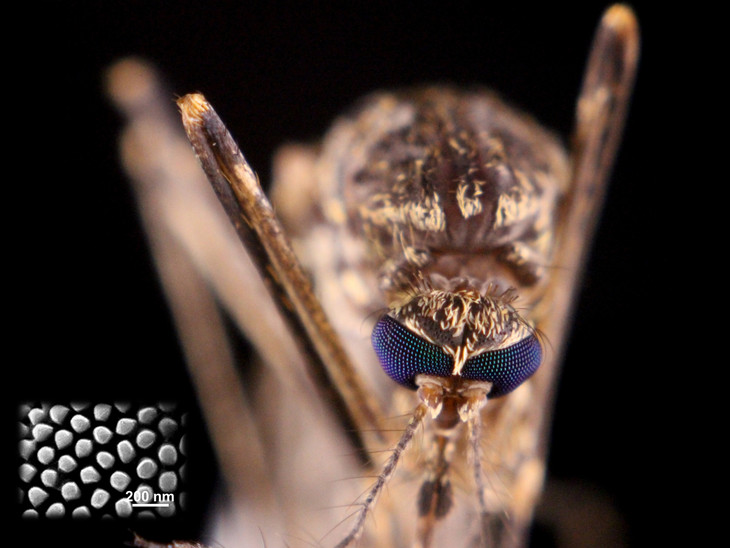
Through the investigation of insect surfaces, Penn State researchers have detailed a previously unidentified nanostructure that can be used to engineer stronger, more resilient water repellent coatings.
With an enhanced ability to repel droplets, this design could be applied to personal protective equipment (PPE) to better resist virus-laden particles, such as COVID-19, among other applications.
"For the past few decades, conventionally designed water repellent surfaces have usually been based on plants, like lotus leaves," said Lin Wang, a doctoral student in the Department of Materials Science and Engineering at Penn State and the lead author of the paper.
Classical engineering theories have used this approach to create superhydrophobic, or water repellent, surfaces. Traditionally, they are manufactured with low solid fraction textures, which maintain an extremely thin layer of air above a low density of microscopic, hair-like nanostructures, which the researchers liken to an air hockey table.
"The reasoning is if the droplet or object is floating on top of that air, it won't become stuck to the surface," said Tak-Sing Wong, the Wormley Early Career Professor of Engineering, associate professor of mechanical and biomedical engineering and Wang's adviser.
Since it works effectively, human-made coatings tend to mimic the low density of these nanostructures.
However, this paper details an entirely different approach. When examining surfaces like the eye of a mosquito, body of a springtail or the wing of a cicada under high resolution electron microscopes, Wang found that the nanoscopic hairs on those surfaces are more densely packed, referred to in engineering as high solid fraction textures. Upon further exploration, this significant departure from plants' structure may imbue additional water repelling benefits.
"Imagine if you had a high density of these nanostructures on a surface," Wang said. "It could be possible to maintain the stability of the air layer from higher impact forces."
This could also mean the more densely packed structures may be able to repel liquid that is moving at a higher speed, such as raindrops.
While the design concept is new to humans, the researchers theorize this nanostructure boosts the insect's resiliency in its natural environment.
"For these insect surfaces, repelling water droplets is a matter of life and death. The impact force of raindrops is enough to carry them to the ground and kill them," Wang said. "So, it is really important for them to stay dry, and we figured out how."
With this knowledge gleaned from nature, the researchers hope to apply this design principle to create next generation coatings. By developing a water repellent surface that can withstand faster moving and higher impact droplets, the applications are abundant.
From small, flying robotic vehicles, such as the drones that Amazon hopes to deliver packages with, to commercial airliners, a coating that can emulate these insect surfaces could provide increased efficiency and safety.
However, in light of the COVID-19 pandemic, researchers have since realized this knowledge could have an additional impact on human health.
"We hope, when developed, this coating could be used for PPE. For example, if someone sneezes around a face shield, those are high velocity droplets. With a traditional coating, those particles could stick to the surface of the PPE," Wong said. "However, if the design principles detailed in this paper were adopted successfully, it would have the ability to repel those droplets much better and potentially keep the surface germ-free."
As seen in this work, the Wong Laboratory for Nature Inspired Engineering draws insights from biological phenomena to make humanity's innovations better and more effective.
"While we didn't imagine that application at the beginning of this project, COVID-19 made us think about how we can use this design principle to benefit more people," Wong said. "It's up to us as engineers to take these discoveries and apply them in a meaningful way."
The next step for this work will be developing a large scale, cost effective method that can manufacture a coating to mimic these properties.
"In the past, we didn't have an effective surface that could repel high speed water droplets," Wong said. "But the insects told us how. There are so many examples like this in nature; we just need to be learning from them."
This research was funded by the National Science Foundation, the PPG Foundation, the Wormley Family Early Career Professorship, the Humanitarian Materials Initiative Award sponsored by Covestro and the Materials Research Institute at Penn State. Additional contributors include Ruoxi Wang, an undergraduate alumna, and Jing Wang, a doctoral graduate, both in the Department of Mechanical Engineering.
Compact nanoscale textures reduce contact time of bouncing droplets
Lin Wang, Ruoxi Wang, Jing Wang, and Tak-Sing Wong
Science Advances (2020)
Contact information:
Penn State associate professor of mechanical and biomedical engineering
tswong@psu.edu
Phone: (814) 865-6122
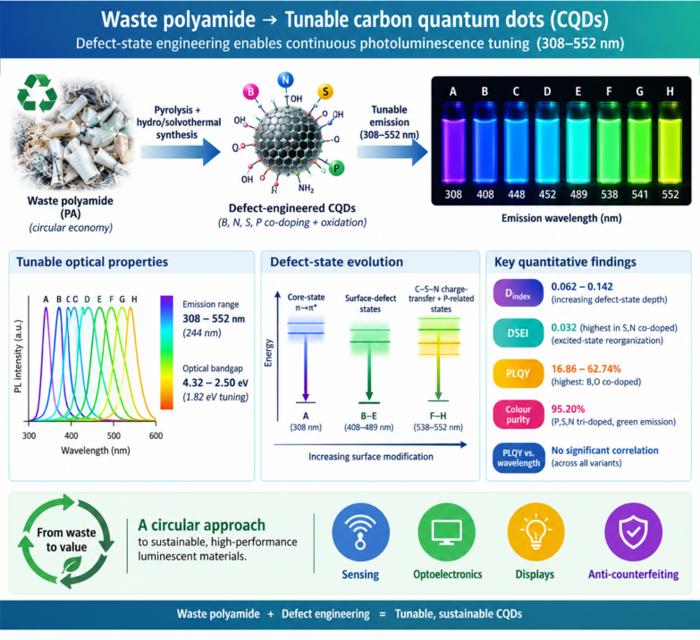
Waste polyamide-derived CQDs show continuous photoluminescence tuning from 308 to 552 nm through sequential defect-state engineering, with optical transition energies decreasing from 4.32 to 2.50 eV. @Christian Ebere Enyoh from Saitama University Carbon quantum dots (CQDs) are fluorescent carbon nanomaterials with potential applications in sensing, optoelectronics, displays, anti-counterfeiting, and environmental technologies. Their optical properties can be adjusted by modifying the carbon...
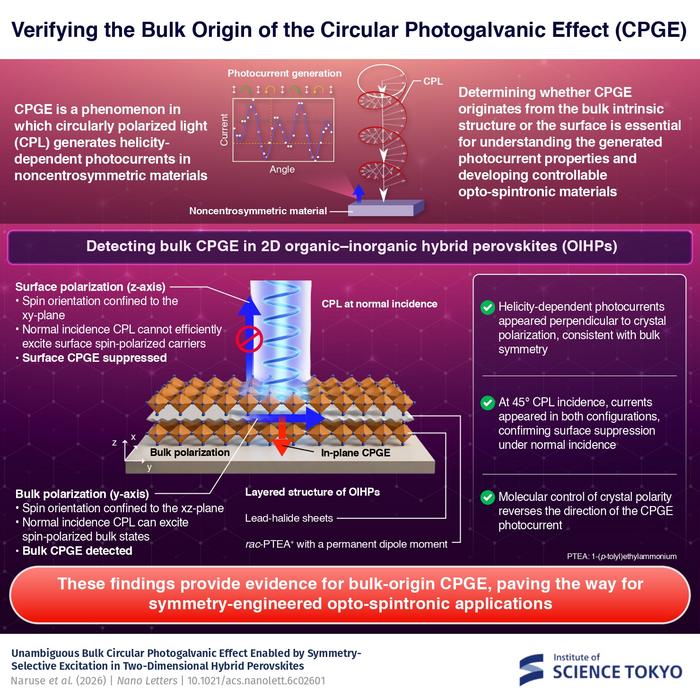
The researchers used circularly polarized light at normal incidence and found that helicity-dependent photocurrents appeared perpendicular to the crystal’s polarization but vanished when measured parallel to it, supporting a bulk origin of CPGE. @Institute of Science Tokyo The circular photogalvanic effect (CPGE), a phenomenon that generates helicity-dependent photocurrents in noncentrosymmetric materials, can originate purely from a crystal's internal structure without contribution from the...
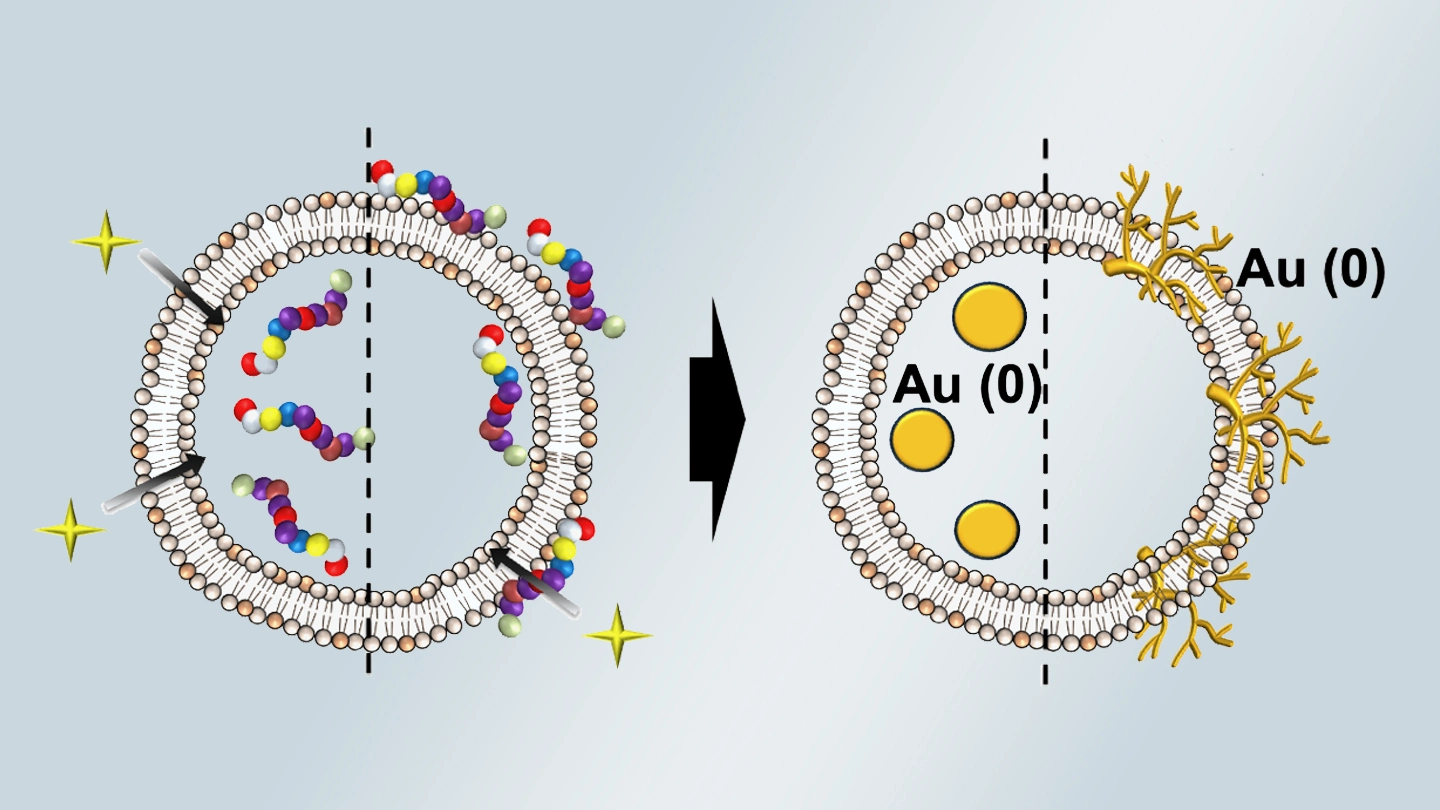
Summary of gold nanoparticle growth programming in liposome based on localization of biomineralization peptide The position of biomineralization peptides within liposomes can influence how gold nanoparticles grow, reports a research team from Institute of Science Tokyo. Peptides localized at the membrane interface promote branched structures, while those confined to the liposome interior favor spherical nanoparticles. The findings offer a new strategy for controlling nanoscale reaction...
