Ecole polytechnique fédérale de Lausanne (EPFL)
Close to half a million people around the world suffer from a serious hearing impairment. In some cases, they can find relief in cochlear and other types of implants. Yet these devices do not help people whose inner ear is damaged or whose auditory nerve does not function properly.
For these patients to recover their sense of hearing, electrical signals must be sent directly to the auditory brainstem. The neuroprosthetic used for this purpose is called an auditory brainstem implant, or ABI. Yet the outcomes of ABIs are mixed and, in many cases, patients recover only sound perception. What's more, clinical ABIs are stiff and cannot conform precisely to the curvature of the auditory brainstem.
To address this problem, Stéphanie Lacour's team at EPFL's Laboratory for Soft BioElectronic Interface (LSBI) worked with clinicians from Harvard Medical School and Massachusetts Eye and Ear to develop a soft electronic interface. The highly elastic implant conforms neatly to the curved surface of the auditory brainstem and can therefore send highly targeted electrical signals. It has been tested successfully on mice - the implant has a surface area only 0.25 mm2 - and has now been produced at a size suitable for human use and in a form that is compatible with current surgical techniques. It will undergo further study in preparation for human trials. The researchers' study was just published in Science Translational Medicine.
Inspired by Japanese cutouts
The new implant consists of a conformable array of platinum electrodes encased in silicone. "We focused on platinum because it's already used widely in clinical settings," says Nicolas Vachicouras, a post-doc at EPFL's School of Engineering and the article's lead author.
Unfortunately, platinum is a rigid metal that cannot be distorted without being damaged. The researchers overcame this hurdle by applying the traditional Japanese paper-cutting technique called kirigami, etching a Y-shaped pattern into metalized plastic segments. Then they machined the metal at the micron scale (one micron = one thousandth of a millimeter), using techniques commonly found in the microfabrication of integrated circuits. The result is a very compliant and highly conductive electrode implant.
The EPFL researchers are already eyeing other applications. "The properties of our device would be of value for all sorts of implantable neuroprosthetics," says Stéphanie Lacour, "such as those used to stimulate or record neural activity in the spine, brain or even peripheral nerves."
Microstructured thin-film electrode technology enables proof of concept of scalable, soft auditory brainstem implants
N. Vachicouras, O. Tarabichi, V. V. Kanumuri, C. M. Tringides, J. Macron, F. Fallegger, Y. Thenaisie, L. Epprecht, S. McInturff, A. A. Qureshi, V. Paggi, M. W. Kuklinski, M. C. Brown, D. J. Lee, S. P. Lacour
Science Translational Medicine 16 Oct 2019: Vol. 11, Issue 514, eaax9487
DOI: 10.1126/scitranslmed.aax9487
Contact information:
Professor at EPFL Center for Neuroprosthetics
stephanie.lacour@epfl.ch
Phone: +41 21 693 11 81
EPFL's Laboratory for Soft BioElectronic Interface (LSBI)
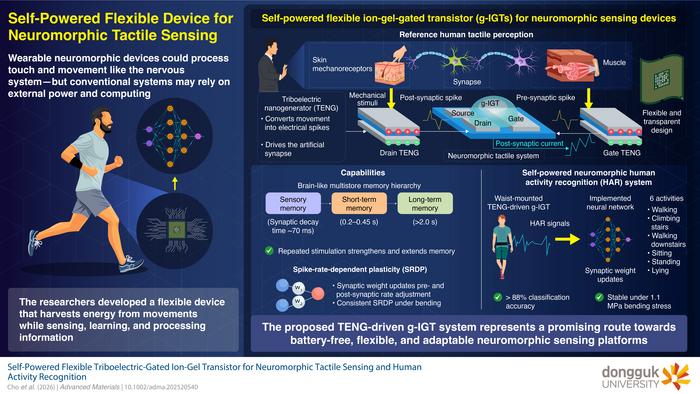
The proposed TENG-driven g-IGT is a flexible, self-powered neuromorphic device capable of reproducing multiple memory states and spike-rate-dependent learning Neuromorphic devices, which are designed to emulate aspects of biological neural networks, are promising candidates for developing low-power and intelligent sensing technologies, including wearable applications. Among the device architectures explored for neuromorphic computing, graphene-channel ion-gel-gated transistors (g-IGTs) are...
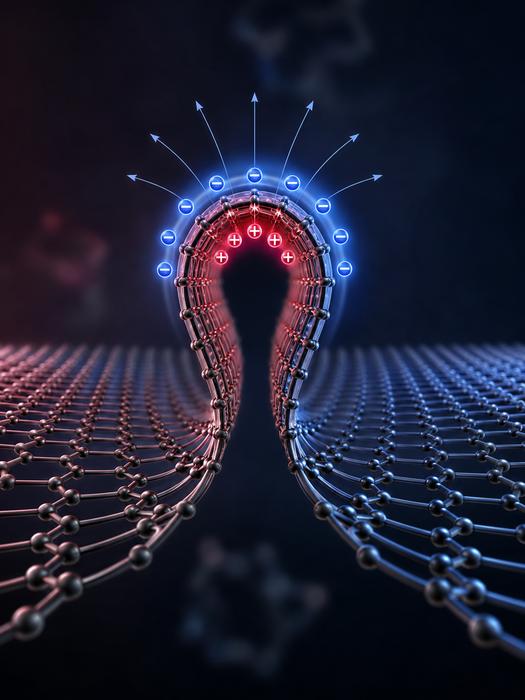
Rice University researchers have shown that sub-nanometer wrinkles in graphene generate flexoelectric charge separation, reshaping local electrical behavior through curvature alone. Extreme bending produces polarization far stronger than in larger systems and may enable geometry-controlled electronics without chemical doping. Published in Advanced Materials.
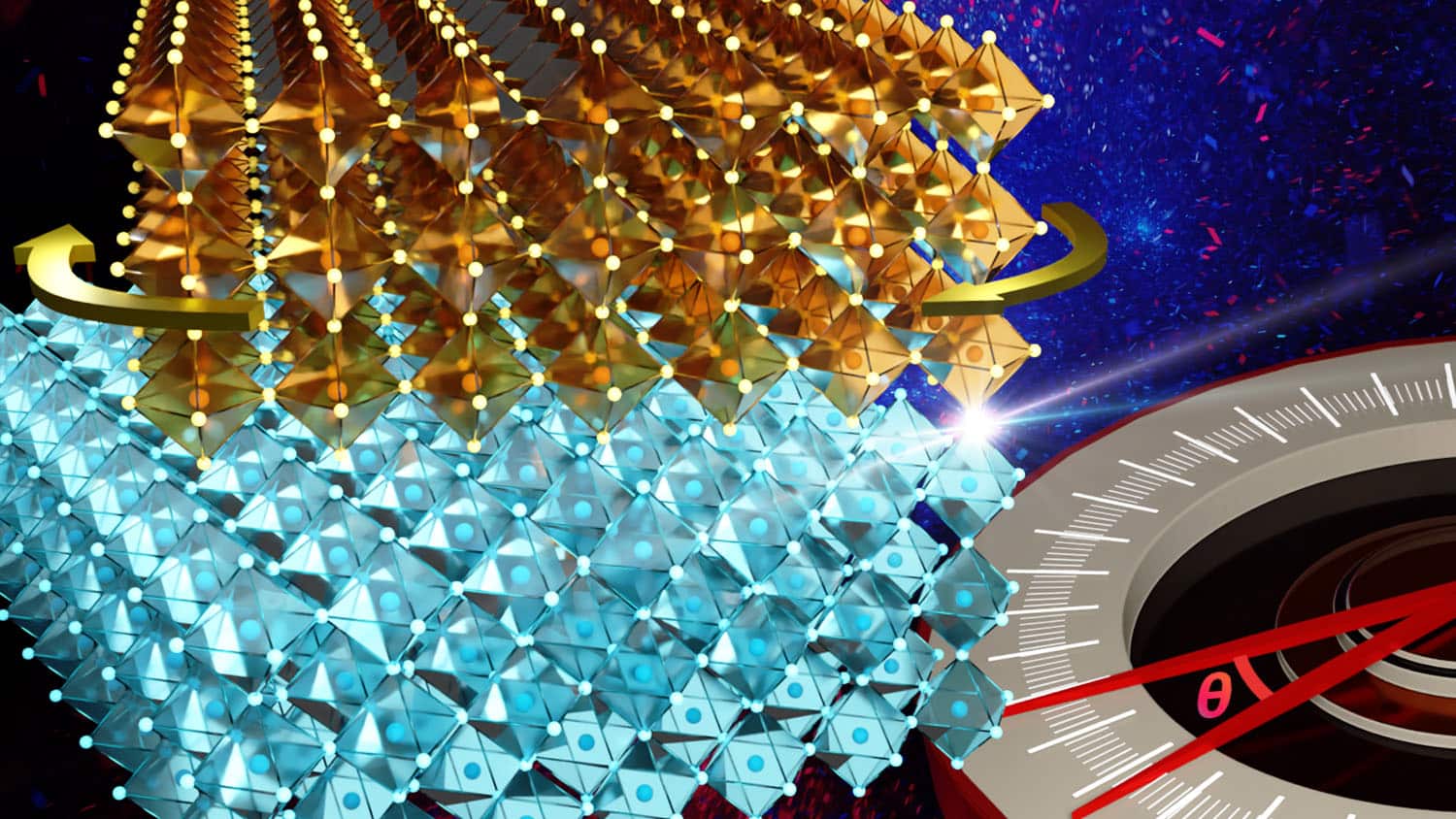
Researchers at NC State have extended twistronics beyond van der Waals materials into strongly bonded crystalline oxides. By stacking sodium niobate membranes with twist angles controlled down to 0.1 degrees, and confirming results via synchrotron X-ray diffraction, the team found interlayer bonds distort the atomic lattice, shifting phase structure and domain configuration. The technique works at near-millimeter scale, far larger than typical twistronic devices, marking a real step toward pract
