The prestigious scientific journals Nature Electronics and Nature Communications, have reported on the progress made by a joint research team from Israel and China, confirming that a structure with as few as 5000 atoms (10nm in diameter) can still exhibit solid-state ferroelectric effects suitable for production of devices with binary information storage.
Ferroelectric effect is a physical phenomenon discovered in the early 20th century by Joseph Valasek. Ferroelectricity is a property of certain materials that creates a spontaneous or induced electric polarization of molecules, resulting in electric field inside the material. The polarization state can be permanent or reversed to opposite direction by the application of an external electric field. Ferroelectric materials in the form of thin films or small crystals can be used for binary information storage and non-volatile (independent of energy source) memories. The size reduction of the individual ferroelectric crystals will increase the amount of the storage units that can be integrated into storage devices, thus providing quicker and more effective performance.
Nanomaterials, prepared in the laboratory of Prof. Alla Zak (Faculty of Sciences, HIT), are semiconductor needle-like crystals ~60-100 nm in diameter (1000 times thinner than human hair) and tens of microns in length, having tubular shape and named nanotubes. Recently, Prof. Yao Guo, China, and Prof. Alla Zak, discovered ferroelectricity in these nanotubes, which allows to build fully operated artificial vision system based on these nanotubes solely. Artificial vision system allows recognition of the subjects using the sequence of actions such as detecting, memorizing and processing. Training of this device was done using machine learning.
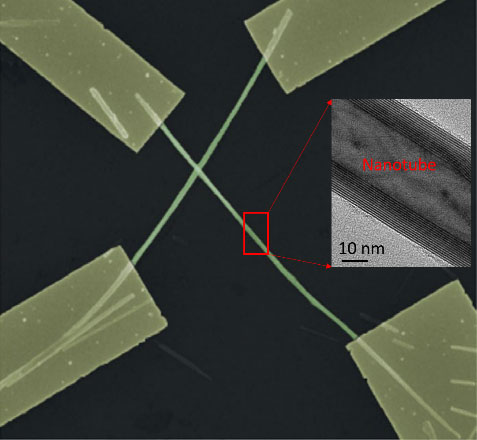
In the current study, Prof. Alla Zak, Prof. Guo Yao and collaborating researchers crossed two nanotubes (composed of tungsten disulfide) to create ferroelectric diode at the interface of two nanotubes contact. This reduces even more the size of the ferroelectric device, being ~10 nm in diameter and consists of only about 5000 atoms.
The electron microscopy image in the figure on the right illustrates such a zero-dimensional (0D) device formed at the interface of two crossed nanotubes. The inset shows zoomed image of the nanotube.
Prof. Alla Zak from HIT Holon Institute of Technology and Prof. Guo Yao from Beijing Institute of Technology explained: “Traditional ferroelectric effect is subject to size limitations, because when the size of ferroelectric crystals decreases, depolarization occurs and this can cause the original polarization, essential for ferroelectric effect, to disappear. Notwithstanding, due to the unique properties of the nanotubes and the proposed device design, the smallest (zero-dimensional) ferroelectric diode was successfully constructed, and its proper performance was demonstrated”.
In two groundbreaking articles entitled "Ferroelectricity in zero-dimensional" and "0D Van der Waals interfacial sliding ferroelectricity", experimental evidence and theoretical simulations were provided, which shattered the previously accepted notion that traditional ferroelectric effects were limited by the size of the ferroelectric crystals. With this discovery, the final piece of the ferroelectricity ‘puzzle’ was completed.
The researchers observed resistance changes and hysteresis phenomena typical to ferroelectric material in this nanoscale 0D device, thus demonstrating their ability to perform as a diode. The device produces resistance and photocurrent changes suitable for information storage, while the programmable photovoltaic responses were recorded across almost the entire visible light wavelength range, despite their small size.
"We are surprised that a 5000-atom interface system can produce such rich functionality”, commented Prof. Emeritus Reshef Tenne (Weizmann Institute, Israel), co-author of this study and recipient of the Materials Research Society’s prestigious Von Hippel Prize. Prof. Tenne believes that the downscaled ferroelectricity has important advantages for future high-density information storage, resulting in more efficient and faster performance. Moreover, this research is of great significance for size decrease of other ferroelectric devices such as sonar, fire sensors, and vibration sensors in the future.
References
Ferroelectricity in zero dimensions
Katharina Zeissler
https://www.nature.com/articles/s41928-023-01085-w
0D van der Waals interfacial ferroelectricity
Yue Niu, Lei Li, Zhiying Qi, Hein Htet Aung, Xinyi Han, Reshef Tenne, Yugui Yao, Alla Zak & Yao Guo
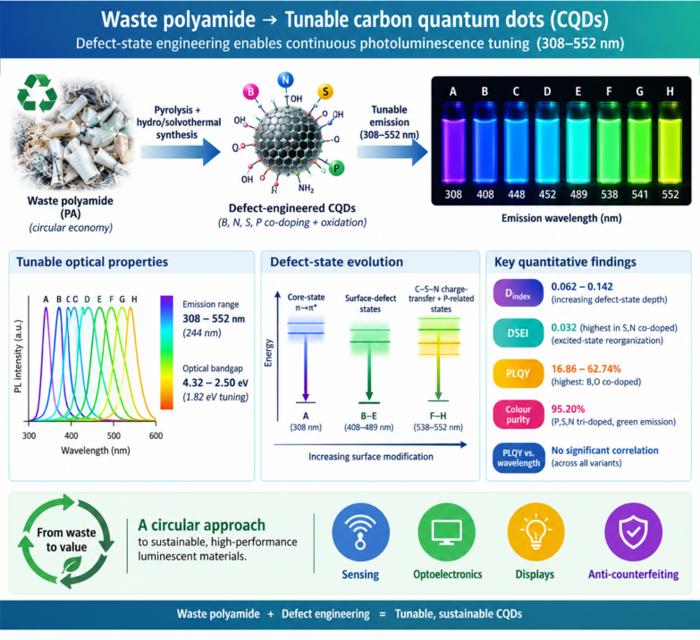
Waste polyamide-derived CQDs show continuous photoluminescence tuning from 308 to 552 nm through sequential defect-state engineering, with optical transition energies decreasing from 4.32 to 2.50 eV. @Christian Ebere Enyoh from Saitama University Carbon quantum dots (CQDs) are fluorescent carbon nanomaterials with potential applications in sensing, optoelectronics, displays, anti-counterfeiting, and environmental technologies. Their optical properties can be adjusted by modifying the carbon...
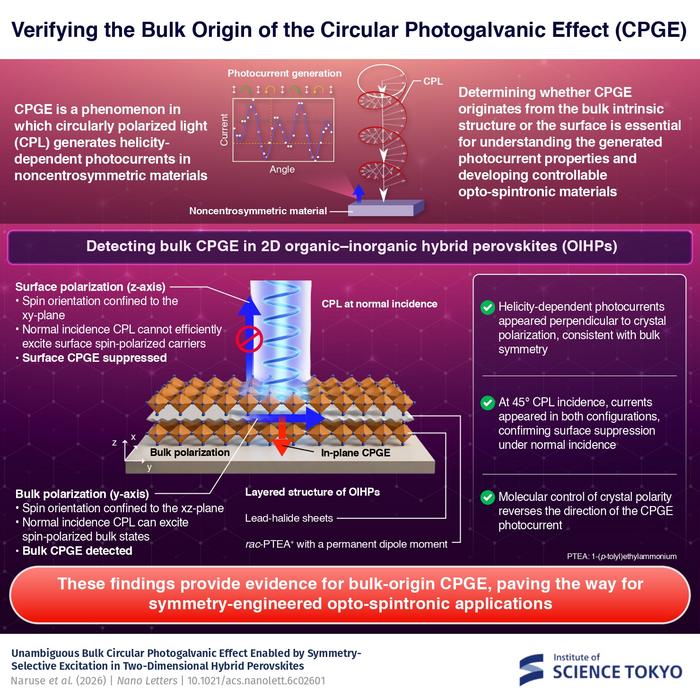
The researchers used circularly polarized light at normal incidence and found that helicity-dependent photocurrents appeared perpendicular to the crystal’s polarization but vanished when measured parallel to it, supporting a bulk origin of CPGE. @Institute of Science Tokyo The circular photogalvanic effect (CPGE), a phenomenon that generates helicity-dependent photocurrents in noncentrosymmetric materials, can originate purely from a crystal's internal structure without contribution from the...
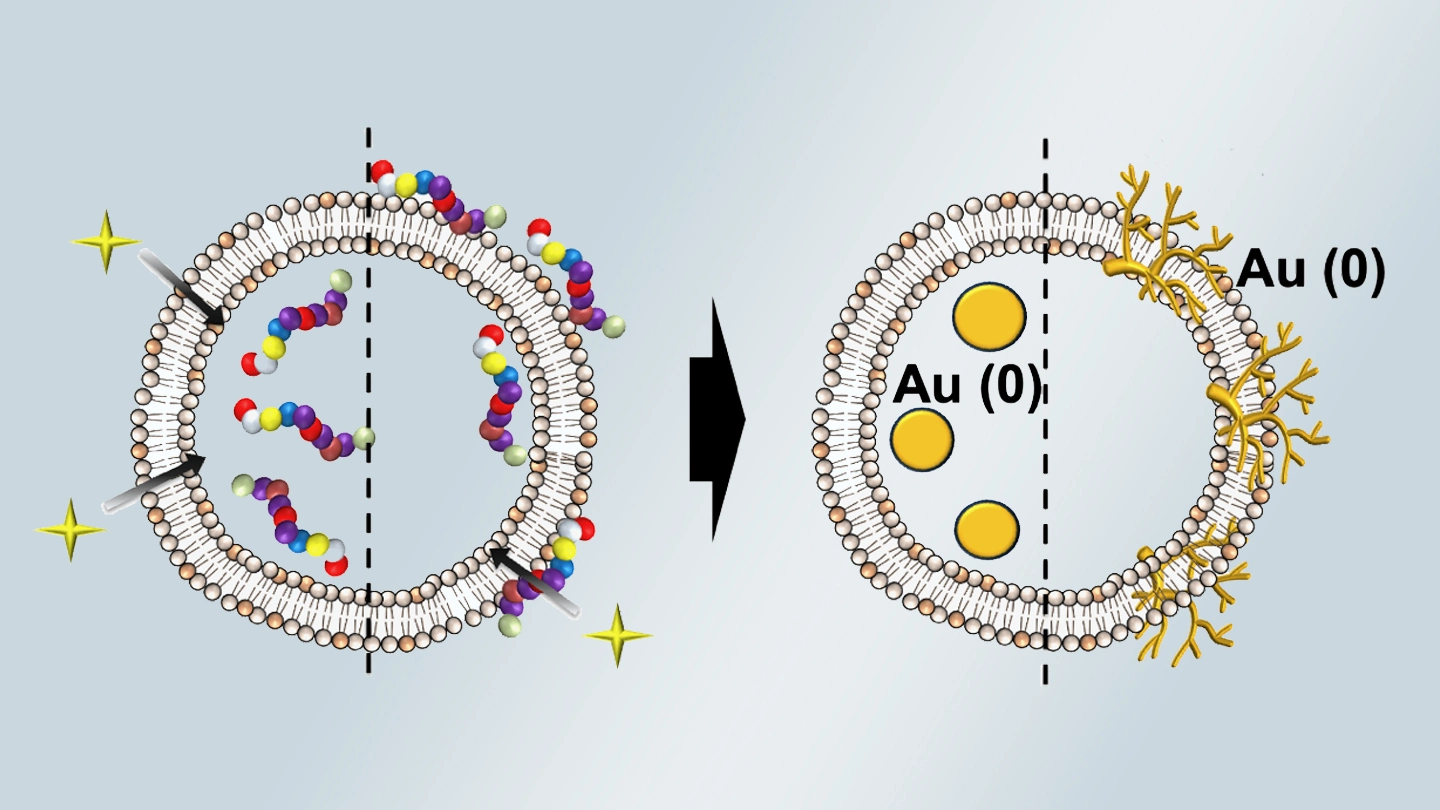
Summary of gold nanoparticle growth programming in liposome based on localization of biomineralization peptide The position of biomineralization peptides within liposomes can influence how gold nanoparticles grow, reports a research team from Institute of Science Tokyo. Peptides localized at the membrane interface promote branched structures, while those confined to the liposome interior favor spherical nanoparticles. The findings offer a new strategy for controlling nanoscale reaction...
