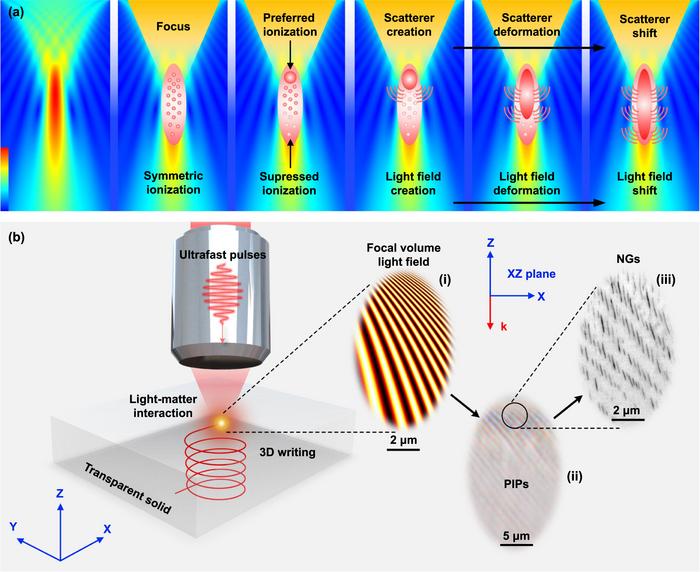
For a long time, an ultrafast laser has been applied as a point-typed energy source to trigger various material modifications, and the profile of light intensity is mainly considered a Gaussian type. Therefore, the actual morphology and evolution of the light field in the focal volume have been overlooked.
In International Journal of Extreme Manufacturing, researchers indicates that the 3D spatial distribution of the light field at the focus can possess finer structures and is tunable, which offers a novel strategy for highly controllable micro-nano fabrication with more degrees of freedom beyond conventional point-by-point optical modification.
It is proposed and experimentally demonstrated that the focal volume light fields induced during the ultrafast laser-matter interaction can be applied for highly integrated and controllable single-step composite structuring within the focus of a single-beam ultrafast laser.
The principles are confirmed to be highly universal and widely applicable in different types of transparent dielectrics and the fabricated composite structures are shown to hold great potential for multiple applications, such as multi-dimensional anti-counterfeit, information encryption, nonlinear planar lenses, and multi-functionally integrated photonic crystals.
"Creating different types of micro-nano structures in one step with a single-beam ultrafast laser is traditionally very difficult and even generally not within the scope of ultrafast laser direct writing because the typical light distribution is generally assumed as the Gaussian type in the focal volume," said Bo Zhang, first author on the paper and researcher in Zhejiang University. "
Can we control the microscopic optical behaviors of highly intense light-matter interaction in the focal volume at the micro-nano scale to make it possess tunable finer structures? If feasible, this would provide a novel strategy for highly controllable micro-nano fabrication with more degrees of freedom beyond conventional point-by-point optical modification."
Micro-nano structures lay at the heart of optical components for light manipulation in different dimensions. In particular, composite micro-nano structures constructed in 3D have been revealed to enable novel photonic devices with unprecedented control degrees of freedom over the state of electromagnetic waves and have emerged as a new research frontier in nanophotonic science and engineering.
Currently, the generation of composite micro-nano structures largely relies on complicated multi-step micro-nano machining processes where the integration of different structural characteristics remains limited. Fast construction of composite micro-nano structures with a higher level of integration in 3D space has long been a bottleneck due to the lack of effective fabrication approaches.
Ultrafast laser-matter interaction has become an excellent platform for preparing functional elements in transparent media. The researchers spent three years focusing on the ultrafast laser-induced focal volume light field and realized the generation, visualization, and manipulation of the focal volume light fields. They found that the focal volume light field can serve as a versatile tool for creating various advanced functional composite structures that are not achievable with traditional techniques and proposed the interference model of the focal volume light field.
The experimental results further confirmed that composite structuring based on focal volume optical printing can serve as a highly universal composite structuring method that enables the creation of composite structures in multiple transparent dielectrics with great potential in multiple aspects of photonics.
Reference
Focal volume optics for composite structuring in transparent solids
Bo Zhang, Zhuo Wang, Dezhi Tan, Min Gu, Yuanzheng Yue and Jianrong Qiu
https://iopscience.iop.org/article/10.1088/2631-7990/ad8712
International Journal of Extreme Manufacturing
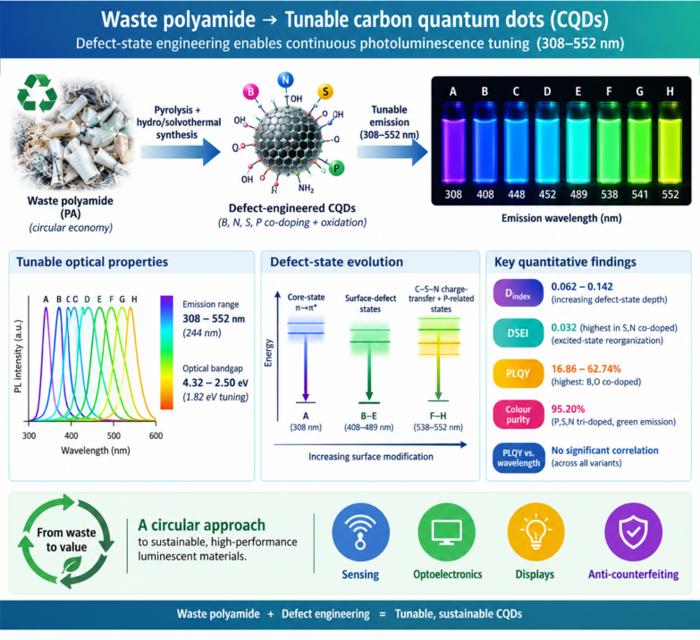
Waste polyamide-derived CQDs show continuous photoluminescence tuning from 308 to 552 nm through sequential defect-state engineering, with optical transition energies decreasing from 4.32 to 2.50 eV. @Christian Ebere Enyoh from Saitama University Carbon quantum dots (CQDs) are fluorescent carbon nanomaterials with potential applications in sensing, optoelectronics, displays, anti-counterfeiting, and environmental technologies. Their optical properties can be adjusted by modifying the carbon...
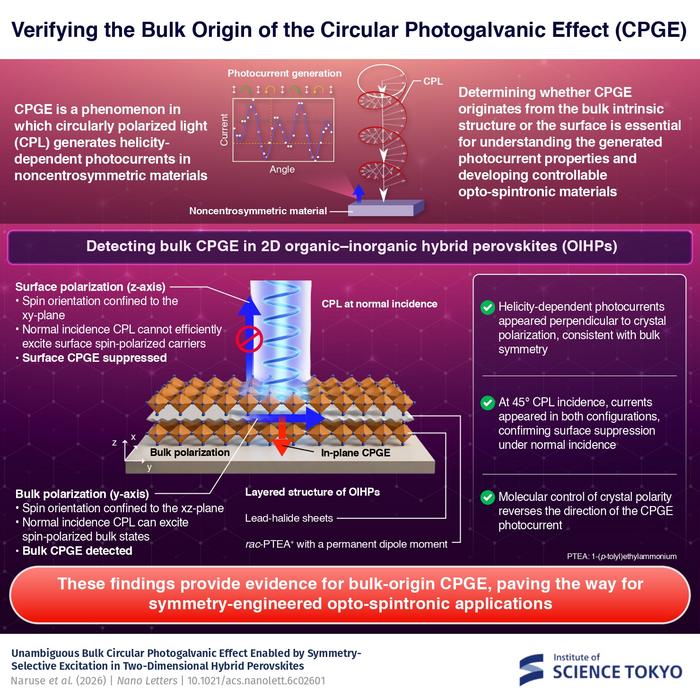
The researchers used circularly polarized light at normal incidence and found that helicity-dependent photocurrents appeared perpendicular to the crystal’s polarization but vanished when measured parallel to it, supporting a bulk origin of CPGE. @Institute of Science Tokyo The circular photogalvanic effect (CPGE), a phenomenon that generates helicity-dependent photocurrents in noncentrosymmetric materials, can originate purely from a crystal's internal structure without contribution from the...
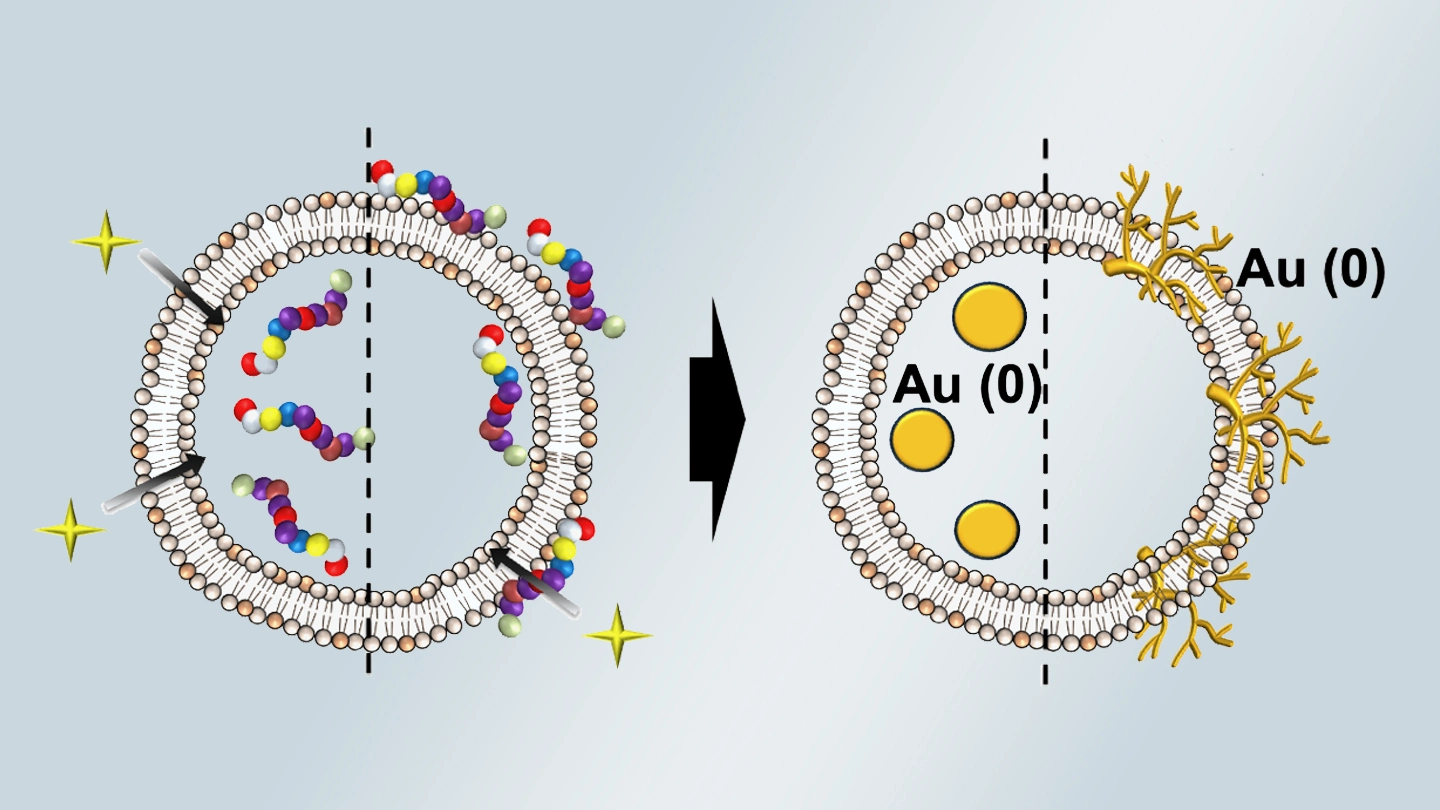
Summary of gold nanoparticle growth programming in liposome based on localization of biomineralization peptide The position of biomineralization peptides within liposomes can influence how gold nanoparticles grow, reports a research team from Institute of Science Tokyo. Peptides localized at the membrane interface promote branched structures, while those confined to the liposome interior favor spherical nanoparticles. The findings offer a new strategy for controlling nanoscale reaction...
