Technical University of Munich (TUM)
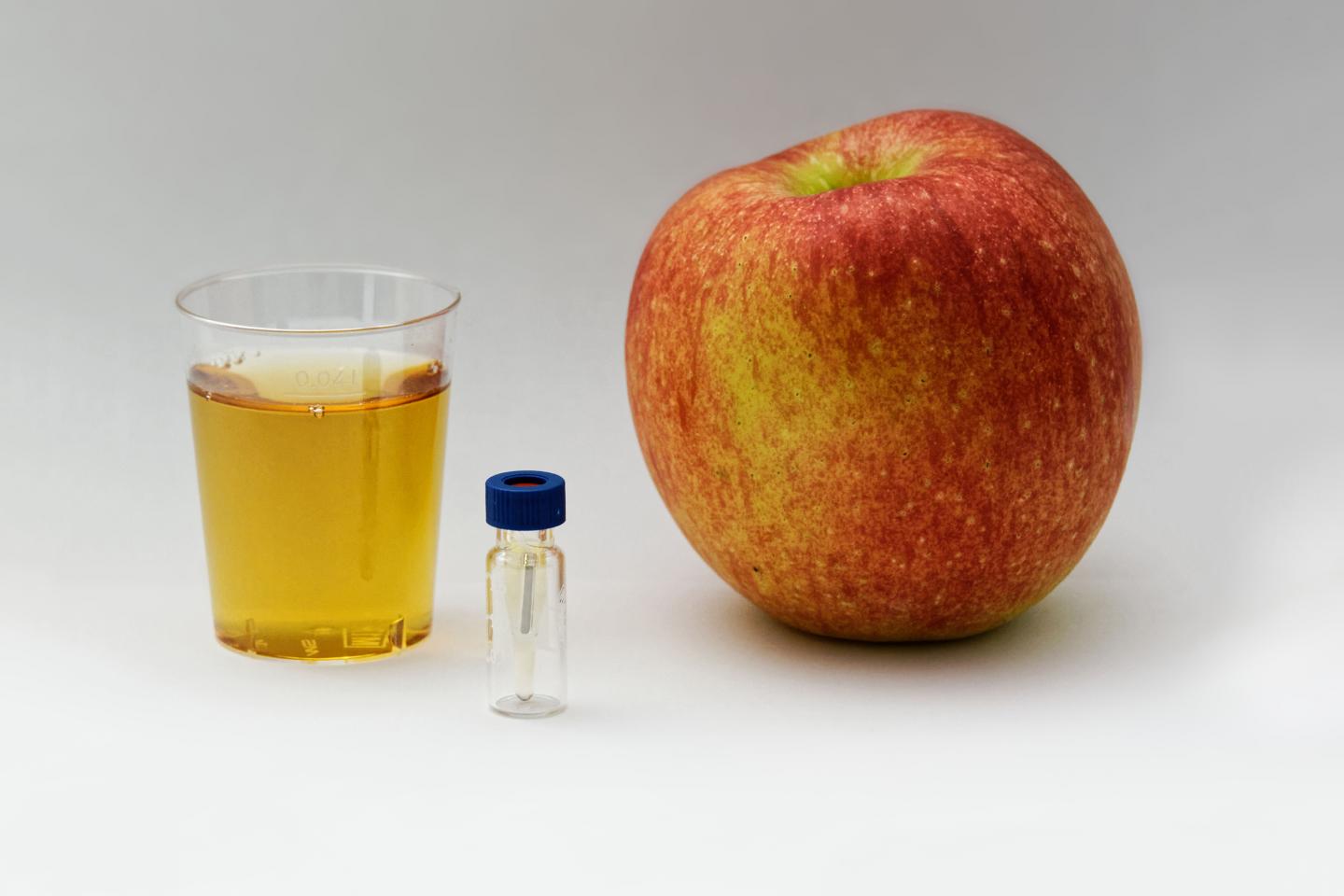
Scientists at the Technical University of Munich (TUM) and the Leibniz-Institute for Food Systems Biology have developed a new methodology for the simultaneous analysis of odorants and tastants. It could simplify and accelerate the quality control of food in the future.
Whether a food tastes good or not is essentially determined by the interaction of odors and tastants. A few trillionths of a gram per kilogram of food is enough to perceive some odorants. Tastants, on the other hand, we only recognize at significantly higher concentrations.
In order to guarantee consistent sensory quality, it is very important for manufacturers to know and control the characteristic odor and taste profiles of their products from the raw material to the finished product. This requires a fast but precise food analysis.
Tastants and aroma substances, however, differ greatly in their chemical and physical properties. As a result, food chemists currently use very different methods to determine the exact nature and quantity of odorants and tastants in a raw material or food. Especially aroma analyses are very time-consuming and therefore expensive. This limits the high-throughput analysis of numerous samples.
One methodical approach for two different substance classes
Thomas Hofmann, Director of the Leibniz-Institute for Food Systems Biology and Professor of Food Chemistry and Molecular Sensory Science at the TUM, explains: "We have now developed a new, innovative methodical approach that will enable us to examine food simultaneously for both odorants and tastants in a time-saving high-throughput process. It is based on an ultra-high performance liquid chromatography mass spectrometry (UHPLC-MS) method typically used for taste analysis.
The new and time-saving feature of the developed approach is that volatile odorous substances can now also be analyzed by means of an upstream enrichment or substance conversion step using this method, which is otherwise not used for aromatic substances.
Apple juice as a test object
"We have tested our new methodological approach using apple juice as an example. The results are very promising," says Andreas Dunkel, Senior Scientist at the Leibniz-Institute of Food Systems Biology. Together with doctoral student Christoph Hofstetter from the TUM, he was substantially involved in the development of the new approach.
According to the scientists, the new method makes it possible for the first time to analyze a large number of samples in a very short time with regard to their taste and odor giving ingredients.
Also suitable for food profiling
The researchers hope to be able to further develop the method so that it can be used by food manufacturers in the future to quickly and easily monitor the flavor of food along the entire value chain and, if necessary, optimize it.
Last but not least, the new method could also be used to stop food fraud. "Using the identified flavor profiles, it would be possible to check the origin and quality label of the manufacturers and detect food fraud," says food profiler and food chemist Andreas Dunkel.
Unified Flavor Quantitation: Toward High-Throughput Analysis of Key Food Odorants and Tastants by Means of Ultra-High-Performance Liquid Chromatography Tandem Mass Spectrometry
Christoph Konrad Hofstetter, Andreas Dunkel, Thomas Hofmann
J. Agric. Food Chem. July 9, 2019
Contact information:
Thomas Hofmann
Professor of Food Chemistry and Molecular Sensory Science at TUM
thomas.hofmann@tum.de
Tel: +49 8161 71-2902

Researchers led by Professor Jaeyune Ryu at Seoul National University identified local pH near electrodes as a decisive variable in organic electrosynthesis. By designing a reactor that narrows electrode spacing and flows electrolyte to counterbalance acidic and alkaline zones, they raised selectivity for lactones and epoxides, feedstocks for biodegradable plastics, polyurethanes, adhesives, and epoxy resins, from about 16% to 97% using only oxygen and electricity, eliminating added peroxide…

Silver nanoparticles with diameters of ~10 nm deliver the best performance as electrocatalysts. The silver particles are sprayed onto the electrode together with a conductive carbon powder. The ideal mixture consists of 20 per cent by mass silver and 80 per cent by mass carbon powder. This image was taken using a transmission electron microscope (TEM). © HZB Via electrolysis, CO₂ can be reduced to CO, a raw material for further chemical products such as fuels. Within the GreenQuest Project,...

A flexible metal–organic framework developed by researchers from Institute of Science Tokyo enables the structural determination of large "beyond rule of 5" molecules from microgram-scale samples. Using APF-40 as a crystalline sponge, the researchers determined the structures of 12 pharmaceutical-related molecules, including the 899 Da drug molecule doramectin and trace ivermectin derivatives. The method could aid drug discovery, natural products research, and the characterization of rare...






