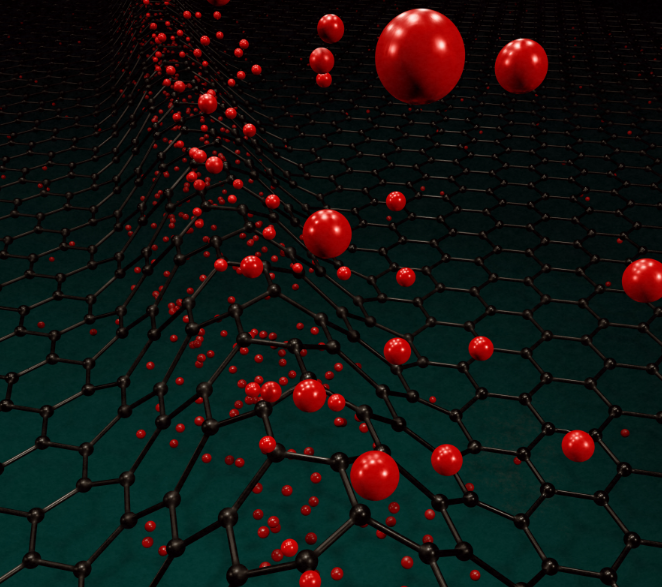
Researchers from The University of Manchester and the University of Warwick finally solved the long-standing puzzle of why graphene is so much more permeable to protons than expected by theory.
A decade ago, scientists at The University of Manchester demonstrated that graphene is permeable to protons, nuclei of hydrogen atoms. The unexpected result started a debate in the community because theory predicted that it would take billions of years for a proton to permeate through graphene’s dense crystalline structure. This had led to suggestions that protons permeate not through the crystal lattice itself, but through the pinholes in its structure.
Now, writing in Nature, a collaboration between the University of Warwick, led by Prof Patrick Unwin, and The University of Manchester, led by Dr Marcelo Lozada-Hidalgo and Prof Andre Geim, report ultra-high spatial resolution measurements of proton transport through graphene and prove that perfect graphene crystals are permeable to protons. Unexpectedly, protons are strongly accelerated around nanoscale wrinkles and ripples in the crystal.
The discovery has the potential to accelerate the hydrogen economy. Expensive catalysts and membranes, sometimes with significant environmental footprint, currently used to generate and utilise hydrogen could be replaced with more sustainable 2D crystals, reducing carbon emissions, and contributing to Net Zero through the generation of green hydrogen.
The team used a technique known as scanning electrochemical cell microscopy (SECCM) to measure minute proton currents collected from nanometre-sized areas. This allowed the researchers to visualise the spatial distribution of proton currents through graphene membranes. If proton transport took place through holes as some scientists speculated, the currents would be concentrated in a few isolated spots. No such isolated spots were found, which ruled out the presence of holes in the graphene membranes.
Drs Segun Wahab and Enrico Daviddi, leading authors of the paper, commented: “We were surprised to see absolutely no defects in the graphene crystals. Our results provide microscopic proof that graphene is intrinsically permeable to protons.”
Unexpectedly, the proton currents were found to be accelerated around nanometre-sized wrinkles in the crystals. The scientists found that this arises because the wrinkles effectively ‘stretch’ the graphene lattice, thus providing a larger space for protons to permeate through the pristine crystal lattice. This observation now reconciles the experiment and theory.
Dr Lozada-Hidalgo said: “We are effectively stretching an atomic scale mesh and observing a higher current through the stretched interatomic spaces in this mesh – mind-boggling.”
Prof Unwin commented: “These results showcase SECCM, developed in our lab, as a powerful technique to obtain microscopic insights into electrochemical interfaces, which opens up exciting possibilities for the design of next-generation membranes and separators involving protons.”
The authors are excited about the potential of this discovery to enable new hydrogen-based technologies.
Dr Lozada-Hidalgo said, "Exploiting the catalytic activity of ripples and wrinkles in 2D crystals is a fundamentally new way to accelerate ion transport and chemical reactions. This could lead to the development of low-cost catalysts for hydrogen-related technologies."
Reference
Proton transport through nanoscale corrugations in two-dimensional crystals
O. J. Wahab, E. Daviddi, B. Xin, P. Z. Sun, E. Griffin, A. W. Colburn, D. Barry, M. Yagmurcukardes, F. M. Peeters, A. K. Geim, M. Lozada-Hidalgo & P. R. Unwin
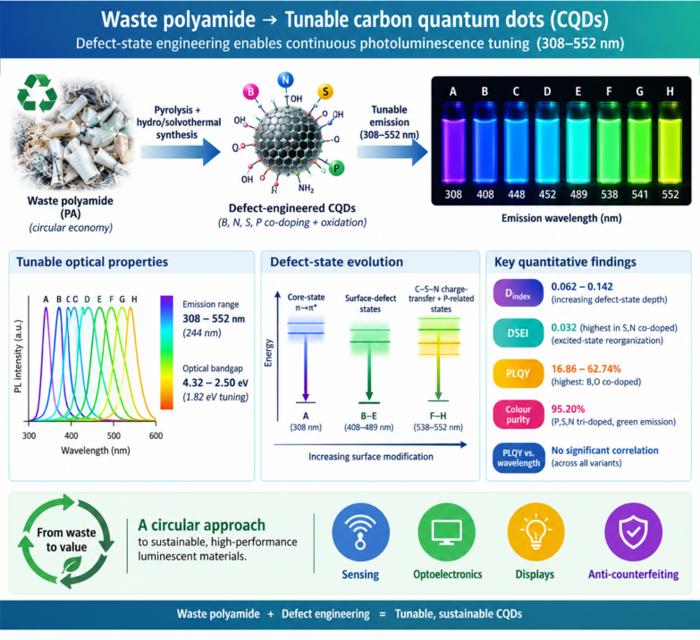
Waste polyamide-derived CQDs show continuous photoluminescence tuning from 308 to 552 nm through sequential defect-state engineering, with optical transition energies decreasing from 4.32 to 2.50 eV. @Christian Ebere Enyoh from Saitama University Carbon quantum dots (CQDs) are fluorescent carbon nanomaterials with potential applications in sensing, optoelectronics, displays, anti-counterfeiting, and environmental technologies. Their optical properties can be adjusted by modifying the carbon...
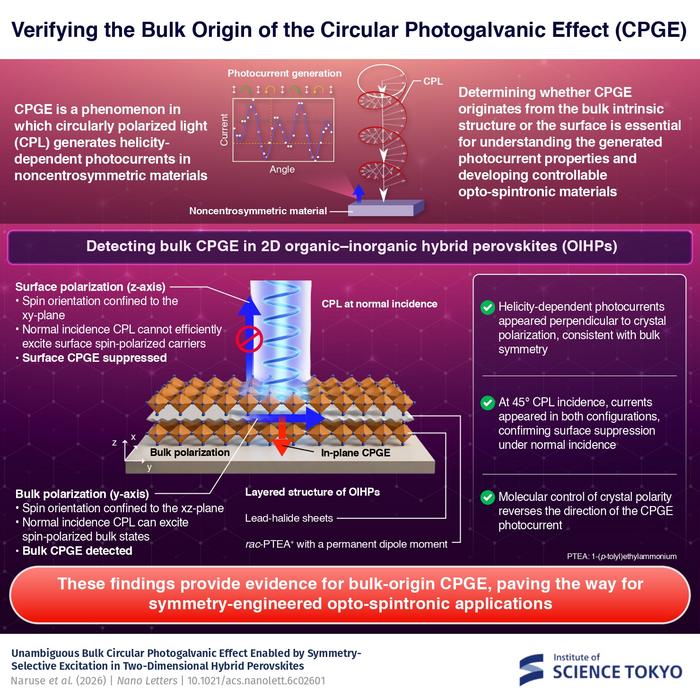
The researchers used circularly polarized light at normal incidence and found that helicity-dependent photocurrents appeared perpendicular to the crystal’s polarization but vanished when measured parallel to it, supporting a bulk origin of CPGE. @Institute of Science Tokyo The circular photogalvanic effect (CPGE), a phenomenon that generates helicity-dependent photocurrents in noncentrosymmetric materials, can originate purely from a crystal's internal structure without contribution from the...
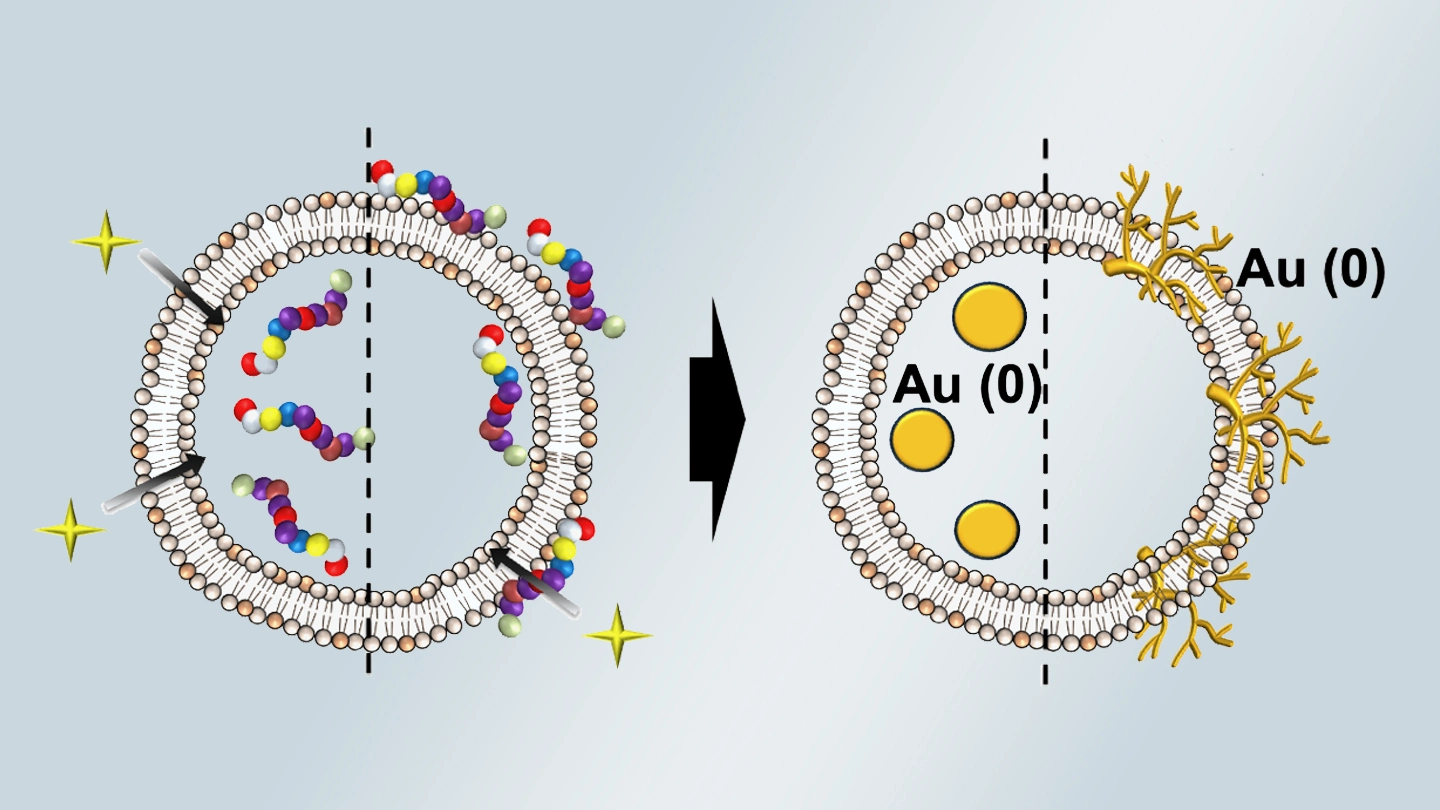
Summary of gold nanoparticle growth programming in liposome based on localization of biomineralization peptide The position of biomineralization peptides within liposomes can influence how gold nanoparticles grow, reports a research team from Institute of Science Tokyo. Peptides localized at the membrane interface promote branched structures, while those confined to the liposome interior favor spherical nanoparticles. The findings offer a new strategy for controlling nanoscale reaction...
