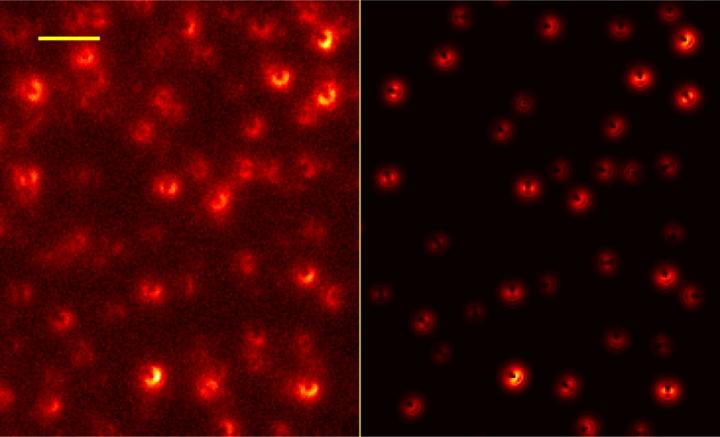
Researchers at the University of Göttingen have developed a new method that takes advantage of the unusual properties of graphene to electromagnetically interact with fluorescing (light-emitting) molecules. This method allows scientists to optically measure extremely small distances, in the order of 1 ångström (one ten-billionth of a meter) with high accuracy and reproducibility for the first time. This enabled researchers to optically measure the thickness of lipid bilayers, the stuff that makes the membranes of all living cells. The results were published in Nature Photonics.
Researchers from the University of Göttingen led by Professor Enderlein used a single sheet of graphene, just one atom thick (0.34 nm), to modulate the emission of light-emitting (fluorescent) molecules when they came close to the graphene sheet. The excellent optical transparency of graphene and its capability to modulate through space the molecules' emission made it an extremely sensitive tool for measuring the distance of single molecules from the graphene sheet. The accuracy of this method is so good that even the slightest distance changes of around 1 ångström (this is about the diameter of an atom or half a millionth of a human hair) can be resolved. The scientists were able to show this by depositing single molecules above a graphene layer. They could then determine their distance by monitoring and evaluating their light emission. This graphene-induced modulation of molecular light emission provides an extremely sensitive and precise "ruler" for determining single molecule positions in space. They used this method to measure the thickness of single lipid bilayers which are constituted of two layers of fatty acid chain molecules and have a total thickness of only a few nanometers (1 billionth of a meter).
"Our method has enormous potential for super-resolution microscopy because it allows us to localise single molecules with nanometre resolution not only laterally (as with earlier methods) but also with similar accuracy along the third direction, which enables true three-dimensional optical imaging on the length scale of macromolecules," says Arindam Ghosh, the first author of the paper.
"This will be a powerful tool with numerous applications to resolve distances with sub-nanometer accuracy in individual molecules, molecular complexes, or small cellular organelles," adds Professor Jörg Enderlein, the publication's corresponding author and head of the Third Institute of Physics (Biophysics) where the work took place.
Original publication: Arindam Ghosh et al, 'Graphene-based metal-induced energy transfer for sub-nanometre optical localization, Nature Photonics, DoI: 10.1038/s41566-019-0510-7
Contact:
Professor Jörg Enderlein
University of Göttingen
Biophysics / Complex Systems
Friedrich-Hund-Platz 1, 37077 Göttingen
Tel: +49-(0)551-39 26908
Email: joerg.enderlein@phys.uni-goettingen.de
https://www.uni-goettingen.de/en/102461.html
Arindam Ghosh
University of Göttingen
Biophysics / Complex Systems
Friedrich-Hund-Platz 1, 37077 Göttingen
Tel: +49-(0)551-39 26908
Email: arindam.ghosh@phys.uni-goettingen.de
https://www.uni-goettingen.de/de/people/513422.html

Researchers led by Professor Jaeyune Ryu at Seoul National University identified local pH near electrodes as a decisive variable in organic electrosynthesis. By designing a reactor that narrows electrode spacing and flows electrolyte to counterbalance acidic and alkaline zones, they raised selectivity for lactones and epoxides, feedstocks for biodegradable plastics, polyurethanes, adhesives, and epoxy resins, from about 16% to 97% using only oxygen and electricity, eliminating added peroxide…

Silver nanoparticles with diameters of ~10 nm deliver the best performance as electrocatalysts. The silver particles are sprayed onto the electrode together with a conductive carbon powder. The ideal mixture consists of 20 per cent by mass silver and 80 per cent by mass carbon powder. This image was taken using a transmission electron microscope (TEM). © HZB Via electrolysis, CO₂ can be reduced to CO, a raw material for further chemical products such as fuels. Within the GreenQuest Project,...

A flexible metal–organic framework developed by researchers from Institute of Science Tokyo enables the structural determination of large "beyond rule of 5" molecules from microgram-scale samples. Using APF-40 as a crystalline sponge, the researchers determined the structures of 12 pharmaceutical-related molecules, including the 899 Da drug molecule doramectin and trace ivermectin derivatives. The method could aid drug discovery, natural products research, and the characterization of rare...






