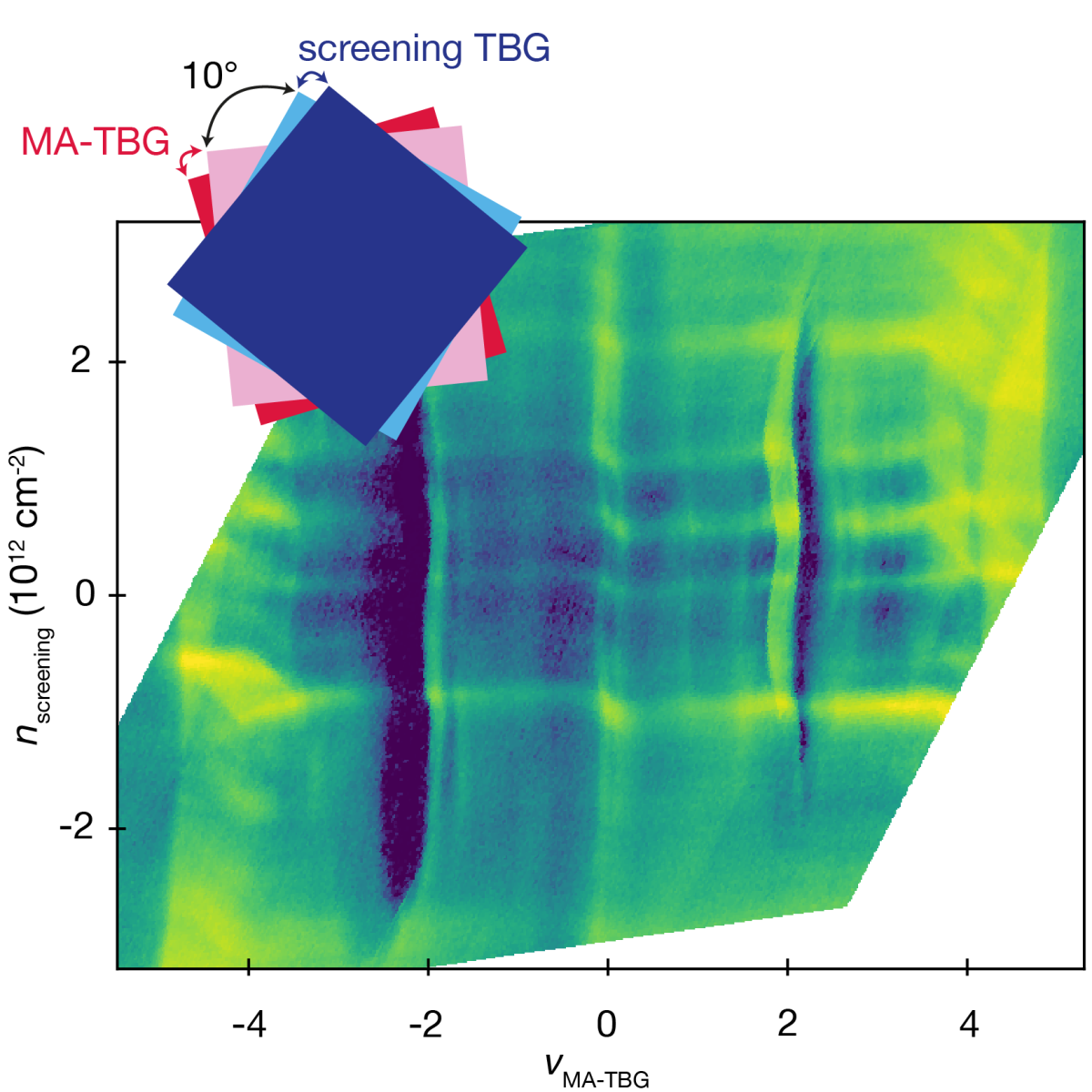
Scientists from the National Graphene Institute at The University of Manchester have demonstrated that superconductivity in magic-angle graphene can be completely switched off by screening interactions between electrons. The finding provides strong evidence that electron interactions play a central role in the phenomenon and helps address a key question that has remained unresolved since superconductivity was first discovered in the material.
In the new study, published in Physical Review X, researchers developed a graphene device that allowed them to test this question directly. The device consisted of two twisted graphene bilayers separated by less than a nanometre but kept electronically separate. This design enabled the team to weaken interactions between electrons in the magic-angle graphene layer and observe how superconductivity responded. The international collaboration involved researchers from the National Graphene Institute, the Henry Royce Institute, Washington University in St Louis, the University of Pennsylvania, the University of Antwerp, Japan’s National Institute for Materials Science and the National University of Singapore.
Magic-angle twisted bilayer graphene, created by stacking two sheets of graphene with a rotational offset of approximately 1.1 degrees, has become one of the most intensely studied quantum materials over the past decade. However, researchers have continued to debate what causes its superconductivity. While some theories propose that electrons themselves drive the pairing responsible for superconductivity, others suggest a more conventional mechanism involving vibrations of the atomic lattice.
Dr Julien Barrier, the lead author of the study, explained: “To make a difference, we had to solve two issues. First, to build a device in which the screening layer sits extremely close, a fraction of a nanometre, to the superconducting graphene while remaining electronically separate. Second, we had to make that screening layer tuneable. To this effect, we used a twisted graphene bilayer in atomic contact to the magic-angle graphene”.
Professor Alexey Berdyugin from the National University of Singapore, the corresponding author of this study, added: “When we switched on the screening, we were surprised to find that superconductivity was completely suppressed. This provides clear experimental evidence that superconductivity in this system originates from strong electron-electron interactions. This behaviour offers a new opportunity to better understand the mechanisms underlying superconductivity in other materials with strong electronic interactions, including high-temperature superconductors.”
Professor Sir Andre Geim, the corresponding author of this work, said: "Personally, I am interested only in high-temperature superconductivity – preferably at room temperature or above. This study was done at temperatures so low that even helium turns liquid. But unless we understand what makes superconductivity work, we are unlikely ever to reach room-temperature superconductivity, let alone make this remarkable phenomenon commercially useful. Our study takes only a tiny step - but still a step - in that direction, helping to nail down the mechanism of exotic superconductivity in graphene. Rome was not built in a day.”
The team found that increasing the carrier density in the neighbouring graphene bilayer progressively weakened superconductivity in the adjacent magic-angle graphene. At sufficiently high carrier densities, superconductivity was completely suppressed.
The researchers also observed that correlated insulating states, another characteristic feature of magic-angle graphene, disappeared under the same conditions. Measurements showed that the superconducting critical temperature could be reduced by more than an order of magnitude through screening.
The effect was substantially stronger than reported in earlier screening experiments. According to the researchers, the enhanced response resulted from the exceptionally small separation between the superconducting layer and the screening layer, allowing Coulomb interactions to be modified much more effectively.
To understand the observations, the team compared the experimental results with theoretical modelling. Conventional phonon-mediated superconductivity would be expected to remain largely unchanged or increase slightly when Coulomb interactions are screened. Instead, the researchers observed the opposite behaviour, indicating that conventional phonon pairing does not explain the superconductivity in this class of materials.
While the authors emphasise that the work does not identify a single definitive pairing mechanism, several unconventional theories remain consistent with the results, including mechanisms based on collective electronic interactions. However, the findings place much tighter constraints on future theories seeking to explain superconductivity in magic-angle graphene.
Professor Berdyugin concludes: “In this study, we introduced a method for screening electron-electron interactions over scales as short as 0.3 nm, which turned out to be crucial for controlling superconductivity in magic-angle graphene. We anticipate that this unprecedented level of short-range screening could also help clarify many other debated phenomena.”
Reference
Coulomb Screening of Superconductivity in Magic-Angle Graphene
Julien Barrier, Liangtao Peng, Shuigang Xu, Christophe De Beule, V. I. Fal’ko, K. Watanabe, T. Tanigushi, A. K. Geim, Shaffique Adam, and Alexey I. Berdyugin
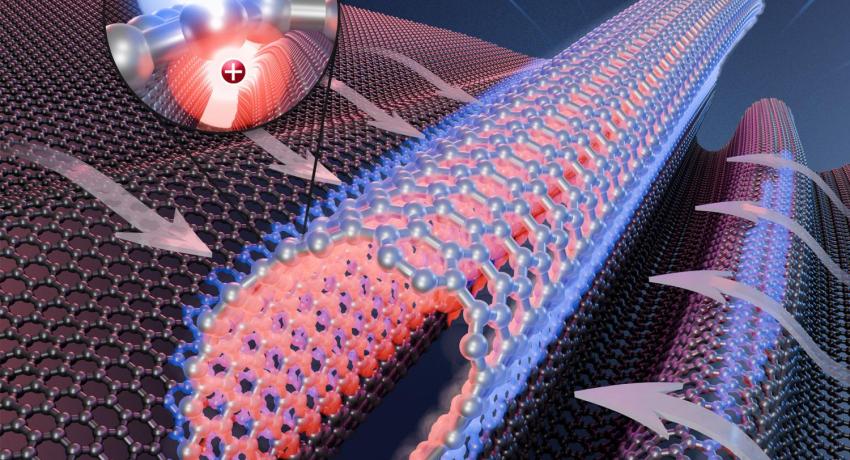
Researchers have shown that tiny wrinkles in graphene can change the material’s electrical properties. By harnessing this characteristic, scientists may one day control electricity in atomically thin materials — such as graphene — by changing their shape instead of adding new chemicals or materials, potentially powering more responsive sensors and ultrathin electronic devices. Credit: Mario Norton/Rice University. All Rights Reserved. Tiny wrinkles could reveal new behaviors in graphene, an...
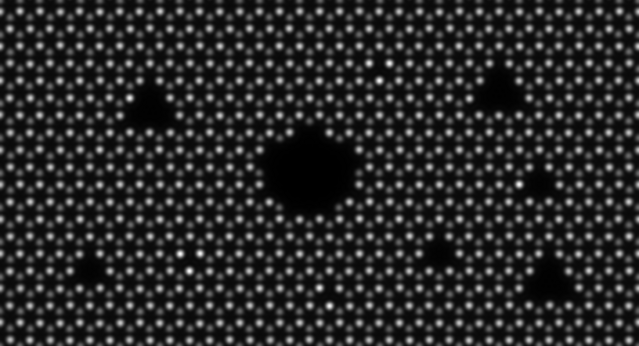
A simulated microscopy image of hexagonal boron nitride with a circular pore surrounded by triangular ones. Darker circles correspond to individual boron and brighter circles to nitrogen atoms. A research team at the University of Vienna led by physicist Jani Kotakoski demonstrates how the shape of nanopores in hexagonal boron nitride - the electrically insulating counterpart to graphene, also known as "white graphene" - can be precisely controlled at the atomic level. Electron irradiation in...
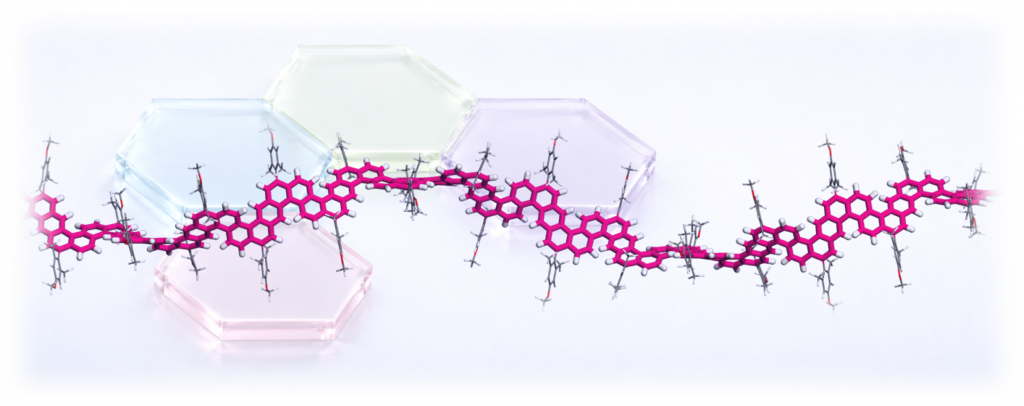
Four-ring helicene units were too unstable to control, so chemists had written them off for chiral materials. Scientists found a way to lock them into place and then switch their twist with a natural solvent. Researchers at Nagoya University have built a graphene nanoribbon that can switch which way it twists using a natural solvent. Graphene nanoribbons are thin ribbon-shaped structures made of fused carbon rings. Twisted or helical versions of these ribbons show promise for advanced light...
