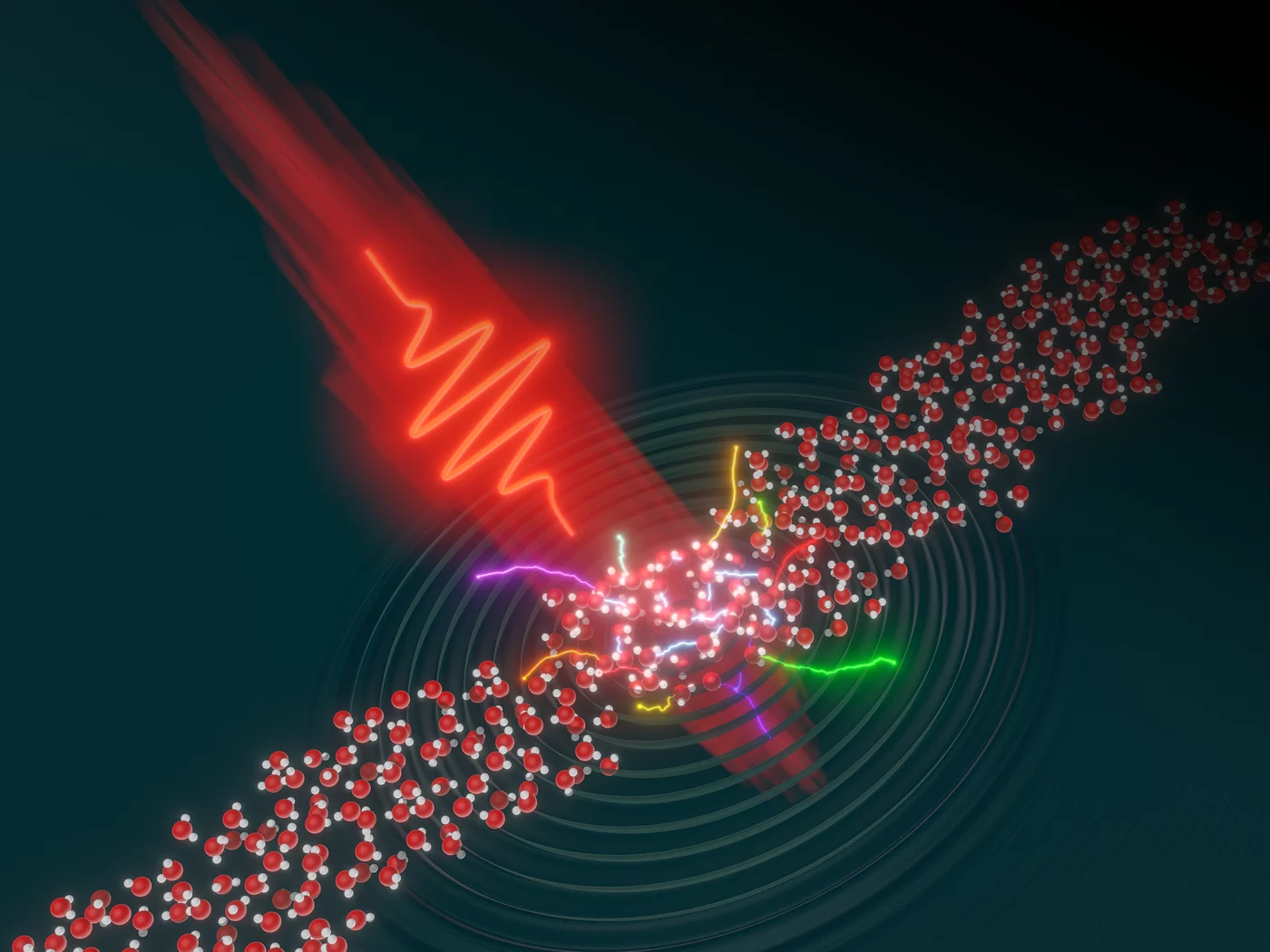
The behavior of electrons in liquids determines a vast range of chemical processes and thus essential processes in organisms and the world as a whole. But electron movements are extremely hard to capture because they take place within attoseconds: the realm of quintillionths of a second. Since advanced lasers now operate at these timescales, they can offer scientists glimpses of these ultrafast processes via a range of techniques.
An international team of researchers from the Max Planck Institute for the Structure and Dynamics of Matter (MPSD) in Hamburg and ETH Zurich has now demonstrated that it is possible to probe electron dynamics in liquids using intense laser fields and to retrieve the electron mean free path – the average distance an electron can travel before colliding with another particle. They found that the mechanism by which liquids emit a particular light spectrum known as the high-harmonic spectrum is markedly different from the one in other phases of matter like gases and solids. The team’s findings open the door to a deeper understanding of ultrafast dynamics in liquids.
Using intense laser fields to generate high-energy photons, known as high-harmonic generation (HHG), is a widespread technique routinely deployed in many different areas of science, for instance for probing electronic motion in materials, or tracking chemical reactions in time. HHG has been studied extensively in gases and, more recently, in crystals but to date much less is known about this phenomenon in liquids.
Now the Swiss-German research team reports in Nature Physics how it demonstrated the unique behavior of liquids when irradiated by intense lasers. So far, almost nothing is known about these light-induced processes in liquids – a stark contrast to the recent scientific progress on how solids in particular behave under irradiation. Hence the experimental team at ETH Zurich developed a unique apparatus to specifically study the interaction of liquids with intense lasers. The researchers discovered a distinctive behavior where the maximum photon energy obtained through HHG in liquids is independent of the laser’s wavelength. So which factor is responsible for this upper limit instead?
That is the question the MPSD Theory group set out to solve. Crucially, the Hamburg researchers identified a connection that had not been uncovered so far. "The distance an electron can travel in the liquid before colliding with another particle is the crucial factor which imposes a ceiling on the photon energy,” said MPSD researcher Nicolas Tancogne-Dejean, a co-author of the study. “We were able to retrieve this quantity – known as the effective electron mean free path – from the experimental data thanks to a specifically developed analytical model which accounts for the scattering of the electrons.”
By combining the experimental and theoretical results in their study of HHG in liquids, the scientists not only pinpointed the key factor which determines the maximum photo energy, but they also performed the first experiment of high-harmonic spectroscopy in liquids. At low kinetic energy, the region probed experimentally in this study, the effective mean free path of the electrons is very hard to measure. Therefore, the work by the ETZ Zurich / MPSD team establishes HHG as a new spectroscopical tool to study liquids and is therefore an important stepping stone in the quest to understand the dynamics of electrons in liquids.
Reference
High-harmonic spectroscopy of low-energy electron-scattering dynamics in liquids
Angana Mondal, Ofer Neufeld, Zhong Yin, Zahra Nourbakhsh, Vít Svoboda, Angel Rubio, Nicolas Tancogne-Dejean & Hans Jakob Wörner
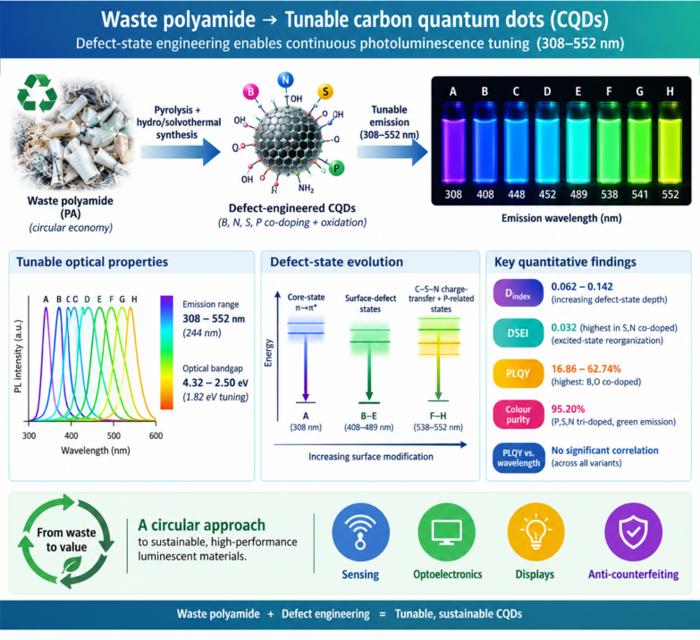
Waste polyamide-derived CQDs show continuous photoluminescence tuning from 308 to 552 nm through sequential defect-state engineering, with optical transition energies decreasing from 4.32 to 2.50 eV. @Christian Ebere Enyoh from Saitama University Carbon quantum dots (CQDs) are fluorescent carbon nanomaterials with potential applications in sensing, optoelectronics, displays, anti-counterfeiting, and environmental technologies. Their optical properties can be adjusted by modifying the carbon...
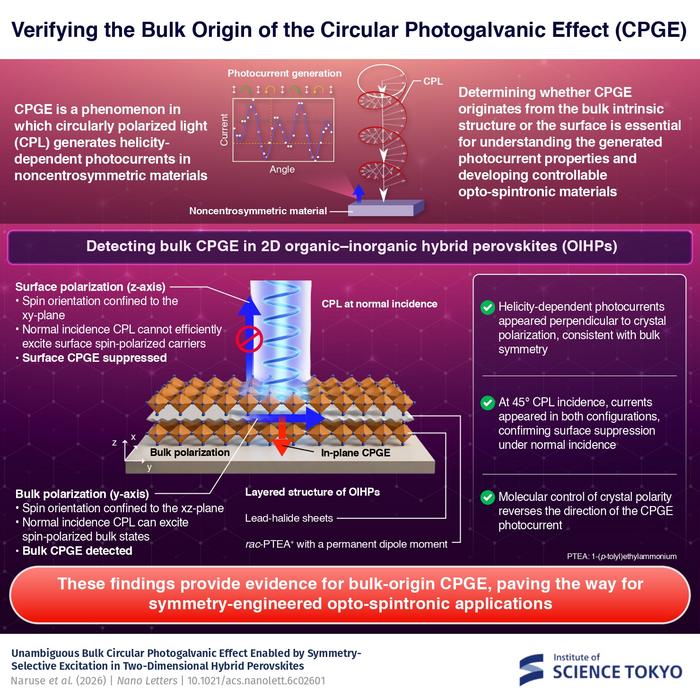
The researchers used circularly polarized light at normal incidence and found that helicity-dependent photocurrents appeared perpendicular to the crystal’s polarization but vanished when measured parallel to it, supporting a bulk origin of CPGE. @Institute of Science Tokyo The circular photogalvanic effect (CPGE), a phenomenon that generates helicity-dependent photocurrents in noncentrosymmetric materials, can originate purely from a crystal's internal structure without contribution from the...
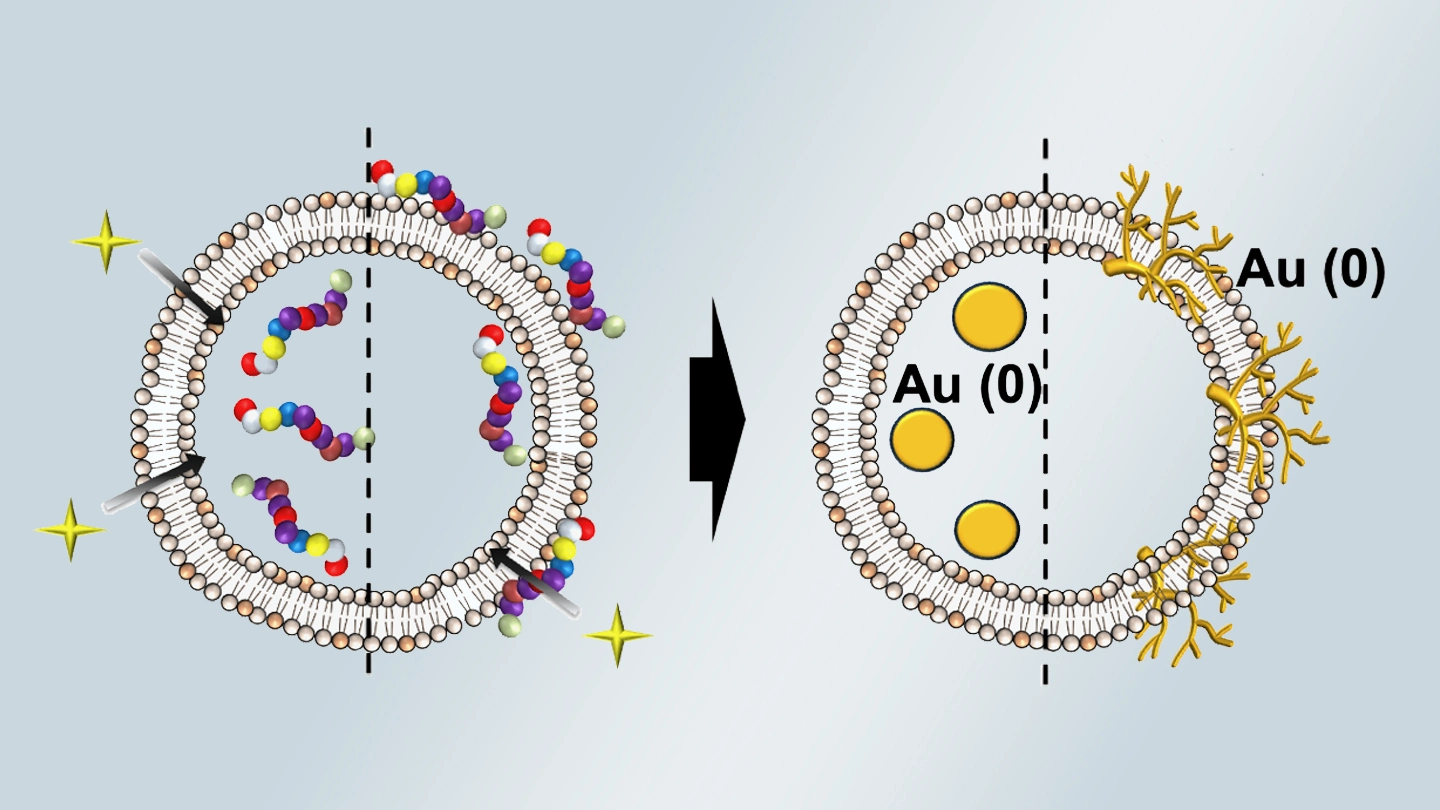
Summary of gold nanoparticle growth programming in liposome based on localization of biomineralization peptide The position of biomineralization peptides within liposomes can influence how gold nanoparticles grow, reports a research team from Institute of Science Tokyo. Peptides localized at the membrane interface promote branched structures, while those confined to the liposome interior favor spherical nanoparticles. The findings offer a new strategy for controlling nanoscale reaction...
