Max Planck Institute of Quantum Optics
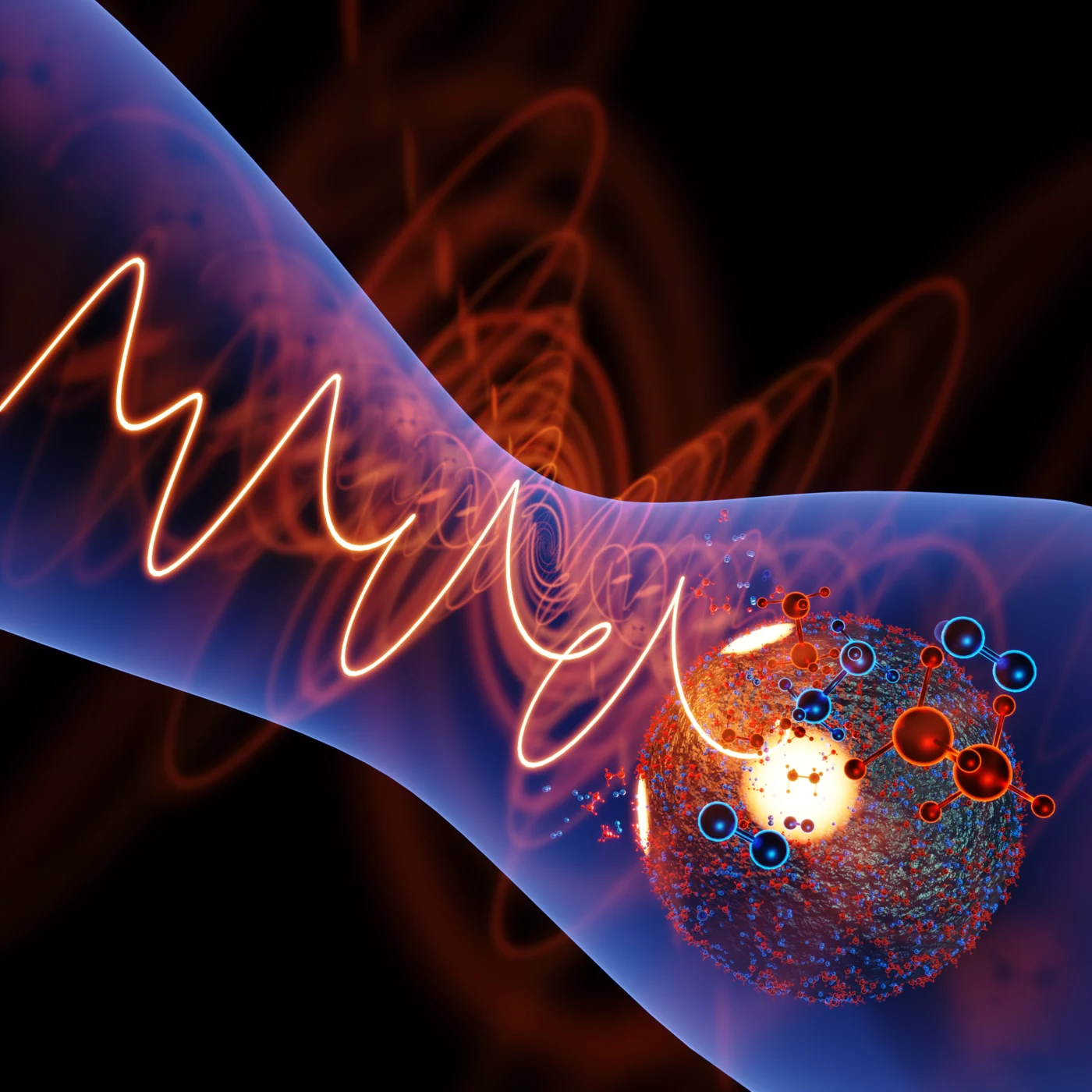
Controlling strong electromagnetic fields on nanoparticles is the key to triggering targeted molecular reactions on their surfaces. Such control over strong fields is achieved via laser light. Although laser-induced formation and breaking of molecular bonds on nanoparticle surfaces have been observed in the past, nanoscopic optical control of surface reactions has not yet been achieved. An international team led by Dr. Boris Bergues and Prof. Matthias Kling at Ludwig-Maximilians-Universität (LMU) and the Max Planck Institute of Quantum Optics (MPQ) in collaboration with Stanford University has now closed this gap. The physicists determined for the first time the location of light-induced molecular reactions on the surface of isolated silicon dioxide nanoparticles using ultrashort laser pulses.
There is hustle and bustle on the surface of nanoparticles. Molecules dock, dissolve and change their location. All this drives chemical reactions, changes matter and even gives rise to new materials. The events in the nanocosmos can be controlled with the help of electromagnetic fields. This has now been demonstrated by a team led by Dr. Boris Bergues and Prof. Matthias Kling from the Ultrafast Electronics and Nanophotonics Group. To this end, the researchers used strong, femtosecond-laser pulses to generate localized fields on the surfaces of isolated nanoparticles. A femtosecond is one millionth of a billionth of a second.
Using so-called reaction nanoscopy, a new technique recently developed in the same group, the physicists were able to image the reaction site and birthplace of molecular fragments on the surface of silica nanoparticles - at a resolution better than 20 nanometers. The nanoscopic spatial control, achievable at even higher resolution, was brought about by the scientists by superimposing the fields of two laser pulses with different color, and controlled waveform and polarization. Thereby, they had to set the time delay between the two pulses with attosecond accuracy. An attosecond is still a thousand times shorter than a femtosecond. When interacting with this tailored light, the surface of the nanoparticles and the molecules adsorbed there were ionized at targeted sites, leading to the dissociation of the molecules into different fragments.
"Molecular surface reactions on nanoparticles play a fundamental role in nanocatalysis. They could be a key to clean energy production, in particular via photocatalytic water splitting," explains Matthias Kling. "Our results also pave the way for tracking photocatalytic reactions on nanoparticles not only with nanometer spatial resolution, but also with femtosecond temporal resolution. This will provide detailed insights into the surface processes on the natural spatial and temporal scales of their dynamics," adds Boris Bergues.
The scientists anticipate that this promising new approach can be applied to numerous complex isolated nanostructured materials.
Reference
All-optical nanoscopic spatial control of molecular reaction yields on nanoparticles
Wenbin Zhang, Ritika Dagar, Philipp Rosenberger, Ana Sousa-Castillo, Marcel Neuhaus, Weiwei Li, Sharjeel A. Khan, Ali S. Alnaser, Emiliano Cortes, Stefan A. Maier, Cesar Costa-Vera, Matthias F. Kling, and Boris Bergues
https://opg.optica.org/optica/fulltext.cfm?uri=optica-9-5-551&id=472893

Cornell and Pacific Northwest National Laboratory researchers have developed a predictive model for how crystals such as calcite incorporate silica nanoparticles, revealing that the energy needed to cross water layers at the crystal surface strongly governs uptake, and that amines rather than carboxylic acids bind best.

A polymer hydrogel that grows stronger under repeated bending and strain has been developed by chemists, who report the material survived 10,000 bending cycles in tests on a knee-like joint. Made from a biodegradable blend of sugar crystals and polyethylene glycol, the 3D printable material uses sliding cyclodextrin rings to reinforce stressed regions, mimicking collagen.
Rigaku has introduced the PhotonJetMAX-S microfocus sealed-tube X-ray source for the XtaLAB Synergy-S, delivering more than twice the diffracted intensity of the PhotonJet-S at a peak power of 50 W.
This week in nanotech
$18.9M raised
4 funding rounds · 31 deals tracked
New products
 Ti-WCMBN Nanomaterialia Featured
 Nion-compatible In Situ STEM Holders for Electrical BiasingHummingbird Scientific Featured
 PKVH / PKVL ZAxis With an opening modelTHK PRECISION CO.,LTD.
Market insights
Last 30 days: Semiconductors & Electronics was the busiest vertical: 52 of 170 events (31%).
Money raised per month