Light controls the separation of ions
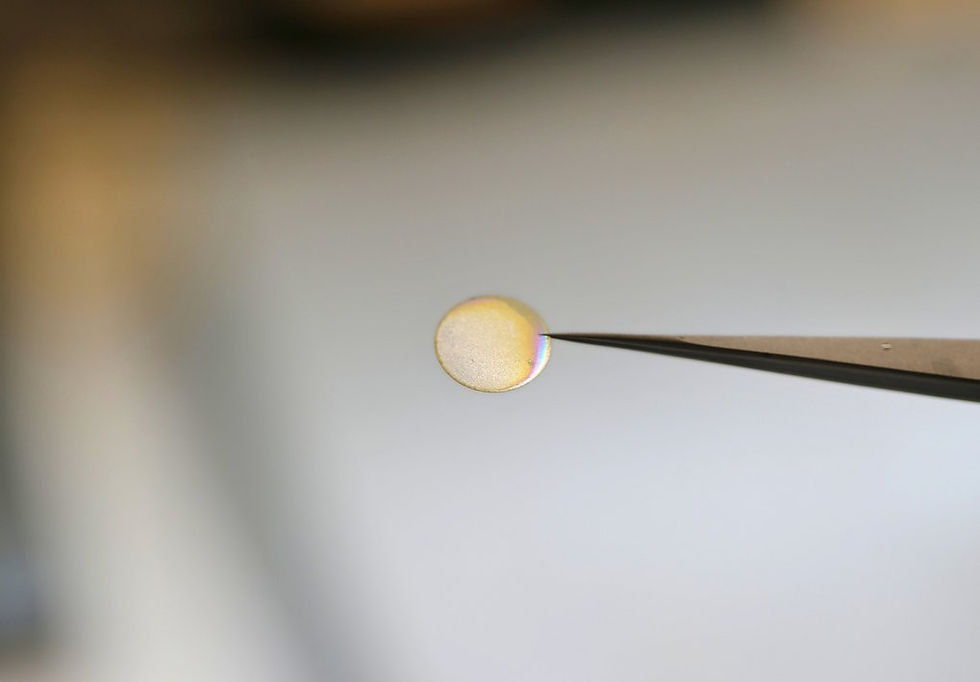
A newly developed membrane makes it possible to selectively influence the permeability of ions using light and an electrical voltage.
Lithium, magnesium, potassium and many other ions usually occur together in natural and technical solutions. Separating them from one another in a targeted manner is a challenge, for example, in the extraction and processing of raw materials. Researchers at the Max Planck Institute of Colloids and Interfaces and the University of Alberta in Canada have now developed a membrane whose ability to separate ions can be modulated using light and an electric field. Under the conditions studied, the membrane transported lithium ions more than 200 times preferentially than magnesium ions. For potassium ions, this ratio was over 500. The results have now been published in Angewandte Chemie.
How ions move through the membrane
Membranes contain tiny channels through which certain ions can pass more easily than others. However, in complex systems such as brines, ion separation is more challenging. Ions are surrounded by water molecules that form a so-called hydration shell, whose size and strength vary between ions. These differences strongly influence how easily individual ions can pass through narrow nanoscale channels.
Monovalent ions such as lithium (Li⁺) or potassium (K⁺) carry a single positive charge, whilst magnesium (Mg²⁺) carries two positive charges. Due to their differing hydration and their interactions with the charged nanochannels, the ions move at different speeds. The researchers are exploiting this difference to separate monovalent and divalent ions from one another.
A multi-layered membrane
The researchers developed a hierarchically structured membrane comprising three components. Anodic aluminium oxide with aligned nanochannels serves as the substrate. On top of this is a thin layer of carbon nitride, which is the photoactive component. The third layer consists of a poly(ionic liquid), which is applied to the carbon nitride layer and forms the membrane’s positively charged surface.
The carbon nitride makes it possible to influence ion transport from the outside. By illuminating the membrane whilst simultaneously applying an electric bias, the electrical conditions within the charged nanochannels change. This allows control over which ions can pass through the membrane.
“The membrane functions, in a sense, like a controllable filter,” says Enis Oğuzhan Eren, first author of the study. “Using light and an electric field, we can influence which ions are preferentially allowed to pass through the nanochannels.”
Light enhances ion separation
The researchers investigated the extent of this effect using, amongst other things, lithium and magnesium ions. Even without external stimuli, the membrane showed a preference for monovalent ions over divalent ones.
By combining light irradiation with an applied voltage, the ion selectivity was significantly enhanced, reaching approximately 228 for lithium over magnesium and 560 for potassium over magnesium, in complex multi-ion solutions.
A principle for controllable ion transport
The results show that the transport of ions through nanoscale membranes can be influenced not only by the chemical composition and structure of the material. Light and electrical voltage can also be used to alter the interactions within the channels and thus specifically regulate the transport of different ions.
“Our results show that ion transport in nanoscale channels can be dynamically controlled,” says Paolo Giusto, Group Leader at the Max Planck Institute of Colloids and Interfaces and Principal Investigator for the bilateral collaborative project. “This lays the foundation for membranes whose separation properties can be influenced by means of light illumination.”
In the long term, this principle could be of interest for applications in which specific ions need to be selectively separated from complex solutions. These include, for example, processes for the treatment and recovery of raw materials. The separation of lithium and magnesium is particularly relevant for lithium extraction, as magnesium can complicate the separation process when treating lithium-containing solutions.
Reference Hierarchical membrane for photoelectrostatically gated monovalent‐divalent ion separation
E. O. Eren, X. Xie, Z. Li, und P. Giusto