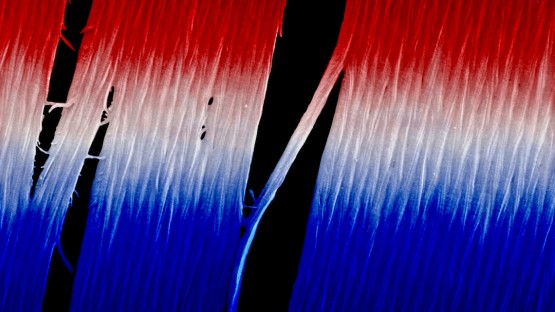
Cornell scientists have developed a novel technique to transform symmetrical semiconductor particles into intricately twisted, spiral structures – or “chiral” materials – producing films with extraordinary light-bending properties.
The discovery, detailed in a paper publishing Jan. 31 in the journal Science, could revolutionize technologies that rely on controlling light polarization, such as displays, sensors and optical communications devices.
Chiral materials are special because they can twist light. One way to create them is through exciton-coupling, where light excites nanomaterials to form excitons that interact and share energy with each other. Historically, exciton-coupled chiral materials were made from organic, carbon-based molecules. Creating them from inorganic semiconductors, prized for their stability and tunable optical properties, has proven exceptionally challenging due to the precise control needed over nanomaterial interactions.
Scientists from the lab of Richard D. Robinson, associate professor of materials science and engineering in Cornell Engineering and senior author of the study, overcame this challenge by employing “magic-sized clusters” made from cadmium-based semiconductor compounds. Magic-sized clusters are unique nanoparticles because they are identical copies of each other, existing only in discrete sizes, unlike many nanoparticles that can vary continuously in size. Previous research by the Robinson Group reported that when the nanoclusters were processed into thin films, they demonstrated circular dichroism, a key signature of chirality.
“Circular dichroism means the material absorbs left-handed and right-handed circularly polarized light differently, like how screw threads dictate which way something twists,” Robinson explained. “We realized that by carefully controlling the film’s drying geometry, we could control its structure and its chirality. We saw this as an opportunity to bring a property usually found in organic materials into the inorganic world.”
The researchers used meniscus-guided evaporation to twist linear nanocluster assemblies into helical shapes, forming homochiral domains several square millimeters in size. These films exhibit an exceptionally large light-matter response, surpassing previously reported record values for inorganic semiconductor materials by nearly two orders of magnitude.
“I’m excited about the versatility of the method, which works with different nanocluster compositions, allowing us to tailor the films to interact with light from the ultraviolet to the infrared,” said Thomas Ugras, a doctoral student in the field of applied and engineering physics who led the research. “The assembly technique imbues not only chirality but also linear alignment onto nanocluster fibers as they deposit, making the films sensitive to both circularly and linearly polarized light, enhancing their functionality as metamaterial-like optical sensors.”
This discovery could revolutionize technologies that rely on controlling light polarization, and lead to new innovations, such as holographic 3D displays, room-temperature quantum computing, ultra-low-power devices, or medical diagnostics that analyze blood glucose levels non-invasively. The findings also provide insights into the formation of natural chiral structures, such as DNA, which could inform future research in biology and nanotechnology.
“We want to understand how factors like cluster size, composition, orientation and proximity influence chiroptic behavior,” Robinson said. “It’s a complex science, but demonstrating this across three different material systems tells us there’s a lot to explore and it opens new doors for research and applications.”
Robinson said future work will focus on extending the technique to other materials, such as nanoplatelets and quantum dots, as well as refining the process for industrial-scale manufacturing processes that coat devices with thin films of semiconductor materials.
Reference
Transforming achiral semiconductors into chiral domains with exceptional circular dichroism
Thomas J. Ugras, River B. Carson, Reilly P. Lynch, Haoyang Li, Yuan Yao, Lorenzo Cupellini, Kirt A. Page, Da Wang, Arantxa Arbe, Sara Bals, Louisa Smieska, Arthur R. Woll, Oriol Arteaga, Tamás Jávorfi, Giuliano Siligardi, Gennaro Pescitelli, Steven J. Weinstein, Richard D. Robinson
https://www.science.org/doi/10.1126/science.ado7201
Cornell University
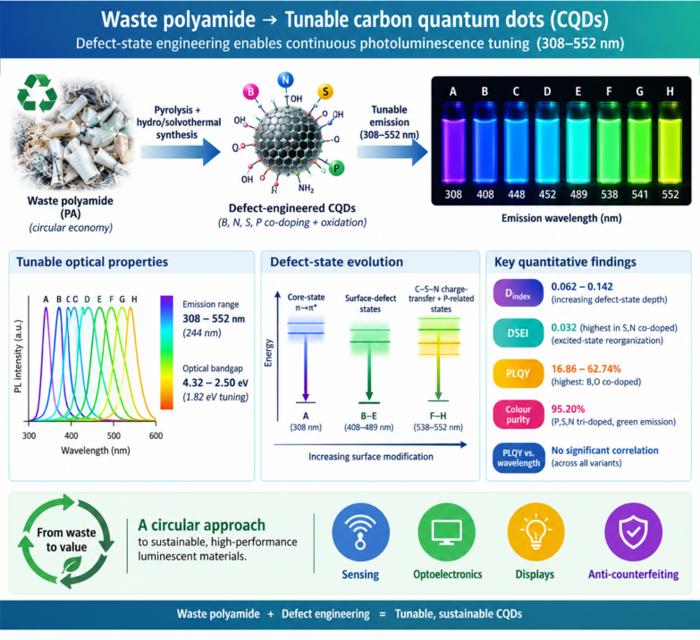
Waste polyamide-derived CQDs show continuous photoluminescence tuning from 308 to 552 nm through sequential defect-state engineering, with optical transition energies decreasing from 4.32 to 2.50 eV. @Christian Ebere Enyoh from Saitama University Carbon quantum dots (CQDs) are fluorescent carbon nanomaterials with potential applications in sensing, optoelectronics, displays, anti-counterfeiting, and environmental technologies. Their optical properties can be adjusted by modifying the carbon...
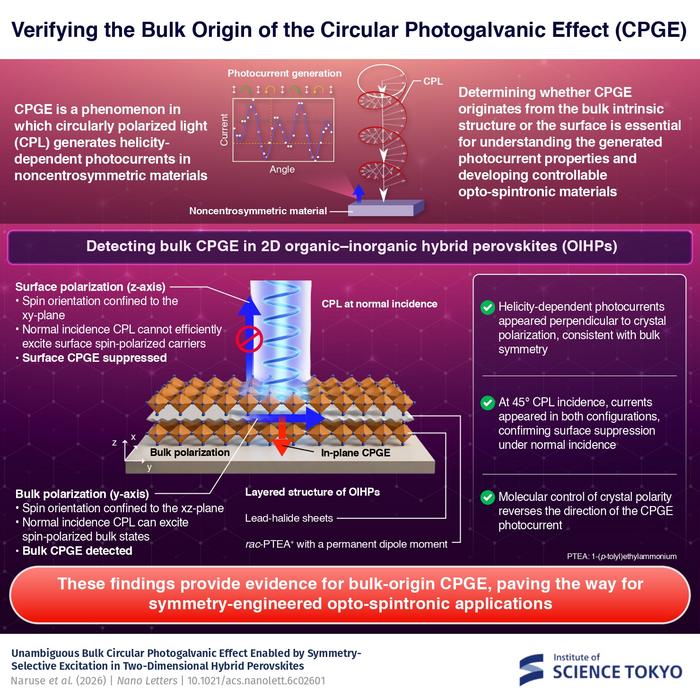
The researchers used circularly polarized light at normal incidence and found that helicity-dependent photocurrents appeared perpendicular to the crystal’s polarization but vanished when measured parallel to it, supporting a bulk origin of CPGE. @Institute of Science Tokyo The circular photogalvanic effect (CPGE), a phenomenon that generates helicity-dependent photocurrents in noncentrosymmetric materials, can originate purely from a crystal's internal structure without contribution from the...
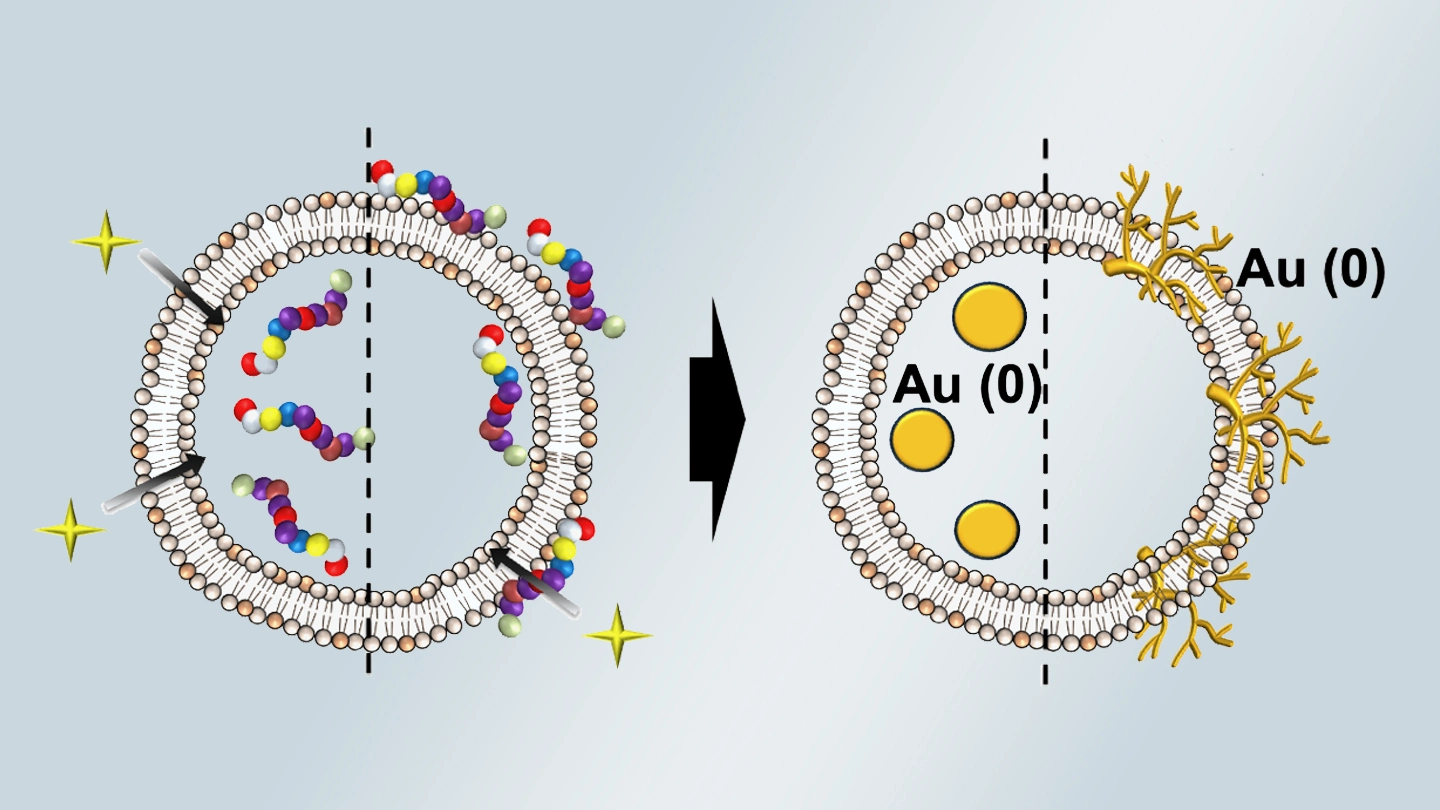
Summary of gold nanoparticle growth programming in liposome based on localization of biomineralization peptide The position of biomineralization peptides within liposomes can influence how gold nanoparticles grow, reports a research team from Institute of Science Tokyo. Peptides localized at the membrane interface promote branched structures, while those confined to the liposome interior favor spherical nanoparticles. The findings offer a new strategy for controlling nanoscale reaction...
