eLife
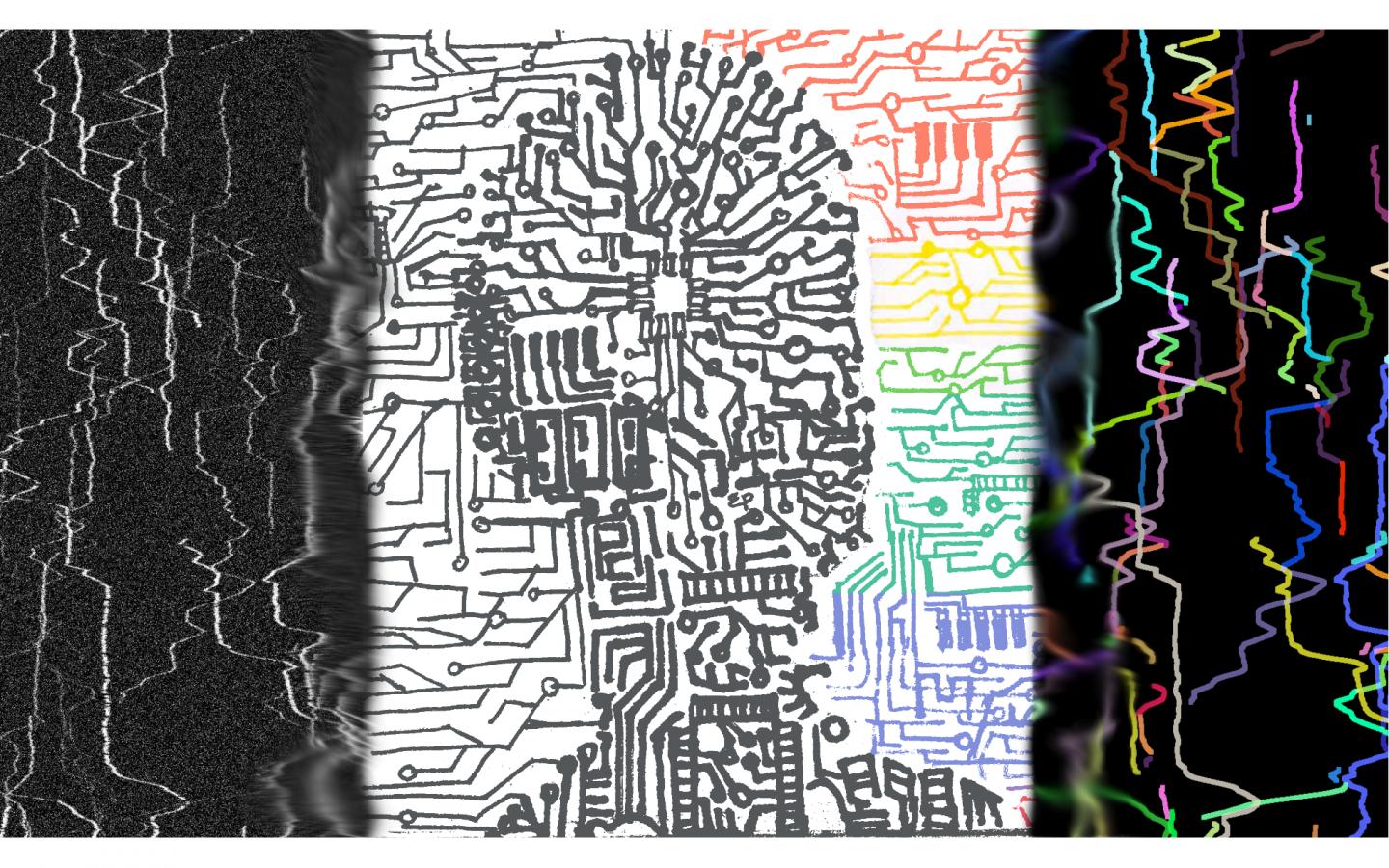
Scientists have developed an automated tool for mapping the movement of particles inside cells that may accelerate research in many fields, a new study in eLife reports.
The movements of tiny molecules, proteins and cellular components throughout the body play an important role in health and disease. For example, they contribute to brain development and the progression of some diseases. The new tool, built with cutting-edge machine learning technology, will make tracking these movements faster, easier and less prone to bias.
Currently, scientists may use images called kymographs, which represent the movement of particles in time and space, for their analyses of particle movements. These kymographs are extracted from time-lapse videos of particle movements recorded using microscopes. The analysis needs to be done manually, which is both slow and vulnerable to unconscious biases of the researcher.
"We used the power of machine learning to solve this long-standing problem by automating the tracing of kymographs," says lead author Maximilian Jakobs, a PhD student in the Department of Physiology, Development and Neuroscience at the University of Cambridge, UK.
The team developed the software, dubbed 'KymoButler', to automate the process. The software uses deep learning technology, which tries to mimic the networks in the brain to allow software to learn and become more proficient at a task over time and multiple attempts. They then tested KymoButler using both artificial and real data from scientists studying the movement of an array of different particles.
"We demonstrate that KymoButler performs as well as expert manual data analysis on kymographs with complex particle trajectories from a variety of biological systems," Jakobs explains. The software could also complete analyses in under one minute that would take an expert 1.5 hours.
KymoButler is available for other researchers to download and use at kymobutler.deepmirror.ai. Senior author Kristian Franze, Reader in Neuronal Mechanics at the University of Cambridge, expects the software will continue to improve as it analyses more types of data. Researchers using the tool will be given the option of anonymously uploading their kymographs to help the team continue developing the software.
"We hope our tool will prove useful for others involved in analysing small particle movements, whichever field they may work in," says Franze, whose lab is devoted to understanding how physical interactions between cells and their environment shape the development and regeneration of the brain.
KymoButler, a deep learning software for automated kymograph analysis
Maximilian AH Jakobs, Andrea Dimitracopoulos, Kristian Franze
eLife 2019; 8:e42288
DOI: 10.7554/eLife.42288
Contact information:
Kristian Franze
Reader in Neuronal Mechanics at the University of Cambridge
kf284@cam.ac.uk
Phone: +44 (0)1223 3-33761
