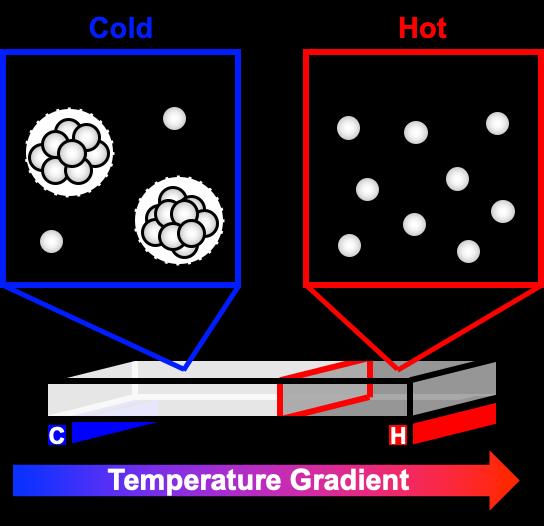
A new mathematical model describes how highly concentrated antibody solutions separate into different phases, similar to an oil and water mixture. This separation can reduce the stability and shelf-life of some drugs that use monoclonal antibodies, including some used to treat autoimmune diseases and cancer. A team of scientists from Penn State and MedImmune, LLC (now AstraZeneca) investigated the thermodynamics and kinetics, the relationships between temperature, energy, and the rates of chemical reactions, of the phenomenon using an innovative method that allows for the rapid study of multiple samples at once. A paper describing their model appears July 22, 2019, in the journal Proceedings of the National Academy of Sciences.
Many drugs today are stored as solids and dissolved in IV bags for delivery to patients, but the pharmaceutical industry has been moving toward drugs that can be stored as liquids and given via a shot. Some of these drug solutions, like those used to treat autoimmune diseases and some cancers, contain high concentrations of monoclonal antibodies--proteins that attach to foreign substances in the body, like bacteria and viruses, flagging them for destruction by the patient's immune system.
"Highly concentrated protein solutions can separate into different phases, like a vinaigrette salad dressing separating into layers over time," said Bradley Rogers, graduate student in chemistry at Penn State and first author of the paper. "Phase separation is one of the pathways that makes these drugs unstable and unsuitable for use. The classical method to understand this process involves manipulating the temperature of one sample over time. We used a temperature gradient microfluidics platform to quickly look at many temperatures simultaneously."
An antibody-rich solution begins as a clear liquid at room temperature, but as the solution cools, cloudy droplets begin to form. Over time, the droplets settle to the bottom, with dilute liquid remaining on top, making the sample appear clear. The team used an innovative device that creates a range of temperatures across a temperature gradient and used a technique called dark-field imaging to measure how quickly this process occurs. Then the team calculated a variety of parameters to better understand the thermodynamics and kinetics of the system, including the temperatures at which phase transitions occur and the amount of energy it takes to go from one phase to the next--activation energies.
"We observed that the rate that a solution separates into two phases has a strange dependence on temperature," said Rogers. "This relationship is much more complicated for concentrated antibody solutions than it is for other systems. We spent a long time trying to make sense of the data, but we eventually developed a model that explains what we are seeing."
The model describes how antibody molecules stick together as the temperature decreases, forming droplets that grow as additional molecules join. This reversible process happens more and more quickly with decreasing temperature, because the solution gets increasingly saturated with free antibody molecules. Then, as the solution continues to cool, droplets stick to other droplets and settle to the bottom. At even colder temperatures, the solution forms a gel and cannot complete the separation, even over the course of a month.
"In a single experiment, we can visualize the homogenous clear solution, the cloudy solution as droplets begin to form, the phase-separated liquid, and the gel," said Paul Cremer, J. Lloyd Huck Chair in Natural Sciences at Penn State and senior author of the paper.
"Previous research described these different states, and our model describes the mathematics and temperature-dependent kinetics behind what we believe is happening."
Next, the research team plans to investigate if their model can explain phase separation in other systems. They also plan to test whether parameters gathered from this type of experiment can predict stability and shelf-life of therapeutics.
"If these parameters can help us predict stability and shelf life, we may be able to select better drug candidates," said Rogers. "We may also be able to determine the ideal solution properties for a promising drug candidate to keep it stable."
In addition to Rogers and Cremer, the research team includes Kelvin Rembert, Matthew Poyton, Halil Okur, Amanda Kale, and Tinglu Yang at Penn State and Jifeng Zhang from AstraZeneca. The work was supported by MedImmune LLC (now AstraZeneca). Additional support was provided by the National Science Foundation.
A stepwise mechanism for aqueous two-phase system formation in concentrated antibody solutions
Bradley A. Rogers, Kelvin B. Rembert, Matthew F. Poyton, Halil I. Okur, Amanda R. Kale, Tinglu Yang, Jifeng Zhang, and Paul S. Cremer
PNAS first published July 23, 2019
Contact information:
Paul S. Cremer
J. Lloyd Huck Chair in Natural Sciences at Penn State
psc11@psu.edu
Tel: (814) 865-6259
Penn State University

Researchers led by Professor Jaeyune Ryu at Seoul National University identified local pH near electrodes as a decisive variable in organic electrosynthesis. By designing a reactor that narrows electrode spacing and flows electrolyte to counterbalance acidic and alkaline zones, they raised selectivity for lactones and epoxides, feedstocks for biodegradable plastics, polyurethanes, adhesives, and epoxy resins, from about 16% to 97% using only oxygen and electricity, eliminating added peroxide…

Silver nanoparticles with diameters of ~10 nm deliver the best performance as electrocatalysts. The silver particles are sprayed onto the electrode together with a conductive carbon powder. The ideal mixture consists of 20 per cent by mass silver and 80 per cent by mass carbon powder. This image was taken using a transmission electron microscope (TEM). © HZB Via electrolysis, CO₂ can be reduced to CO, a raw material for further chemical products such as fuels. Within the GreenQuest Project,...

A flexible metal–organic framework developed by researchers from Institute of Science Tokyo enables the structural determination of large "beyond rule of 5" molecules from microgram-scale samples. Using APF-40 as a crystalline sponge, the researchers determined the structures of 12 pharmaceutical-related molecules, including the 899 Da drug molecule doramectin and trace ivermectin derivatives. The method could aid drug discovery, natural products research, and the characterization of rare...






