University of Pennsylvania
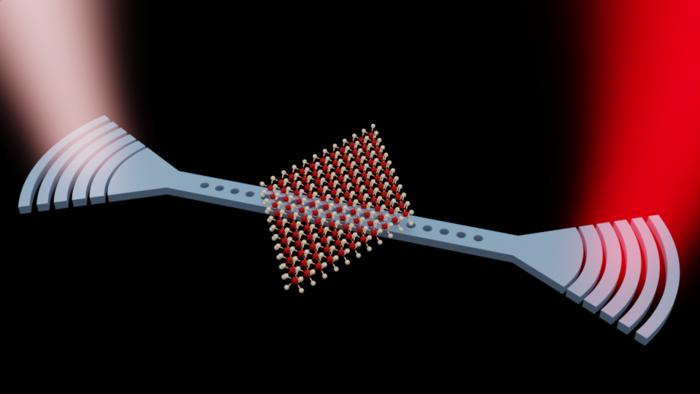
Eighty years ago, Penn researchers J. Presper Eckert and John Mauchly launched the age of electronic computing by harnessing electrons to solve complex numerical problems with ENIAC, the world’s first general-purpose electronic computer.
Today, that same architecture still underlies general computing, but electrons are beginning to show their limits. Because they carry a charge, they lose energy as heat, encounter resistance as they move through materials, and become harder to manage as chips incorporate more transistors and handle larger volumes of data.
With artificial intelligence pushing today’s hardware to process, move, and cool more, Penn physicists led by Bo Zhen in the School of Arts & Sciences are looking to the electron’s massless counterpart, the photon, to shoulder more of the load.
“Because they are charge-neutral and have zero rest mass, photons can carry information quickly over long distances with minimal loss, dominating communications technology,” explains Li He, co-first author of a paper published in Physical Review Letters and a former postdoctoral researcher in the Zhen Lab. “But that neutrality means they barely interact with their environment, making them bad at the sort of signal-switching logic that computers depend on.”
Zhen’s team has created a quasiparticle that “combines the speed of light with the strong interactions of matter.” These quasiparticles, or exciton-polaritons, are made by coupling photons with electrons in an atomically thin semiconductor, allowing light to interact strongly enough for signal switching needed in computation.
The advance could be especially important for AI.
Many photonic AI chips can already perform straightforward calculations using light, Zhen says, but to do nonlinear activation steps such as applying decision rules, they still must convert light signals back into slower, more energy-hungry electronic ones.
Those repeated translations erode the speed and efficiency that make photonic computing attractive. By using exciton-polaritons, the team demonstrated all-light switching at about 4 quadrillionths of a joule, which is an extraordinarily small amount of energy—far less than the energy used to briefly power a tiny LED light.
If scaled, the platform could help photonic chips process light directly from cameras, reduce the power demands of large AI systems, and pave the way for basic quantum computing capabilities on chips.
Bo Zhen is the Jin K. Lee Presidential Associate Professor in the Department of Phy
Reference
Strongly nonlinear nanocavity exciton-polaritons in gate-tunable monolayer semiconductors
Zhi Wang, Li He, Bumho Kim, Bo Zhen
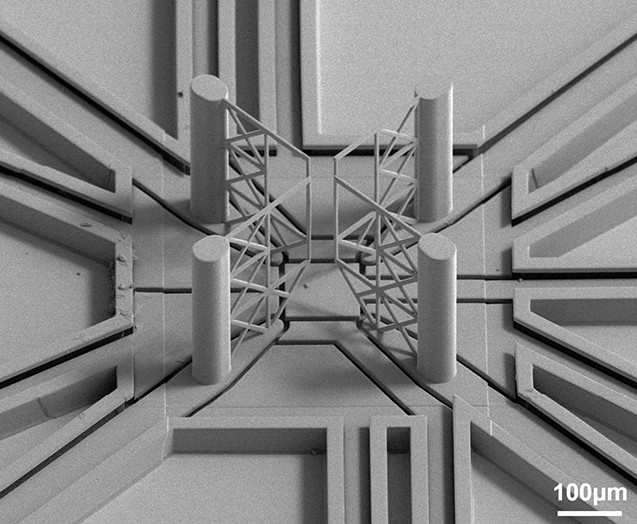
Scanning electron microscope (SEM) image of the team’s miniaturized, 3D-printed ion trap. Forty calcium ions are trapped in the space between the four poles that create an oscillating electrical potential. @Xiaoxing Xia/LLNL Researchers at Lawrence Livermore National Laboratory (LLNL), the University of California (UC) Berkeley, UC Riverside and UC Santa Barbara have miniaturized quadrupole ion traps for the first time with 3D printing — a breakthrough in one of the most promising...
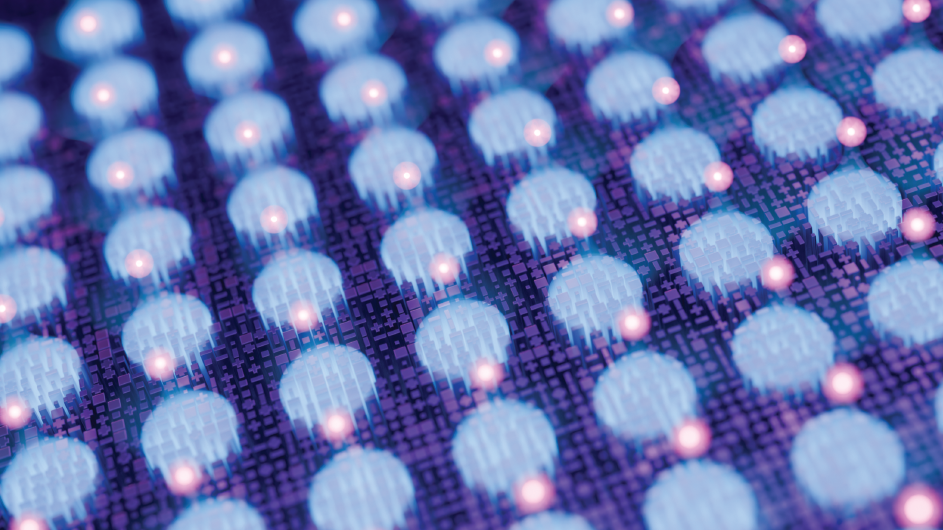
For about a decade, researchers have been trapping atoms with what are known as optical tweezer arrays. In essence, a single “optical tweezer” is a tightly focused laser beam that holds an individual atom at its focal point. Tweezer arrays are made up of many individual tweezers, typically generated via spatial light modulators (SLMs) or acousto-optic deflectors (AODs). Using these techniques, a team at Caltech recently achieved arrays with 6,100 trapped atoms and demonstrated that they can s...
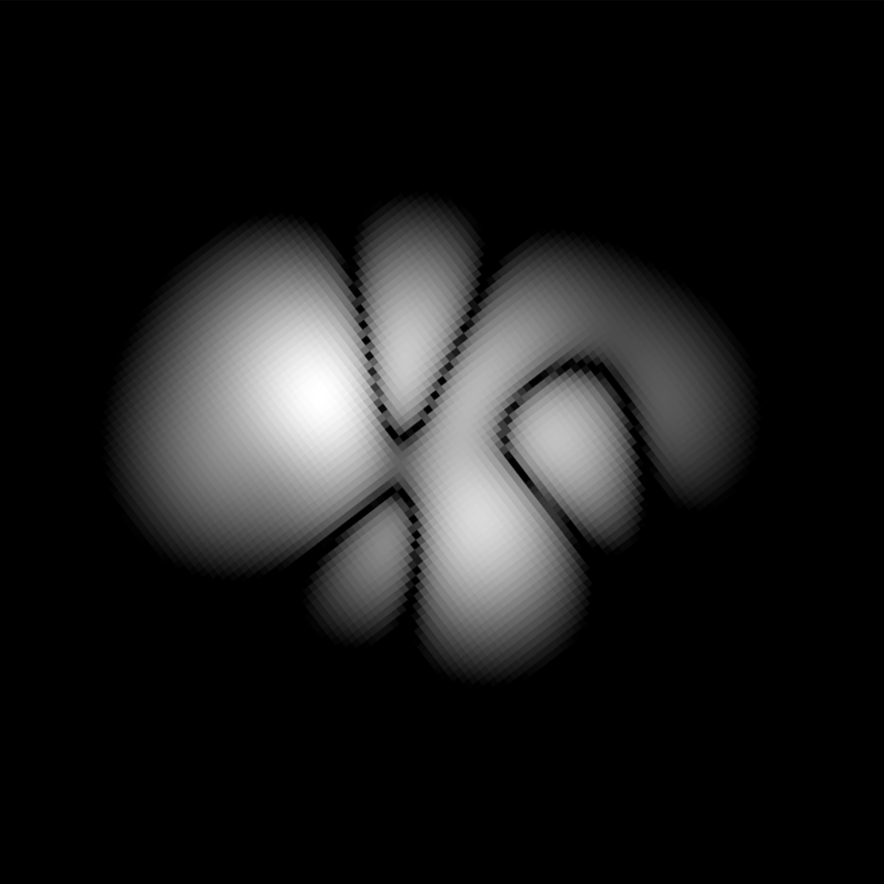
Published recently in Science, it is the first experimental observation of a half-Möbius electronic topology in a single molecule. To the scientists’ knowledge, a molecule with such topology has never before been synthesized, observed, or even formally predicted. Understanding this molecule’s behavior at the electronic structure level required something equally fundamental: a high fidelity quantum computing simulation. The discovery advances science on two fronts. For chemistry, it demonstrat...
