Columbia University in the City of New York

For quantum computers to outperform their classical counterparts, they need more quantum bits, or qubits. State-of-the-art quantum computers have around 1,000 qubits. Columbia physicists Sebastian Will and Nanfang Yu have their sights set much higher.
“We are laying critical groundwork to enable quantum computers with more than 100,000 qubits,” Will said. In a new paper published today in Nature, Will and Yu combine two powerful technologies—optical tweezers and metasurfaces—to dramatically scale the size of neutral-atom arrays.
Neutral-atom arrays are a rapidly emerging platform to create quantum computers. In a foundational study led by graduate students Aaron Holman and Yuan Xu from the Will and Yu labs, respectively, the team successfully trapped 1,000 strontium atoms and demonstrated that their approach can scale to well above 100,000.
These atoms could one day serve as qubits in a quantum computer, a task for which atoms are well-suited. Atoms offer a powerful way to engineer the quantum properties that quantum computers need, like superposition and entanglement. Each atom is also identical, so there’s no need to spend time characterizing and synchronizing them—a daunting task for fabricated forms of qubits, especially as the number grows.
“Atoms are nature’s own qubits; perfectly identical and massively abundant. The bottleneck has always been finding a way to control them at scale,” said Holman.
For about a decade, researchers have been trapping atoms with what are known as optical tweezer arrays. In essence, a single “optical tweezer” is a tightly focused laser beam that holds an individual atom at its focal point. Tweezer arrays are made up of many individual tweezers, typically generated via spatial light modulators (SLMs) or acousto-optic deflectors (AODs). Using these techniques, a team at Caltech recently achieved arrays with 6,100 trapped atoms and demonstrated that they can successfully function as qubits. “Their report is an amazing achievement,” said Will. “With our metasurface tweezer array approach, we hope to scale neutral-atom arrays even further, perhaps even beyond 100,000 atoms.”
This scaling comes from a fundamentally new approach to generating optical tweezer arrays: metasurfaces. Metasurfaces are flat optical devices comprising a two-dimensional array of nanometer-sized “pixels.” When a single beam of light passes through a metasurface, it is shaped by the pixels into a unique pattern. In the current work, the pixels are much smaller than the wavelength of the light they are manipulating: less than 200 nm, compared to the 520-nm light used for the tweezers. That means they can directly generate a tweezer array; SLM and AOD approaches require additional equipment that is bulky, expensive, and limits the ultimate size of the array.
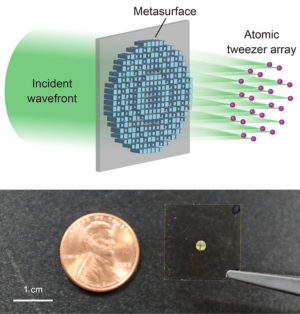
“The metasurfaces used in this work can be considered a superposition of tens of thousands of flat lenses over the same plane and differing in their focal spot location,” said Yu, “so that upon the incidence of a laser beam, one metasurface can simultaneously produce tens of thousands of focal spots.”
The metasurfaces, made from silicon nitride and titanium dioxide, can also tolerate extremely powerful lasers with optical intensities of more than 2000 W/mm²—that’s about a million times more intense than sunlight as it reaches Earth. “The high-power handling capability of metasurfaces coupled with the scalability of cleanroom nanofabrication of ever larger and more precise devices makes our platform uniquely capable of realizing massively scalable optical tweezer arrays,” said Xu.
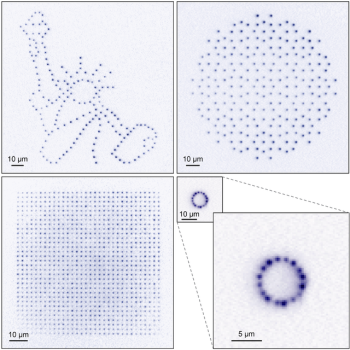
For the paper, the team demonstrated the versatility of the metasurface optical tweezer platform by trapping atoms into a number of highly uniform 2D arrays. The patterns include a square lattice with 1024 sites; quasicrystal and Statue of Liberty patterns with hundreds of sites; and a circle made up of atoms spaced just under 1.5 microns apart.
The team also created a 3.5-mm diameter metasurface containing more than 100 million pixels that generates a 600 x 600 array: that’s 360,000 optical tweezers in total, which is two orders of magnitude beyond the capabilities of current technologies.
Will and Yu see a realistic path to scalability for neutral-atom arrays, which may not only benefit quantum computers but also other neutral-atom quantum technologies, like quantum simulators, which help scientists model complex quantum many-body phenomena, and precise optical atomic clocks that could be deployed outside of laboratories.
What’s next? The team is ready to take on more atoms. To do so, they just need a bigger laser. “To trap a hundred thousand atoms, we’ll need a much more powerful laser than we currently have,” said Will. “But, it’s in a realistic range.”
Reference
Trapping of single atoms in metasurface optical tweezer arrays
Aaron Holman, Yuan Xu, Ximo Sun, Jiahao Wu, Mingxuan Wang, Zezheng Zhu, Bojeong Seo, Nanfang Yu & Sebastian Will

In a landmark achievement at the confluence of artificial intelligence and fundamental physics, a team of researchers from Tongji University, the Chinese university of Hong Kong and Nanyang Technological University has developed an AI algorithm capable of classifying complex topological phases of matter without relying on the mathematical tools that have limited human scientists for decades. This breakthrough, which tackles the notoriously difficult realm of non-Hermitian systems, suggests th...
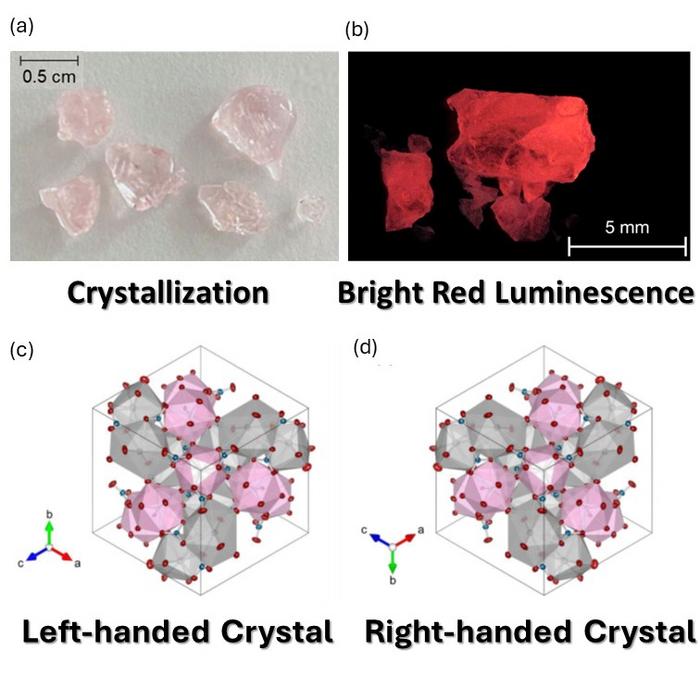
Researchers at Kumamoto University have discovered that a purely inorganic crystal grown from water solution can emit circularly polarized light, a special form of light whose “handedness” distinguishes left from right. The finding opens a new pathway toward robust optical materials for security printing, advanced displays, and photonic technologies, using simple inorganic chemistry rather than complex organic molecules.

An atomic force microscope tip writes data in stable ferroelectric structures, enabling reliable multistate storage at extremely small scales in this illustration. @ Morgan Manning/ORNL, U.S. Dept. of Energy Researchers at Oak Ridge National Laboratory used specialized tools to study materials at the atomic scale and analyze defects at the materials’ surface. Results of their research help to better understand these materials used for advanced electronics, enabling innovative data storage and...
This week in nanotech
$10.2M raised
2 funding rounds · 18 deals tracked
New products
 Ti-WCMBN Nanomaterialia Featured
 Nion-compatible In Situ STEM Holders for Electrical BiasingHummingbird Scientific Featured
 GiiiGii
Market insights
Last 30 days: Quantum Technologies was the busiest vertical: 52 of 174 events (30%).
Money raised per month