In a significant development in the field of superconductivity, researchers at The University of Manchester have successfully achieved robust superconductivity in high magnetic fields using a newly created one-dimensional (1D) system. This breakthrough offers a promising pathway to achieving superconductivity in the quantum Hall regime, a longstanding challenge in condensed matter physics.
Superconductivity, the ability of certain materials to conduct electricity with zero resistance, holds profound potential for advancements of quantum technologies. However, achieving superconductivity in the quantum Hall regime, characterised by quantised electrical conductance, has proven to be a mighty challenge.
The research, published in Nature, details extensive work of the Manchester team led by Professor Andre Geim, Dr Julien Barrier and Dr Na Xin to achieve superconductivity in the quantum Hall regime. Their initial efforts followed the conventional route where counterpropagating edge states were brought into close proximity of each other. However, this approach proved to be limited.
"Our initial experiments were primarily motivated by the strong persistent interest in proximity superconductivity induced along quantum Hall edge states," explains Dr Barrier, the paper's lead author. "This possibility has led to numerous theoretical predictions regarding the emergence of new particles known as non-abelian anyons."
The team then explored a new strategy inspired by their earlier work demonstrating that boundaries between domains in graphene could be highly conductive. By placing such domain walls between two superconductors, they achieved the desired ultimate proximity between counterpropagating edge states while minimising effects of disorder.
"We were encouraged to observe large supercurrents at relatively ‘balmy’ temperatures up to one Kelvin in every device we fabricated," Dr Barrier recalls.
Further investigation revealed that the proximity superconductivity originated not from the quantum Hall edge states propagating along domain walls, but rather from strictly 1D electronic states existing within the domain walls themselves. These 1D states, proven to exist by the theory group of Professor Vladimir Falko’s at the National Graphene Institute, exhibited a greater ability to hybridise with superconductivity as compared to quantum Hall edge states. The inherent one-dimensional nature of the interior states is believed to be responsible for the observed robust supercurrents at high magnetic fields.
This discovery of single-mode 1D superconductivity shows exciting avenues for further research. “In our devices, electrons propagate in two opposite directions within the same nanoscale space and without scattering", Dr Barrier elaborates. "Such 1D systems are exceptionally rare and hold promise for addressing a wide range of problems in fundamental physics."
The team has already demonstrated the ability to manipulate these electronic states using gate voltage and observe standing electron waves that modulated the superconducting properties.
“It is fascinating to think what this novel system can bring us in the future. The 1D superconductivity presents an alternative path towards realising topological quasiparticles combining the quantum Hall effect and superconductivity,” concludes Dr Xin. "This is just one example of the vast potential our findings holds."
20 years after the advent of the first 2D material graphene, this research by The University of Manchester represents another step forward in the field of superconductivity. The development of this novel 1D superconductor is expected to open doors for advancements in quantum technologies and pave the way for further exploration of new physics, attracting interest from various scientific communities.
Reference
One-dimensional proximity superconductivity in the quantum Hall regime
Julien Barrier, Minsoo Kim, Roshan Krishna Kumar, Na Xin, P. Kumaravadivel, Lee Hague, E. Nguyen, A. I. Berdyugin, Christian Moulsdale, V. V. Enaldiev, J. R. Prance, F. H. L. Koppens, R. V. Gorbachev, K. Watanabe, T. Taniguchi, L. I. Glazman, I. V. Grigorieva, V. I. Fal’ko & A. K. Geim
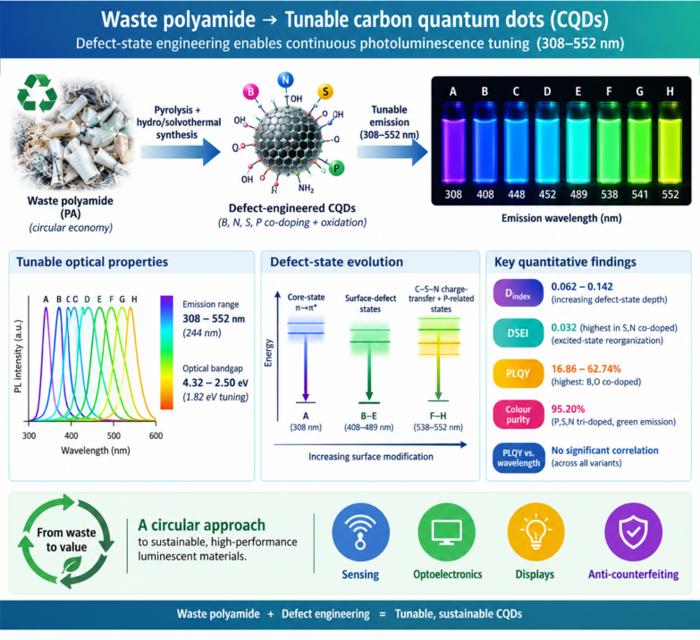
Waste polyamide-derived CQDs show continuous photoluminescence tuning from 308 to 552 nm through sequential defect-state engineering, with optical transition energies decreasing from 4.32 to 2.50 eV. @Christian Ebere Enyoh from Saitama University Carbon quantum dots (CQDs) are fluorescent carbon nanomaterials with potential applications in sensing, optoelectronics, displays, anti-counterfeiting, and environmental technologies. Their optical properties can be adjusted by modifying the carbon...
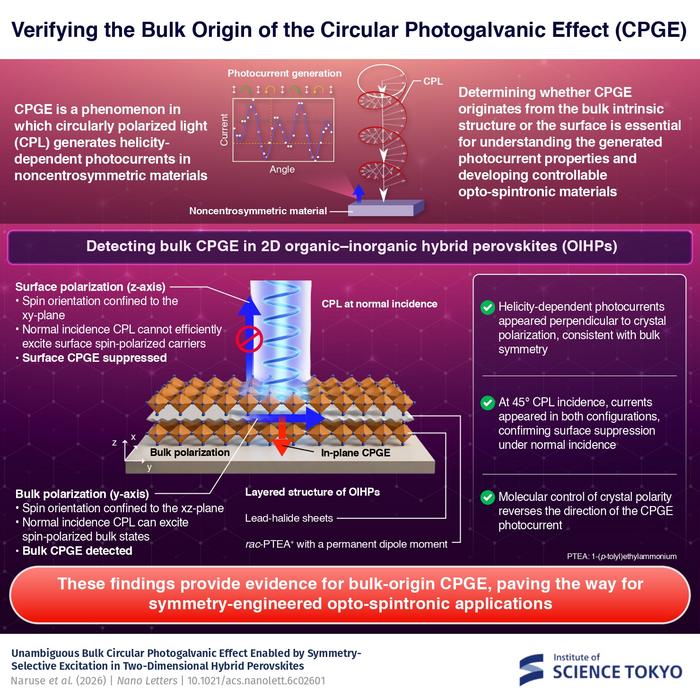
The researchers used circularly polarized light at normal incidence and found that helicity-dependent photocurrents appeared perpendicular to the crystal’s polarization but vanished when measured parallel to it, supporting a bulk origin of CPGE. @Institute of Science Tokyo The circular photogalvanic effect (CPGE), a phenomenon that generates helicity-dependent photocurrents in noncentrosymmetric materials, can originate purely from a crystal's internal structure without contribution from the...
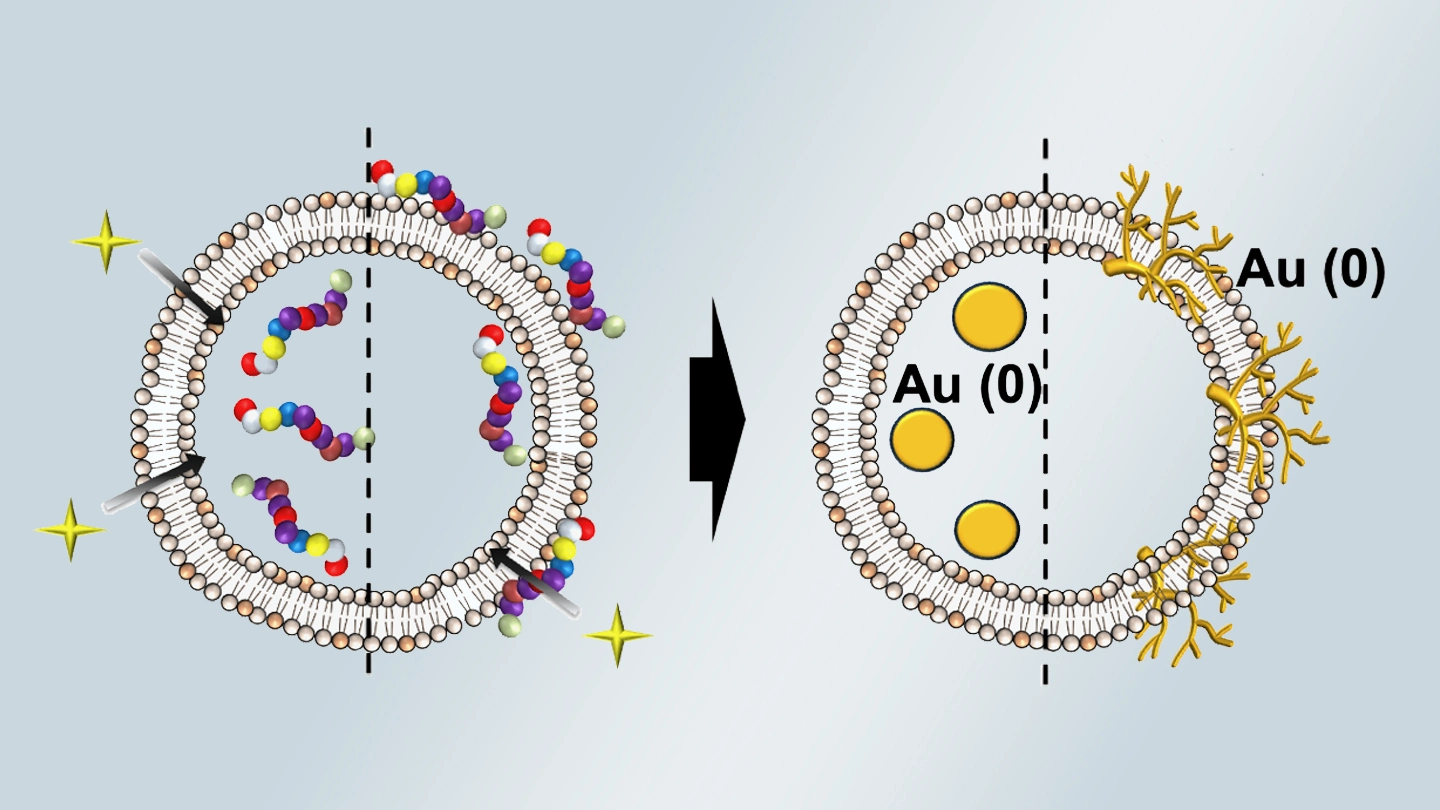
Summary of gold nanoparticle growth programming in liposome based on localization of biomineralization peptide The position of biomineralization peptides within liposomes can influence how gold nanoparticles grow, reports a research team from Institute of Science Tokyo. Peptides localized at the membrane interface promote branched structures, while those confined to the liposome interior favor spherical nanoparticles. The findings offer a new strategy for controlling nanoscale reaction...
