Fudan University
The Overlooked Force Driving the Universe's Hottest Fluid
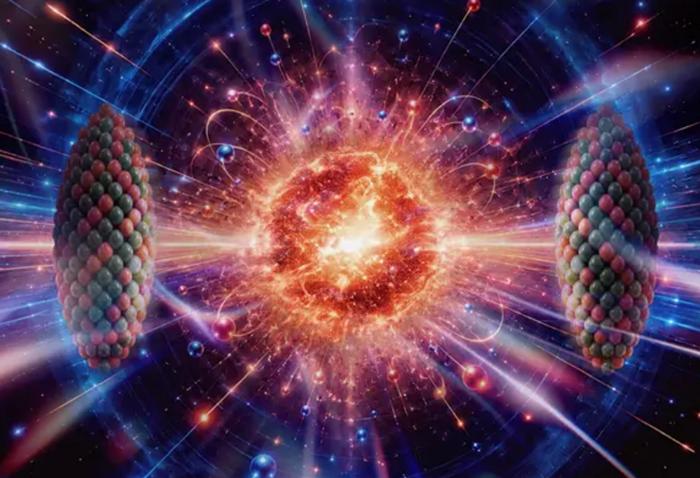
When two atomic nuclei collide at nearly the speed of light, they melt into the quark–gluon plasma, a nearly perfect fluid in which quarks and gluons roam free. While the plasma's enormous vorticity and electromagnetic fields have been intensively studied, its fluid acceleration—the very force behind its explosive expansion—has remained largely unexplored, even though hydrodynamics places acceleration on an equal footing with vorticity, much as the electric field stands to the magnetic field.
Charting the Acceleration Landscape
Led by physicists Yu-Gang Ma and Xu-Guang Huang at Fudan University, the research team combined two well-established transport models, AMPT and UrQMD, with a Gaussian smearing technique that converts discrete particle distributions into smooth energy–momentum and velocity fields. This allowed them to track how acceleration is generated and evolves across collision energies from 3.5 GeV to 2.76 TeV. "Acceleration is not merely a kinematic detail—it may act as a thermodynamic control parameter of QCD matter," explains Professor Huang.
Fireball Edges Act as Acceleration Hotspots
The simulations show that the peak proper acceleration reaches several hundred MeV at both low and high collision energies. The transverse acceleration always points outward and is strongest at the fireball's edge, where the pressure drops steeply while the enthalpy density is low—a double amplification described by the relativistic Euler equation. At low energies, nuclear stopping produces early deceleration up to about 500 MeV, whereas at ultra-relativistic energies the fast-passing nuclei drag the newly formed plasma into sharp acceleration pulses. Intriguingly, because the most extreme acceleration always localizes at the boundary, the overall acceleration depends only weakly on how
head-on the collision is.
A New Thermodynamic Dial for QCD Matter
Through the Unruh effect—by which an accelerated observer perceives the vacuum as a thermal bath—a few-hundred-MeV acceleration could mimic temperatures comparable to the QCD transition temperature. This suggests that acceleration may reshape the phase structure of QCD matter along a new “acceleration axis”, influencing the chiral and deconfinement transitions. Acceleration can also drive novel transport phenomena and polarize particle spins in ways complementary to vorticity, shedding new light on the spin puzzles observed at RHIC and the LHC.
Toward the Physics of Non-Inertial QCD Matter
The team plans to incorporate realistic hydrodynamic evolution and to identify experimental observables—such as hyperon spin-polarization patterns—that could test these acceleration effects. The work charts a largely unexplored dimension of strong-interaction matter and links it to signatures that experiments can measure.
"Just as temperature and density define the phase diagram of matter, acceleration may open a new axis of that diagram," stated Professor Huang. "By mapping this hidden dimension of the quark–gluon plasma, we hope to turn non-inertial quantum effects into signatures that experiments can actually measure."
Reference
Fluid acceleration in heavy-ion collisions
Song-Ze Zhong, Xian-Gai Deng, Xu-Guang Huang & Yu-Gang Ma
https://link.springer.com/article/10.1007/s41365-026-02044-8
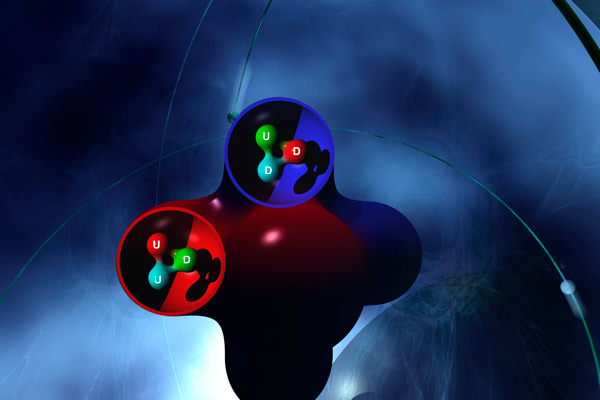
The internal structure of a proton (left) in a lithium atom. The proton is made up of three quarks, but its spin does not correspond to the sum of the spins of the quarks. @ CAROL & MIKE WERNER/SCIENCE PHOTO LIBRARY An analysis by physicists of colliding protons is tackling the mystery of where protons get their intrinsic property known as spin1. Along with neutrons, protons are housed inside an atom’s nucleus. Like many subatomic particles, they carry spin—an internal property that can point...

Scientists have new evidence that gluons—the gluelike particles that hold quarks together within protons and neutrons—have a positive...

Physicists report new evidence that production of an exotic state of matter in collisions of gold nuclei at the Relativistic Heavy Ion...
