An analysis by physicists of colliding protons is tackling the mystery of where protons get their intrinsic property known as spin1.
Along with neutrons, protons are housed inside an atom’s nucleus. Like many subatomic particles, they carry spin—an internal property that can point in one of two opposing directions.
Since the 1960s, physicists have known that protons are made up of elementary particles called quarks and gluons, each with its own spin.
“It was initially assumed that the proton’s spin came from the spin of its quarks,” says Yasuyuki Akiba, a particle physicist at the RIKEN Brookhaven Research Center (RBRC) and a spokesperson for the PHENIX experiment at the Relativistic Heavy Ion Collider (RHIC) in Brookhaven National Laboratory in New York, USA. However, experiments in the 1980s revealed that quarks contribute only around 30% of the proton’s spin.
“The fundamental question was then: where does the rest of the proton’s spin come from?” says Akiba. Physicists embarked on a search for the source of the missing 70% of the proton’s spin.
Quarks within a proton are held together by massless particles called gluons. Around seven years ago, teams working on PHENIX and on a second RHIC experiment called STAR established that the spin of gluons contributes to the proton spin. But they could not determine whether the gluon spins align with the direction of the spin of the proton containing them.
That’s where this new analysis comes in. During collisions between protons, a gluon can be transformed into a photon, or a particle of light. The photons produced by this process are called direct photons. This is such a rare process that the PHENIX detector needed 25,000 photon-measuring detectors to pick them up. “It’s like the compound eye of an insect,” comments Akiba.
The physicists searched for the production of direct photons in two types of proton collisions—one where the colliding protons had spins that were aligned and one where the colliding protons had spins pointing in opposing directions.
They saw a small increase in the production of direct photons when the original proton spins were pointing in opposite directions. This indicates that gluon spins point in the same direction as the spin of their parent proton, enabling them to contribute to the proton’s spin, as expected.
But a puzzle remains. The calculations show that gluon spins add only 20–30% to the proton’s spin, so there is still a missing component. This might come from the motion of the gluons and the quarks.
“They are currently building a new accelerator, called the Electron-Ion Collider at Brookhaven, which could provide the answer,” says Akiba.
Reference
Measurement of Direct-Photon Cross Section and Double-Helicity Asymmetry at
√s=510 GeV in →p+→p Collisions
N. J. Abdulameer et al. (PHENIX Collaboration)
https://journals.aps.org/prl/abstract/10.1103/PhysRevLett.130.251901
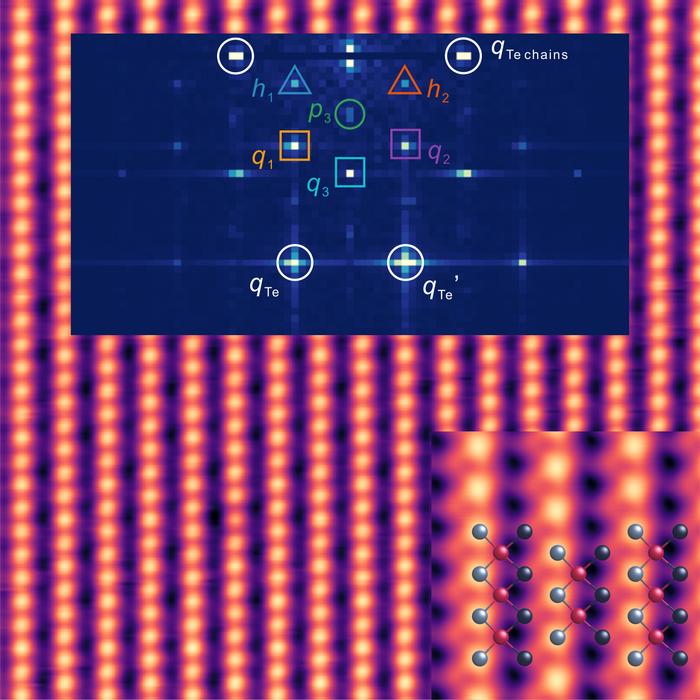
A Fourier transform revealing spatial patterns on the surface at 300 millikelvins. A charge density wave signals the presence of the pair density wave. The background is tellurium atoms on the surface of uranium ditelluride. @University of Illinois Urbana-Champaign’s Grainger College of Engineering Physicists with the University of Illinois Urbana-Champaign’s Grainger College of Engineering have identified a new form of superconducting behavior. Experiments on the metal uranium ditelluride...
Stack two atomically thin layers, rotate one slightly against the other, and a new material emerges. The resulting moiré pattern can slow electrons down so much that their interactions take over. This produces superconductivity, magnetism and exotic fractional quantum states that neither layer shows on its own. This field, known as twistronics, has become one of the most active frontiers in condensed matter physics. So far, however, it has been built on only a handful of materials, mainly...
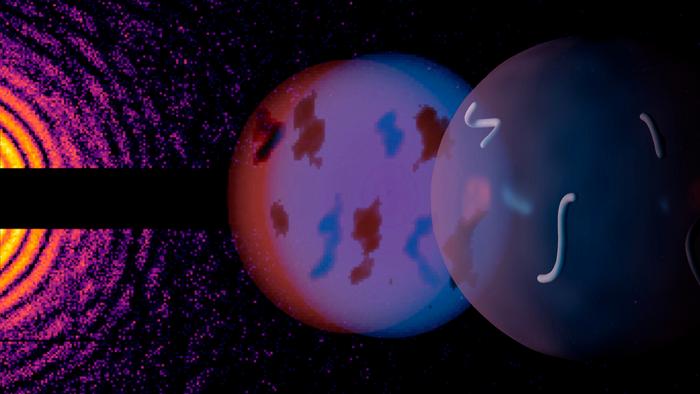
From a two-colour diffraction pattern (left), two snapshots of a helium droplet doped with xenon nanoparticles can be reconstructed (centre). These images can inform a potential 3D rendering of a xenon-doped helium nanodroplet (right). An overarching goal of ultrafast science is to enable researchers to watch structural changes in matter on their natural timescale. Experimentally, this translates into taking two snapshots of the same nanoscale object that are only femtoseconds apart to...






