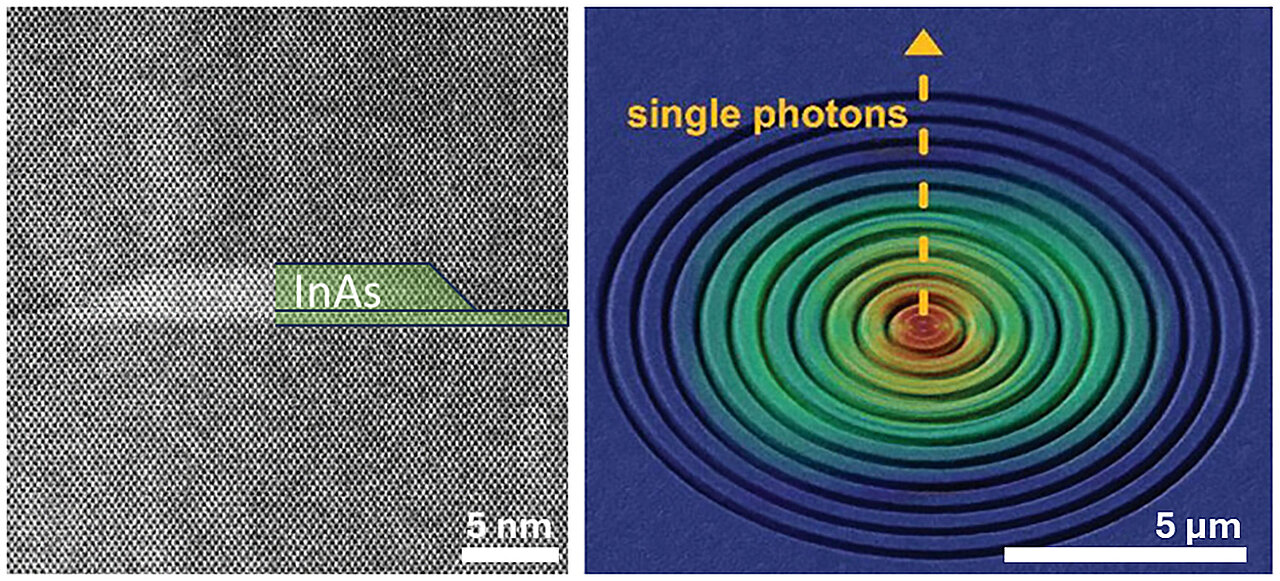
Research teams from the Universities of Stuttgart and Würzburg have jointly realised a single photon source that generates photons in the telecommunication C band with unprecedented quality and on demand.
The source was developed in Würzburg and comprehensively characterised in Stuttgart - a decisive step towards scalable photonic quantum processors and powerful quantum networks.
"The lack of a high-quality C-band photon source that works on demand has been a central problem in quantum optics laboratories for a decade - our new technology now removes this obstacle," says Stefanie Barz, Professor of Quantum Information and Technology at the University of Stuttgart.
Identical photons as a key resource
For many applications of quantum technologies, it is crucial that photons are completely identical in all their properties. Only then can the interference effects required for quantum computers, quantum networks or quantum repeaters be utilised. The new source delivers such photons deterministically and with a purity and stability that was previously unattainable in the telecommunications band. This fulfils a key requirement for scalable photonic architectures.
To integrate photonic quantum technologies into existing fibre optic networks, sources must operate in the telecommunications C-band, where optical losses are minimal. While quantum dots already deliver near-ideal photonic properties at shorter wavelengths, transferring this performance to nanometres has proven to be a major challenge. Previous C-band quantum dot sources achieved interference visibility of around 72 per cent at most, which is too low for demanding applications.
Photons made to measure - deterministic and compatible with fibre optics
The new source overcomes these limitations. It is based on indium arsenide quantum dots embedded in a customised resonator structure that amplifies the emission and makes it precisely controllable. Unlike probabilistic SPDC sources (SPDC: spontaneous parametric down-conversion), the device generates photons deterministically: a photon is always provided when it is needed. This allows several sources to be operated synchronously, a prerequisite for scalable quantum architectures.
The Stuttgart team investigated various excitation schemes and identified an operating mode that delivers particularly stable and pure photons through phonon-mediated excitation. In this mode, the source achieved a two-photon interference visibility of almost 92 per cent - a record value for deterministic sources in the C-band and a decisive step towards complex photonic quantum processors.
"The source is based on a technology platform that we have been researching and advancing in Würzburg for years. Its demonstration in the PhotonQ consortium shows how important a reliable device basis is for scalable photonic quantum processors," says Dr Andreas Pfenning, University of Würzburg.
The Würzburg team, led by Professor Sven Höfling, holder of the Chair of Technical Physics, was responsible for the development of the complete device, from epitaxy to resonator design and nanofabrication. Andreas Pfenning and his team were responsible for the scientific realisation and day-to-day project management.
New applications for synchronised photons
With the combination of deterministic generation, high indistinguishability and telecommunication wavelength, the source opens up new possibilities for photonic quantum technologies. Applications range from measurement-based quantum computing to multiphoton experiments and quantum repeaters needed for long-distance communication.
"Our ability to simultaneously generate single photons deterministically, in the telecommunication C-band and with high indistinguishability will enable applications that require large amounts of synchronised photons - from measurement-based quantum computing to quantum repeaters for long-distance communication," says Nico Hauser from the University of Stuttgart.
The results were obtained as part of the PhotonQ consortium funded by the German Federal Ministry of Research, Technology and Space (BMFTR). The consortium is coordinated by the University of Stuttgart and is jointly developing the foundations for a new type of photonic quantum processor, which is being built and operated in Stuttgart.
"This result is an important milestone in our long-term research agenda in Würzburg. The collaboration in the PhotonQ consortium enables us to use our components in sophisticated system architectures and develop them further together," emphasises Sven Höfling.
The source now presented also forms a central technological basis for the Quantenrepeater.Net (QR.N) project, also funded by the BMFTR, in which the teams from Stuttgart and Würzburg are working together on the networking of photonic quantum processors.
Reference
Deterministic and highly indistinguishable single photons in the telecom C-band
Nico Hauser, Matthias Bayerbach, Jochen Kaupp, Yorick Reum, Giora Peniakov, Johannes Michl, Martin Kamp, Tobias Huber-Loyola, Andreas T. Pfenning, Sven Höfling & Stefanie Barz
https://www.nature.com/articles/s41467-026-68336-0
