University of Bayreuth
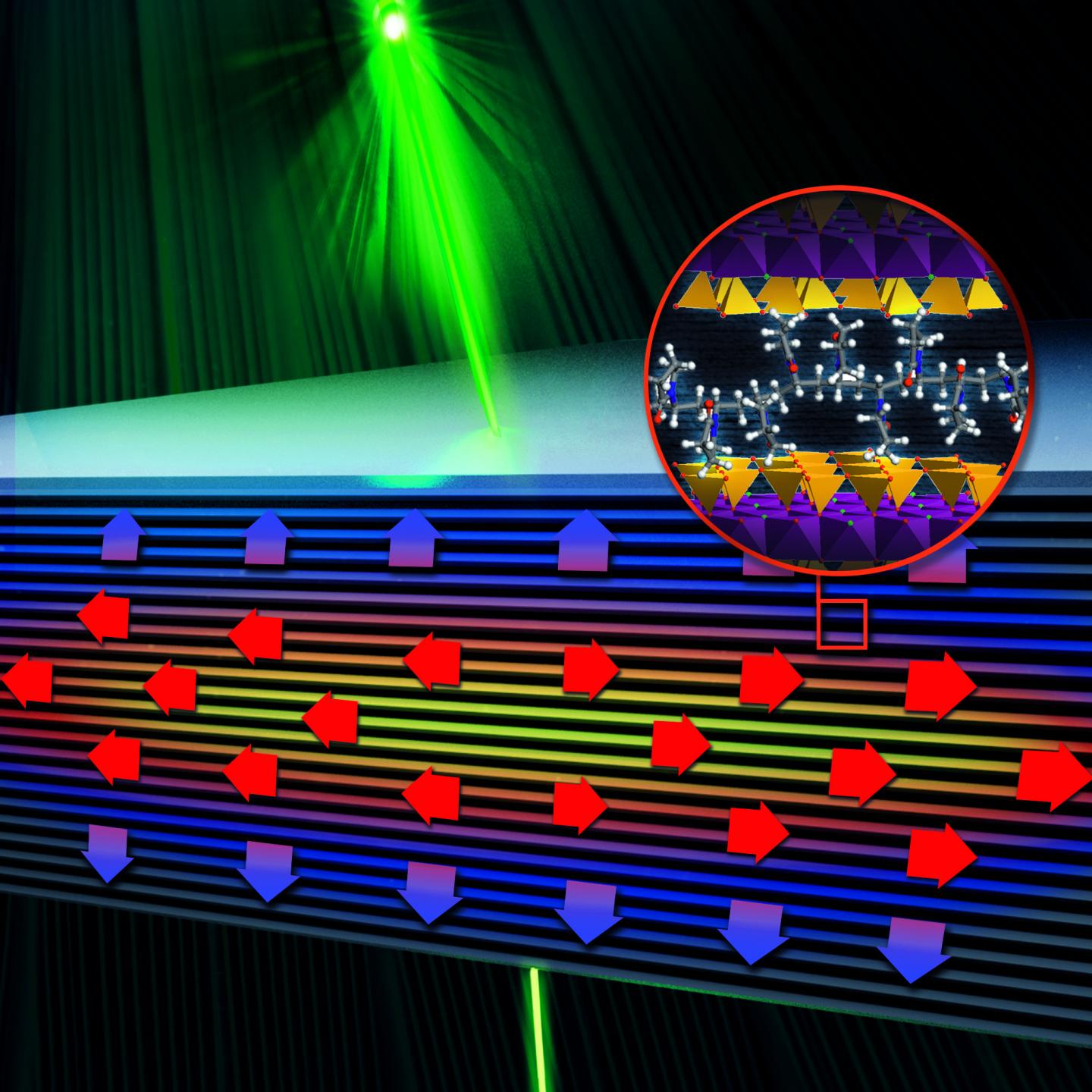
Styrofoam or copper - both materials have very different properties with regard to their ability to conduct heat. Scientists at the Max Planck Institute for Polymer Research (MPI-P) in Mainz and the University of Bayreuth have now jointly developed and characterized a novel, extremely thin and transparent material that has different thermal conduction properties depending on the direction. While it can conduct heat extremely well in one direction, it shows good thermal insulation in the other direction.
Thermal insulation and thermal conduction play a crucial role in our everyday lives - from computer processors, where it is important to dissipate heat as quickly as possible, to houses, where good insulation is essential for energy costs. Often extremely light, porous materials such as polystyrene are used for insulation, while heavy materials such as metals are used for heat dissipation. A newly developed material, which scientists at the MPI-P have jointly developed and characterized with the University of Bayreuth, can now combine both properties.
The material consists of alternating layers of wafer-thin glass plates between which individual polymer chains are inserted. "In principle, our material produced in this way corresponds to the principle of double glazing," says Markus Retsch, Professor at the University of Bayreuth. "It only shows the difference that we not only have two layers, but hundreds".
Good thermal insulation is observed perpendicular to the layers. In microscopic terms, heat is a movement or oscillation of individual molecules in the material that is transferred to neighbouring molecules. By building up many layers on top of each other, this transfer is reduced: Each new boundary layer blocks part of the heat transfer. In contrast, the heat within a layer can be conducted well - there are no interfaces that would block the heat flow. Overall, the heat transfer within a layer is 40 times higher than perpendicular to it.
The thermal conductivity along the layers is comparable to the thermal conductivity of thermal paste, which is used, among other things, to apply heat sinks to computer processors. For electrically insulating materials based on polymer/glass, this value is exceptionally high - it exceeds that of commercially available plastics by a factor of six.
For the material to function efficiently and also be transparent, the layers had to be produced with very high precision - any inhomogeneity would disturb the transparency similar to a scratch in a piece of Plexiglas. Each layer is only one millionth of a millimeter high - i.e. one nanometer. In order to investigate the homogeneity of the layer sequence, the material was characterized in the group of Josef Breu, Professor of Inorganic Chemistry at the University of Bayreuth.
"We use X-rays to illuminate the material," says Breu. "By superimposing these rays, which are reflected by the individual layers, we were able to show that the layers could be produced very precisely."
Prof. Fytas, member of Prof. Hans-Jürgen Butt's department, was able to give an answer to the question why this layer-like structure has such extraordinarily different properties along or perpendicular to the individual glass plates. Using a special laser-based measurement, his group was able to characterize the propagation of sound waves, which is like heat also related to the movement of the material's molecules. "This structured yet transparent material is excellent for understanding how sound propagates in different directions," says Fytas. The different sound velocities allow direct conclusions to be drawn about the direction-dependent mechanical properties, which are not accessible with any other method.
In their further work, the researchers hope to gain a better understanding of how sound and heat propagation can be influenced by the structure of the glass plate and the polymer composition. The researchers see a possible application in the field of high-performance light-emitting diodes, in which the glass-polymer layer serves on the one hand as a transparent encapsulation and on the other hand can dissipate the released heat laterally.
Tunable Thermoelastic Anisotropy in Hybrid Bragg Stacks with Extreme Polymer Confinement
Zuyuan Wang, Konrad Rolle, Theresa Schilling, Patrick Hummel, Alexandra Philipp, Bernd A. F. Kopera, Anna M. Lechner, Markus Retsch, Josef Breu, George Fytas
Angewandte Chemie International Edition (2020), Vol. 59, Issue 3
Contact information:
Georg Fytas
Professor at MPI for Polymer Research
fytas@mpip-mainz.mpg.de
Phone: +49 6131 379-718
Josef Breu
Professor of Inorganic Chemistry at University of Bayreuth
josef.breu@uni-bayreuth.de
Phone: +49 (0)921 / 55-3520
Markus Retsch
Professor of Physical Chemistry at University of Bayreuth
markus.retsch@uni-bayreuth.de

Researchers led by Professor Jaeyune Ryu at Seoul National University identified local pH near electrodes as a decisive variable in organic electrosynthesis. By designing a reactor that narrows electrode spacing and flows electrolyte to counterbalance acidic and alkaline zones, they raised selectivity for lactones and epoxides, feedstocks for biodegradable plastics, polyurethanes, adhesives, and epoxy resins, from about 16% to 97% using only oxygen and electricity, eliminating added peroxide…

Silver nanoparticles with diameters of ~10 nm deliver the best performance as electrocatalysts. The silver particles are sprayed onto the electrode together with a conductive carbon powder. The ideal mixture consists of 20 per cent by mass silver and 80 per cent by mass carbon powder. This image was taken using a transmission electron microscope (TEM). © HZB Via electrolysis, CO₂ can be reduced to CO, a raw material for further chemical products such as fuels. Within the GreenQuest Project,...

A flexible metal–organic framework developed by researchers from Institute of Science Tokyo enables the structural determination of large "beyond rule of 5" molecules from microgram-scale samples. Using APF-40 as a crystalline sponge, the researchers determined the structures of 12 pharmaceutical-related molecules, including the 899 Da drug molecule doramectin and trace ivermectin derivatives. The method could aid drug discovery, natural products research, and the characterization of rare...






