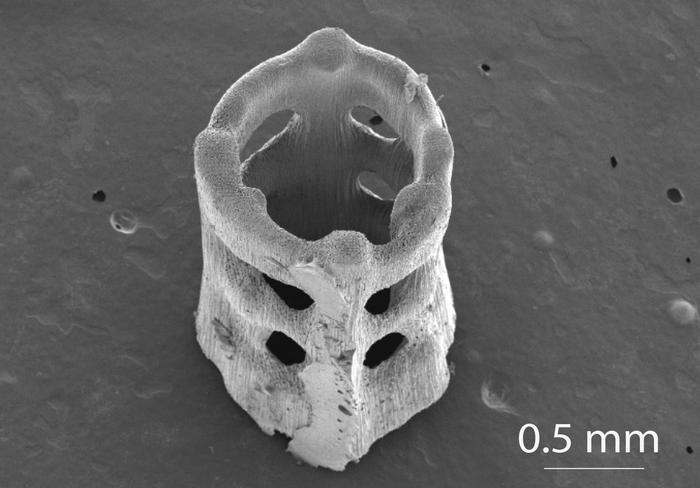
Researchers at the University of Utah’s John and Marcia Price College of Engineering, in collaboration with researchers from The University of Texas at Austin, have demonstrated a new method of 3D printing that avoids the leaky seams that come with the layer-by-layer process. Using a nanoscale “mask” that diffracts laser light into a holographic pattern of the desired shape, it fuses its print material solid in one shot. The process can take as little as 7.5 seconds, a stark contrast from the hours other laser-based printing methods can take.
In a paper published earlier this year, the Price researchers demonstrated this technique by printing microtubule assemblies with individual diameters as small as 6 micrometers. Long, thin tubes were a natural fit for the printing techniques capabilities, but those capabilities are already expanding.
Now, along with colleagues from UT Austin, they have demonstrated even more complicated prints, including ones that have hollow voids along multiple axes.
Their latest study, published in the journal Science Advances, was led by Rajesh Menon, professor in the Department of Electrical & Computer Engineering, along with lab member Dajun Lin. They collaborated with Texas’ Michael Cullinan, associate professor of mechanical engineering, and Zachariah A. Page, associate professor of chemistry, as well as members of their labs.
Like their previous study, this project takes inspiration from photolithography but applies the concept to three dimensions.
The researchers’ prints are made of a specially formulated resin. Consisting of stringy polymers, those molecular threads crosslink and harden when exposed to laser light. The unexposed sections of the substrate can then be easily washed away, leaving the desired shape behind.
In 2D photolithography, that shape is controlled by an opaque mask that blocks the laser from reaching the unwanted parts of the substrate. This approach is fine for two dimensions, since light only needs to reach the substrate’s surface. To apply the concept to three dimensions, the laser must pass through the substrate itself, crosslinking a volume of space inside. The challenge there is accuracy; because the substrate isn’t perfectly transparent, it will diffract the path of the laser as it passes through, causing blurring.
Menon’s group devised a way around the blurring problem: a nanopatterned mask that compensates for the substrate’s diffraction. Placed in front of the light source, the mask channels the laser’s energy only to the volume of substrate that will become the final print.
In their previous demonstration of the printer, the researchers made a variety of complex microtubule arrays, with dimensional ratios as high as 120:1. These prints featured voids along their length and width—the hollow portions of the tubes—but could not make them along the print’s height, leading Menon to call them “extended 2D” rather than “true 3D.”
In their latest paper, however, Menon and colleagues have devised a way around this limitation.
Starting with tweaks to the chemical makeup of their resin, the researchers take advantage of the fact that the light exposure and curing process happen at vastly different timescales, with the former taking place multiple orders of magnitude faster than the other. Through careful computational engineering, the researchers can design their photomasks such that print regions intended to remain hollow voids are kept dark enough to avoid crosslinking.
“We engineer the way light flows through the resin such that there are bright regions where we want curing to happen—the solid regions of the print—and darker regions where we don’t,” says Menon.
The resulting shapes, including a hollow cylinder and cube, serve as a proof-of-concept for even larger prints, all done in a matter of seconds.
Reference
Single-exposure holographic 3D printing via inverse-designed phase masks
Dajun Lin, Xiaofeng Chen, Connor J. O’Dea, Ji-Won Kim, Keldy S. Mason, Barbara Groh, Kwong Sang Lee, Apratim Majumder, Chih-Hao Chang, Michael Cullinan, Zachariah A. Page, Rajesh Menon
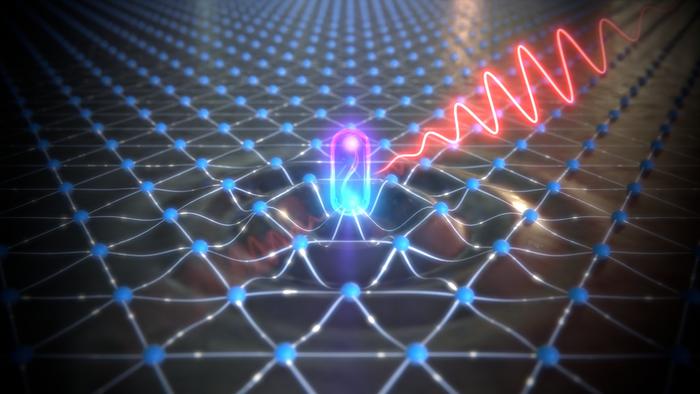
Researchers at the University of Basel and Technical University of Munich have used light to probe the collective motion of electrons in a Wigner crystal formed in monolayer tungsten diselenide. Optical signatures of Wigner crystal polarons reveal internal dynamics of this fragile quantum state, opening a new window into strongly correlated electronic systems. Published in Nature Physics.
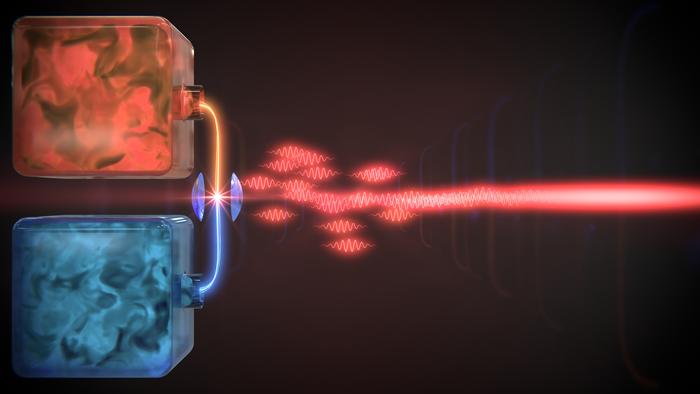
Thermodynamics was built for steam engines; quantum mechanics for atoms. The two meet again in a driven cavity, where an atom absorbs and emits photons while a laser continuously supplies energy and light leaks through the mirrors. Patrick Potts and colleagues at the University of Basel treat this textbook open system as a miniature light engine. Their key step is not to count every escaping photon as waste heat. Part of that outgoing energy can still do work on another quantum system. That b...

Electrons are indivisible, yet in a strong magnetic field they can move as if they carried only a fraction of their charge. Mitali Banerjee’s group at EPFL has built a bilayer-graphene antidot—a small electrically defined energy hill—that measures those fractions directly. Quasiparticles circle the hill and tunnel at regular intervals as the magnetic field or gate voltage is swept. The spacing of the resulting conductance oscillations gives the charge. The team recorded e/3 at filling factors...
