Tohoku University

Scientists have achieved a breakthrough in the development of non-volatile phase change memory−−a type of electronic memory that can store data even when the power is turned off−−in a material that has never displayed the sort of characteristics that such memory requires.
Until now, phase change memory has primarily been developed using chalcogenides−−a group of materials known to exhibit reversible electrical changes when they transition between their crystalline and amorphous states.
But what if there's an even better material out there?
In a recently published study, researchers report a thermally reversible switching of room-temperature electrical resistivity in a layered nickelate−−potentially offering better performance and superior sustainability.
The study was published in the journal Advanced Science on September 3, 2023.
Layered nickelates are a class of complex oxide materials composed of nickel ions. They exhibit a layered structure, where planes of nickel and oxygen atoms are interspersed with layers containing other elements, often alkaline-earth or rare-earth elements. Their unique layered arrangement has drawn the interest of researchers due to the intriguing properties of their electrons, with potential applications in fields such as superconductivity and, in this case, electronics.
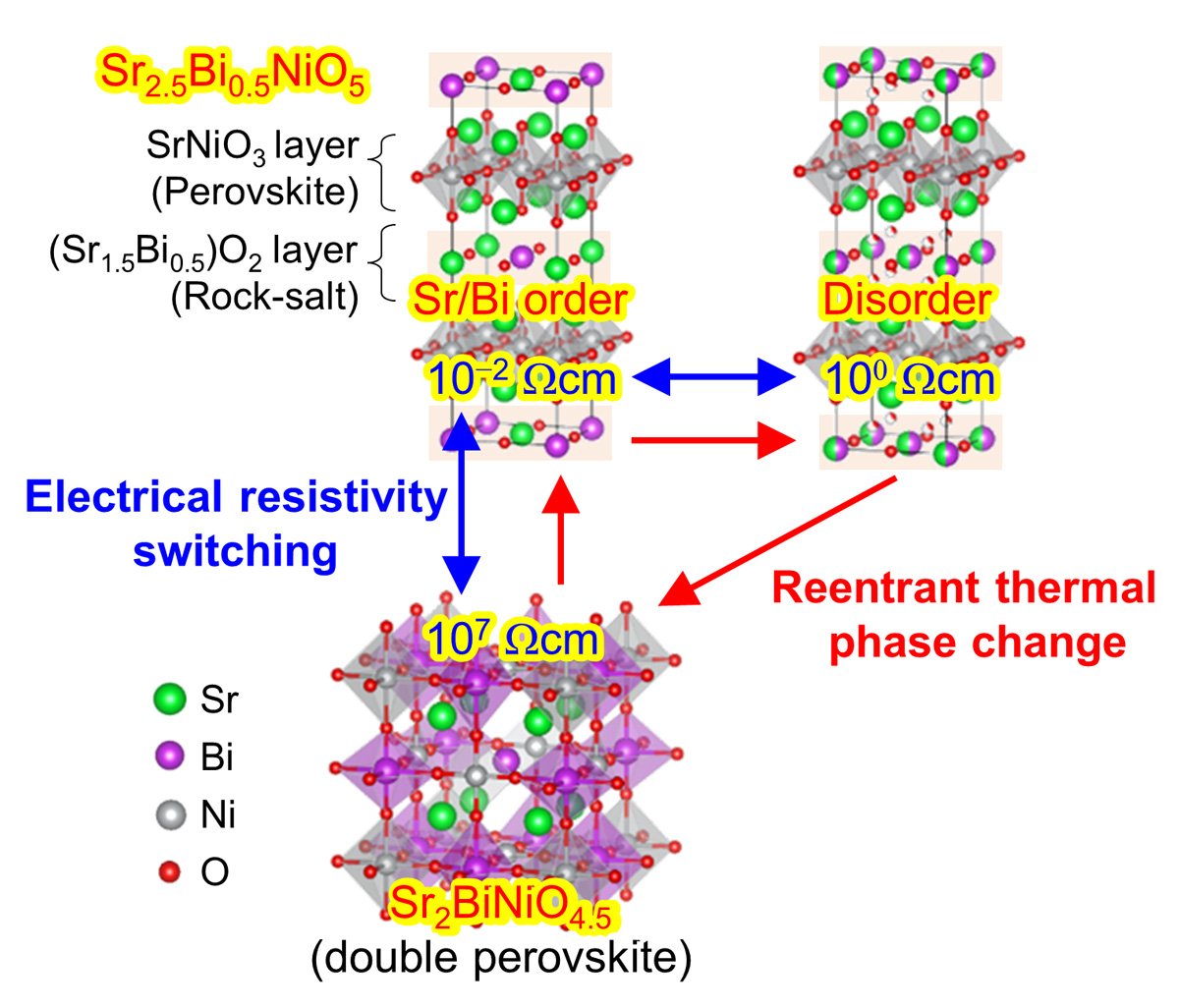
The researchers' particular layered nickelate is composed of layers of of strontium, bismuth and oxygen atoms in a 'rock salt' structural arrangement, interleaved with layers of molecules of strontium, nickel and oxygen atoms in a perovskite structure. Perovskites are defined by a specific crystal structure of two positively charged atoms and one negatively charged one, and have a number of intriguing properties, from superconductivity to ferroelectricity−−a spontaneous electric polarization that can be reversed by the application of an electric field.
This latter characteristic is of particular interest with respect to non-volatile phase change memory, as the latter relies on the ability of a material to switch between two states of electrical resistivity in a reversible manner.
"We wanted to know if a similar reversibility could be achieved thermally," said Hideyuki Kawasoko, co-author of the study and a materials scientist at Tohoku University in Japan.
Such reversibility has been demonstrated in various chalcogenides−−any compound formed with elements from group 16 of the periodic table (such as sulfur, selenium and tellurium), but not in transition metal oxides (compounds of oxygen and any elements found in the middle portion of the periodic table, specifically in groups 3 through 12)−−at least until now.
This is important because while chalcogenides have already proven effective for many phase-change memory applications, transition metal oxides often exhibit better thermal and chemical stability compared to some chalcogenides. This could lead to devices that have longer lifetimes and can operate under more challenging conditions.
Many transition metal oxides are also more abundant than chalcogenides, which can reduce costs and improve sustainability. And transition metal oxides are already widely used in electronics, sensors, and related applications. If they can be adapted to new functions, such as phase change memory, it might be easier to integrate them into existing manufacturing processes and devices−−further simplifying the supply chain, which potentially has additional sustainability advantages.
The researchers found that their particular layered nickelate exhibits a thermally reentrant crystalline phase change. This refers to a type of phase change that occurs when a material undergoes a reversible transition between three crystalline phases upon heating and cooling.
"Basically, the material can switch back and forth between the three phases multiple times as it is heated and cooled," said Tomoteru Fukumura, the other author of the paper.
This is in contrast to a typical phase change, which is irreversible and occurs only once as the material is heated or cooled. The thermally reentrant phase change observed in the layered nickelate in the study is significant because it enables the reversible switching of electrical resistivity−−and, crucially, at room temperature, which allows for the development of multi-level non-volatile phase change memory using this type of material, and in everyday applications.
The study also shed light on the specific mechanisms that are involved in the reversible switching of room-temperature electrical resistivity, which could have important implications for any devices that rely on non-volatile memory much more widely than with respect to this study's particular material.
Reference
Thermally Reentrant Crystalline Phase Change in Perovskite-Derivative Nickelate Enabling Reversible Switching of Room-Temperature Electrical Resistivity
Kota Matsumoto, Hideyuki Kawasoko, Eiji Nishibori, Tomoteru Fukumura
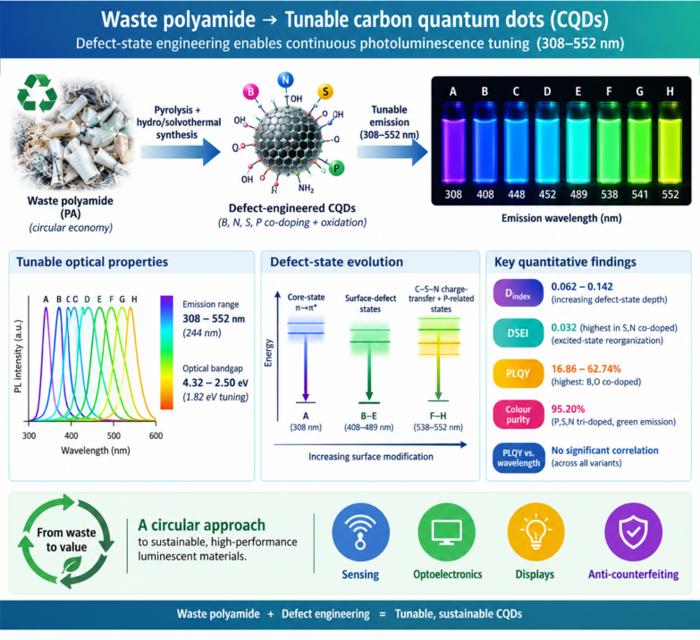
Waste polyamide-derived CQDs show continuous photoluminescence tuning from 308 to 552 nm through sequential defect-state engineering, with optical transition energies decreasing from 4.32 to 2.50 eV. @Christian Ebere Enyoh from Saitama University Carbon quantum dots (CQDs) are fluorescent carbon nanomaterials with potential applications in sensing, optoelectronics, displays, anti-counterfeiting, and environmental technologies. Their optical properties can be adjusted by modifying the carbon...
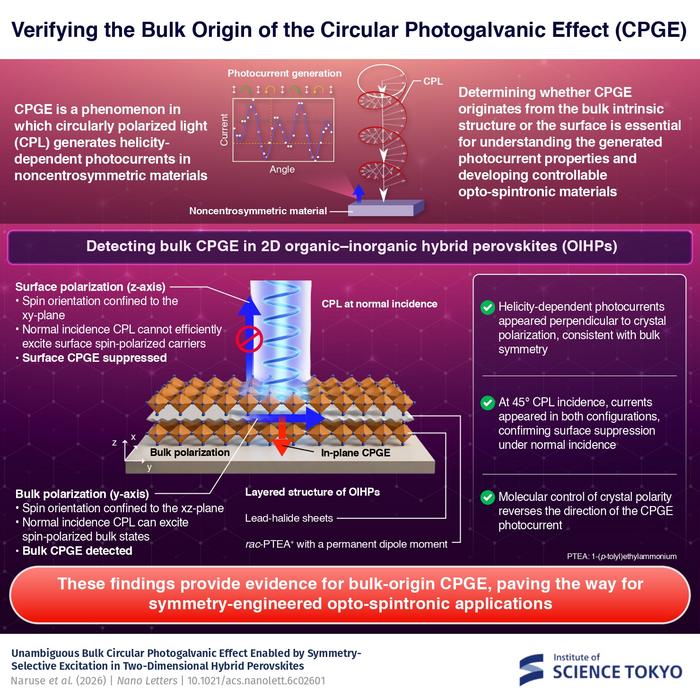
The researchers used circularly polarized light at normal incidence and found that helicity-dependent photocurrents appeared perpendicular to the crystal’s polarization but vanished when measured parallel to it, supporting a bulk origin of CPGE. @Institute of Science Tokyo The circular photogalvanic effect (CPGE), a phenomenon that generates helicity-dependent photocurrents in noncentrosymmetric materials, can originate purely from a crystal's internal structure without contribution from the...
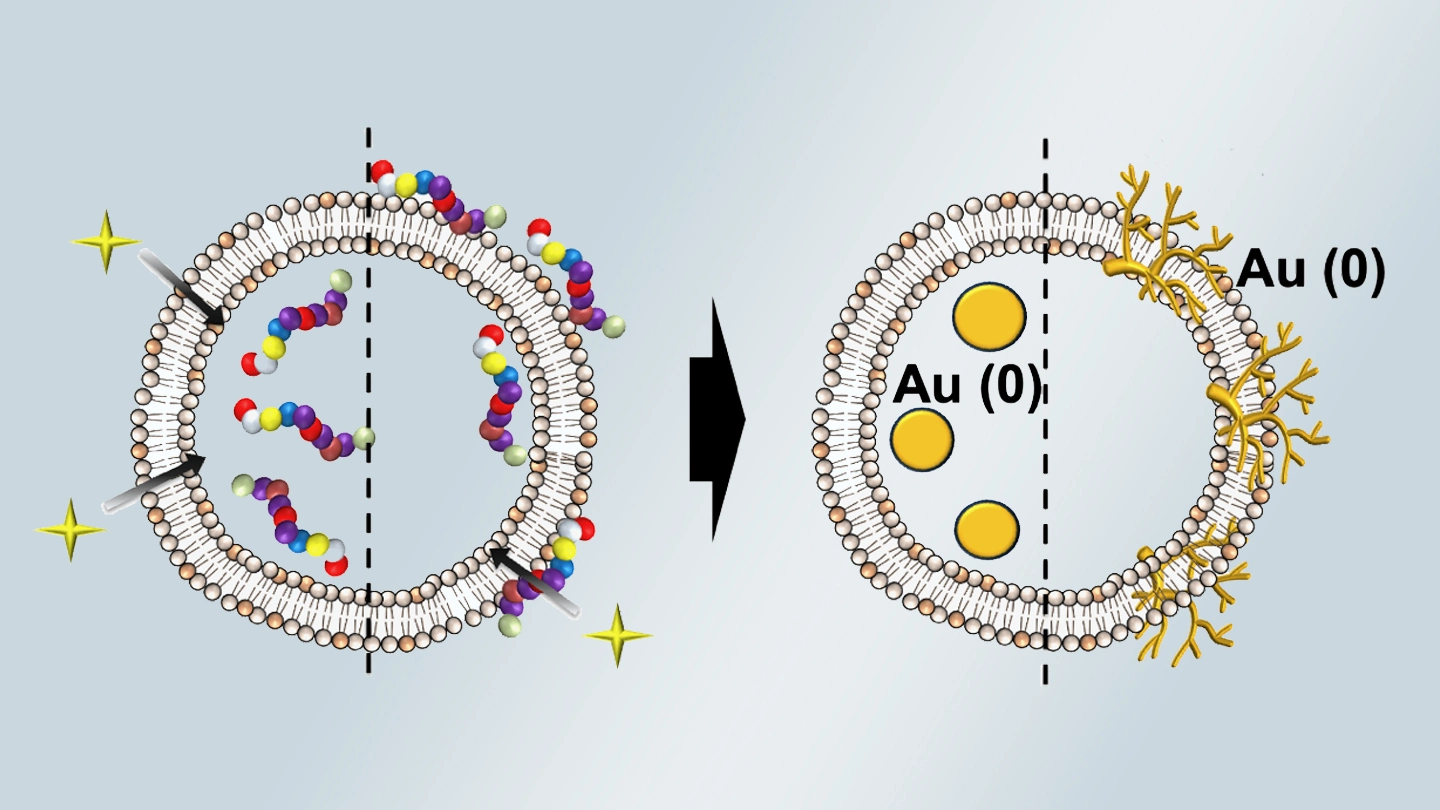
Summary of gold nanoparticle growth programming in liposome based on localization of biomineralization peptide The position of biomineralization peptides within liposomes can influence how gold nanoparticles grow, reports a research team from Institute of Science Tokyo. Peptides localized at the membrane interface promote branched structures, while those confined to the liposome interior favor spherical nanoparticles. The findings offer a new strategy for controlling nanoscale reaction...
