Chalmers University of Technology
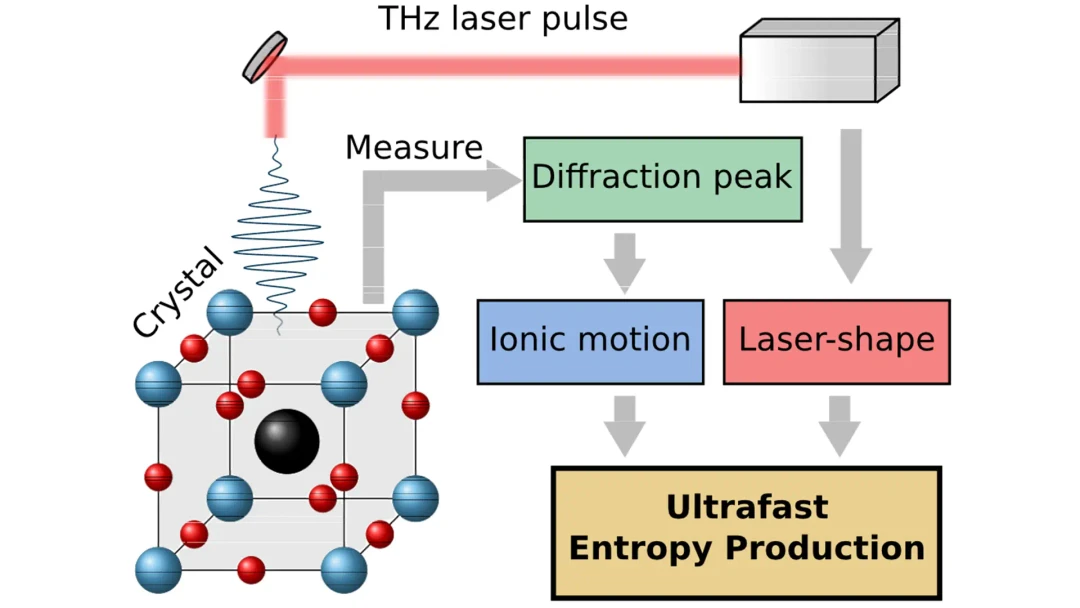
Entropy, the central quantity of thermodynamics, is produced in several systems but cannot be measured directly. An equation developed by researchers at Chalmers University of Technology and Heinrich Heine University Düsseldorf, now sheds new light on how entropy is produced on a very short time scale in laser excited materials.
“New computational models give us new research opportunities. Extending thermodynamics for ultrashort excitations will provide novel insights into how materials function on the nanoscale,” says researcher Matthias Geilhufe.
Entropy is a measure of irreversibility and is central in thermodynamics. Two centuries ago, it was part of a conceptual breakthrough, building the theoretical framework for machines, fundamental for the industrial revolution. Today, we are seeing advances in new areas of nano and quantum devices, but still, entropy is a pivotal concept.
“A system usually wants to evolve to a state with maximum entropy. It can be compared to a sugar cube dissolving in a glass. While the sugar dissolves, the system composed of water and sugar slowly increases its entropy. The reverse process – a spontaneous formation of a sugar cube – is never observed,” says Matthias Geilhufe, Assistant Professor at the Department of Physics at Chalmers University of Technology.
A computational model for entropy
“If we turn to how entropy is formed in devices, they all need to be turned on and off, or need to move something from A to B. As a consequence, entropy is produced. In some cases, we would like to minimize the entropy production, for example to avoid information loss,” says Matthias Geilhufe.
While entropy has become a well-established concept, it cannot be measured directly. However, Matthias Geilhufe together with researchers Lorenzo Caprini and Hartmut Löwen at Heinrich Heine University Düsseldorf, have developed a computational model to measure entropy production on a very short time scale in laser excited crystalline materials. Their research was recently published in an article in Nature Communications.
Phonons in crystalline materials can produce entropy
Crystalline materials are essential for various technologies that transfer and store information over short periods, such as semiconductors in computers or magnetic storage spaces. These materials are made up of a regular crystalline lattice, whereby atoms arrange in repeating patterns. Laser light can shake the atoms into a collective motion which physicists call phonons. Astonishingly, phonons often behave as if they were a particle. They are called quasiparticles, to distinguish them from actual particles like electrons or ions.
What the researchers now have discovered, is that the phonons – the lattice vibrations in the crystalline materials – can produce entropy in the same way as bacteria in water as shown by previous research in biological physics by Caprini and Löwen. By the very nature of the phonon being a quasiparticle in a crystal it can be shown that the same mathematical pattern holds as for their biological counterparts in water. This insight precisely determines the entropy and heat production in laser excited materials and allows us to understand or even change their properties on demand.
New perspectives on ultrafast materials
The researchers’ computational model can also be applied to other types of material excitations and thus opens a new perspective in the field of research on ultrafast materials.
“In the long run, this knowledge can be useful for tailoring future technologies, or lead to new scientific findings,” says Matthias Geilhufe.
Reference
Ultrafast entropy production in pump-probe experiments
Lorenzo Caprini, Hartmut Löwen & R. Matthias Geilhufe
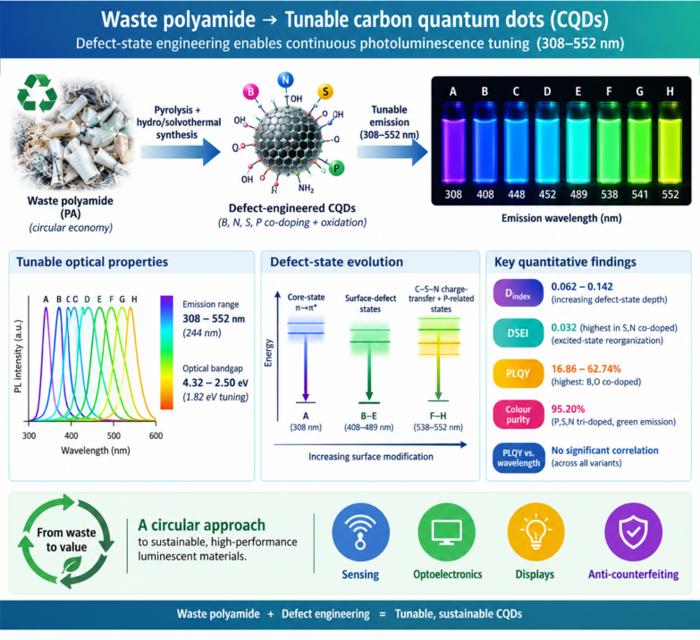
Waste polyamide-derived CQDs show continuous photoluminescence tuning from 308 to 552 nm through sequential defect-state engineering, with optical transition energies decreasing from 4.32 to 2.50 eV. @Christian Ebere Enyoh from Saitama University Carbon quantum dots (CQDs) are fluorescent carbon nanomaterials with potential applications in sensing, optoelectronics, displays, anti-counterfeiting, and environmental technologies. Their optical properties can be adjusted by modifying the carbon...
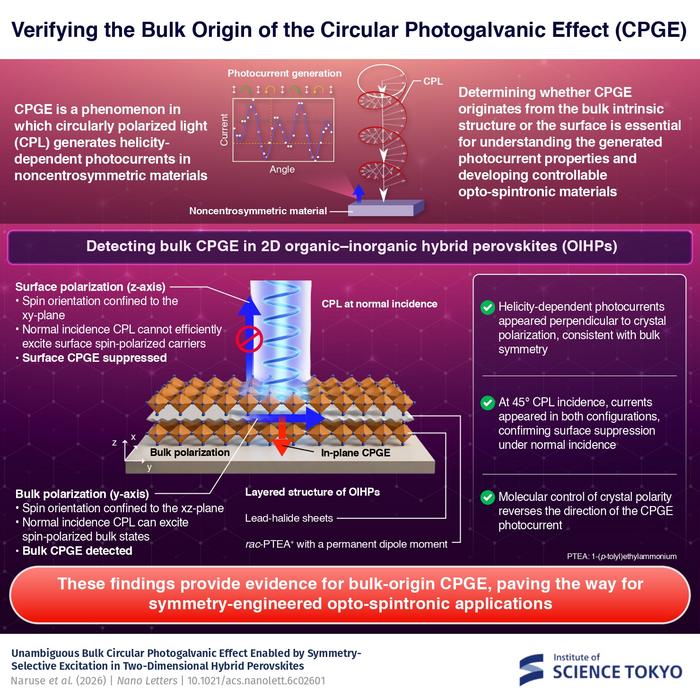
The researchers used circularly polarized light at normal incidence and found that helicity-dependent photocurrents appeared perpendicular to the crystal’s polarization but vanished when measured parallel to it, supporting a bulk origin of CPGE. @Institute of Science Tokyo The circular photogalvanic effect (CPGE), a phenomenon that generates helicity-dependent photocurrents in noncentrosymmetric materials, can originate purely from a crystal's internal structure without contribution from the...
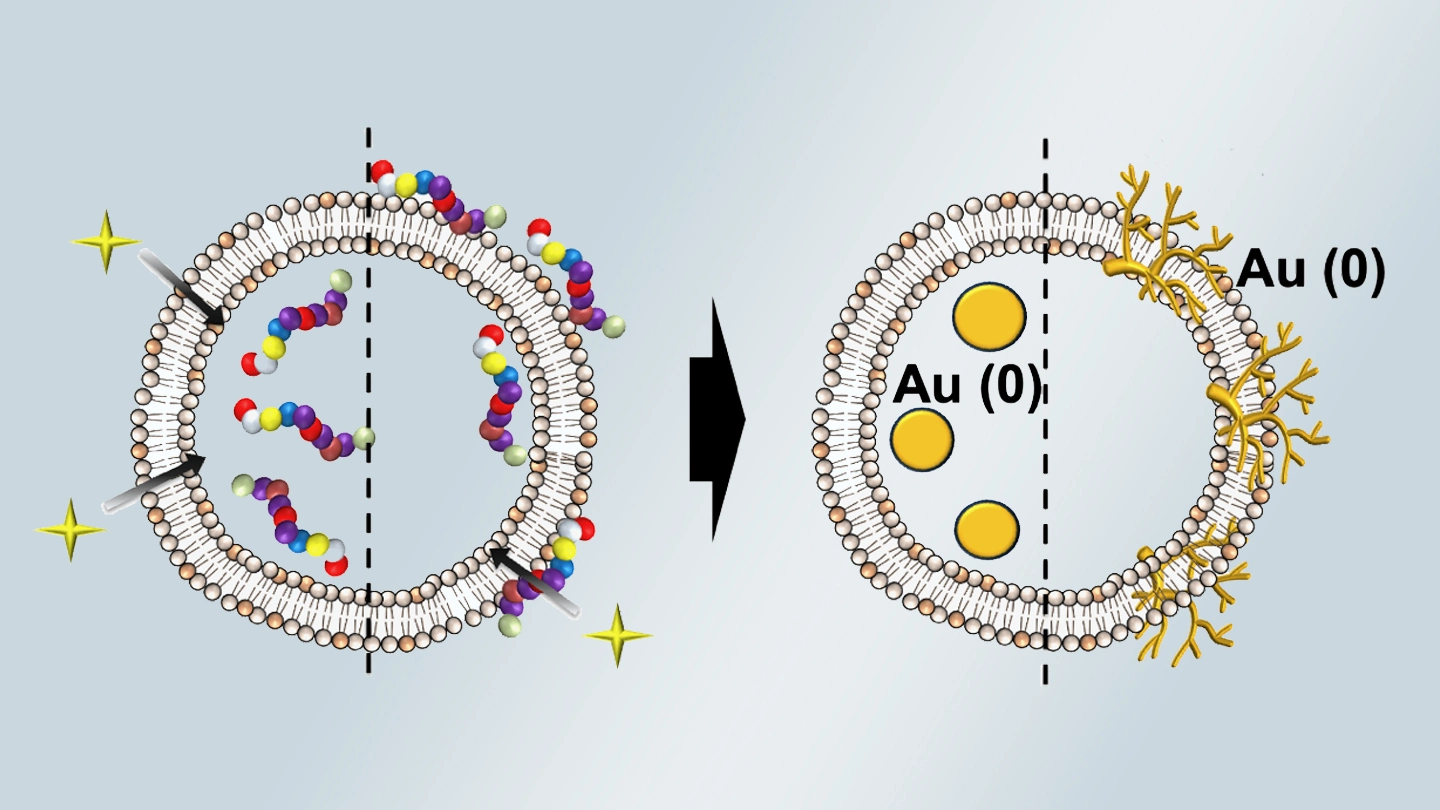
Summary of gold nanoparticle growth programming in liposome based on localization of biomineralization peptide The position of biomineralization peptides within liposomes can influence how gold nanoparticles grow, reports a research team from Institute of Science Tokyo. Peptides localized at the membrane interface promote branched structures, while those confined to the liposome interior favor spherical nanoparticles. The findings offer a new strategy for controlling nanoscale reaction...