Chongqing University
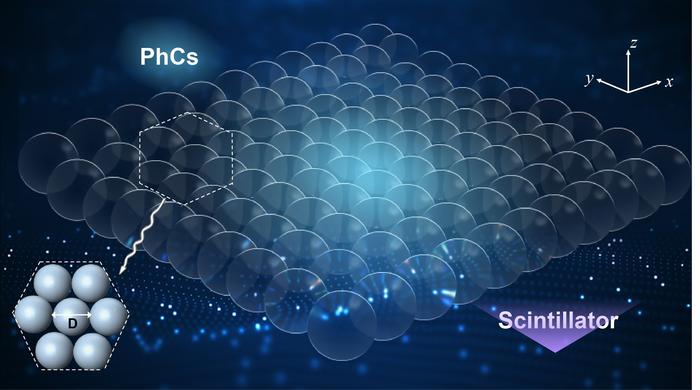
Improving X-ray imaging under photon-starved conditions could enable lower-dose and higher-resolution imaging for medical diagnosis, security inspection, and industrial testing. Researchers from Chongqing University, the 26th Institute of CETC, and Stevens Institute of Technology developed a scalable photonic crystal scintillator using Marangoni effect-driven interfacial self-assembly. The approach increased average light output by 4.64-fold and improved the X-ray imaging signal-to-noise ratio by 13 dB while maintaining spatial resolution better than 25 μm.
X-ray imaging technology plays an indispensable role in medical diagnosis, security inspection, and industrial non-destructive testing, and scintillators are the core "photosensitive" components within this technological system.
Essentially, a scintillator is a specialized energy-conversion material. It absorbs high-energy X-ray photons invisible to the human eye and converts them into visible light signals, which are then captured by a downstream camera or photodetector and reconstructed into images. It functions like a precision "translator," converting the "language" of high-energy radiation into the language of optics.
However, although high-density inorganic scintillators (such as GAGG:Ce) are widely valued for their strong X-ray stopping power and high luminescence efficiency, their practical performance has long been limited by a fundamental physical bottleneck: refractive index mismatch. Since the refractive index of scintillator materials is far higher than that of the surrounding air or packaging medium, most of the visible light generated inside the material undergoes total internal reflection at the interface when trying to escape. As a result, up to 90% of photons are confined inside the material in waveguide modes and cannot be effectively utilized.
This severe photon trapping effect reduces the sensitivity and signal-to-noise ratio of detectors. The problem becomes even more prominent when ultra-thin scintillators are required for high-resolution imaging or under low-dose radiation conditions, making it a key barrier to high-performance X-ray imaging.
To overcome this limitation, researchers have introduced photonic crystal structures. Their operating principle is analogous to etching nanoscale periodic gratings onto the scintillator surface: via Bragg diffraction, they provide additional momentum compensation to couple the originally trapped guided modes into free-space radiation, thereby greatly improving light extraction efficiency.
The fundamental motivation for this research stems from the shortcomings of existing manufacturing technologies. Traditional top-down lithography, while highly precise, requires expensive equipment and complex processes, and is difficult to implement on large-area brittle scintillator substrates. Bottom-up self-assembly methods, by contrast, are low-cost but have long suffered from disordered defects such as cracks, vacancies, and multi-crystal domains during large-area film formation. These defects limit the brightness enhancement effect and introduce imaging artifacts.
To address this challenge, the research group of Associate Professor Feng Peng from Chongqing University, in collaboration with Dr. Ding Yuchong from the 26th Institute of CETC and PhD candidate Kaifeng Liu from Stevens Institute of Technology, USA, have successfully proposed and validated a Marangoni effect-driven interfacial self-assembly strategy for the scalable fabrication of large-area, high-quality photonic crystal scintillators.
This work, entitled Scalable Photonic Crystal Scintillators for High-Performance X-ray Imaging in Photon-Starved Regimes, was made available online on September 16, 2026, in the journal Opto-Electronic Advances. The researchers exploited the surface tension gradient induced by an ethanol-water binary solvent system, combined with surfactant-assisted interfacial densification and vibration-free drainage transfer technology, to construct a macroscopically continuous monolayer photonic crystal structure composed of polystyrene nanospheres with hexagonal close-packed features on a 25 mm-diameter GAGG:Ce scintillator wafer.
Traditionally, improving the X-ray detection sensitivity often relies on increasing the scintillator thickness, but the resulting lateral light diffusion degrades spatial resolution. This work instead focuses on the scintillation light extraction interface. By constructing periodic photonic crystals to regulate light propagation and emission inside the scintillator, it provides a new approach to alleviate the trade-off between sensitivity and spatial resolution.
Studies demonstrate that the periodic photonic crystal structure provides additional in-plane momentum. Through momentum matching, it couples optical modes originally confined within the scintillator into free-space radiation modes, significantly improving scintillation light extraction.
In experiments, the photonic crystal-modified scintillator achieved an approximately 4.64-fold increase in average light output and a 13 dB improvement in signal-to-noise ratio in X-ray imaging while maintaining a spatial resolution better than 25 μm.
This technology is particularly suitable for photon-starved scenarios, such as low-dose medical diagnosis, rapid security screening, and high-precision industrial non-destructive testing. It can improve imaging quality under weak signal conditions and is expected to support lower-radiation-doses and higher-definition X-ray imaging.
Looking ahead, the technology requires further optimization of the self-assembly process to eliminate the minor impact of residual structural defects on resolution, and exploration of compatibility with a broader range of scintillator materials, providing a practical technical pathway for low-cost, high-performance X-ray detectors.
Reference
Scalable photonic crystal scintillators for high-performance X-ray imaging in photon-starved regimes
Yao Zhu, Chentao Li, Sijun Cao, Junan Lai, Peng He, Qiang Wang, Xiong Xiao, Kaifeng Liu, Yuchong Ding, and Peng Feng
https://www.oejournal.org/oea/article/doi/10.29026/oea.2027.260038
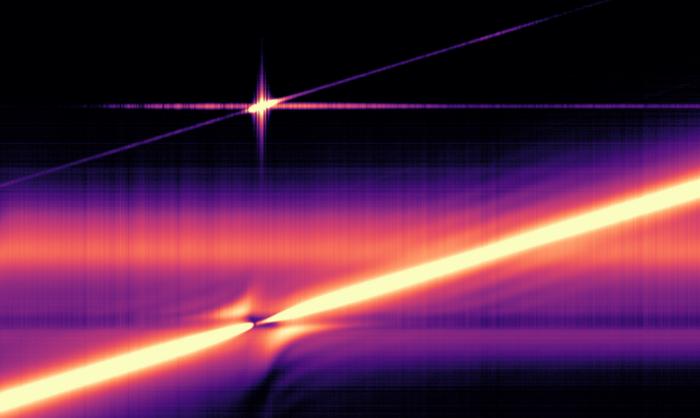
Researchers at the Max Planck Institute for the Science of Light and Leibniz University Hannover have achieved strong coupling between light and long-lived acoustic vibrations in an optical fiber for the first time, using stimulated Brillouin scattering at 4 K without any optical or mechanical resonator. A measurable gap in the spectral response confirms the effect, which typically appears only in cavity systems.
EMode Photonix has raised a $1 million pre-seed round led by Ground State Ventures, with participation from Harlow Capital Management. The company's simulation stack speeds up non-linear photonic circuit simulation by 1,000x.
Bristol-based Siloton has secured an £8.4 million contract from Innovate UK to accelerate development of its handheld GiraffeOCT eye imaging system and complete clinical trials over two years.
This week in nanotech
$2.28B raised
12 funding rounds · 66 deals tracked
New products
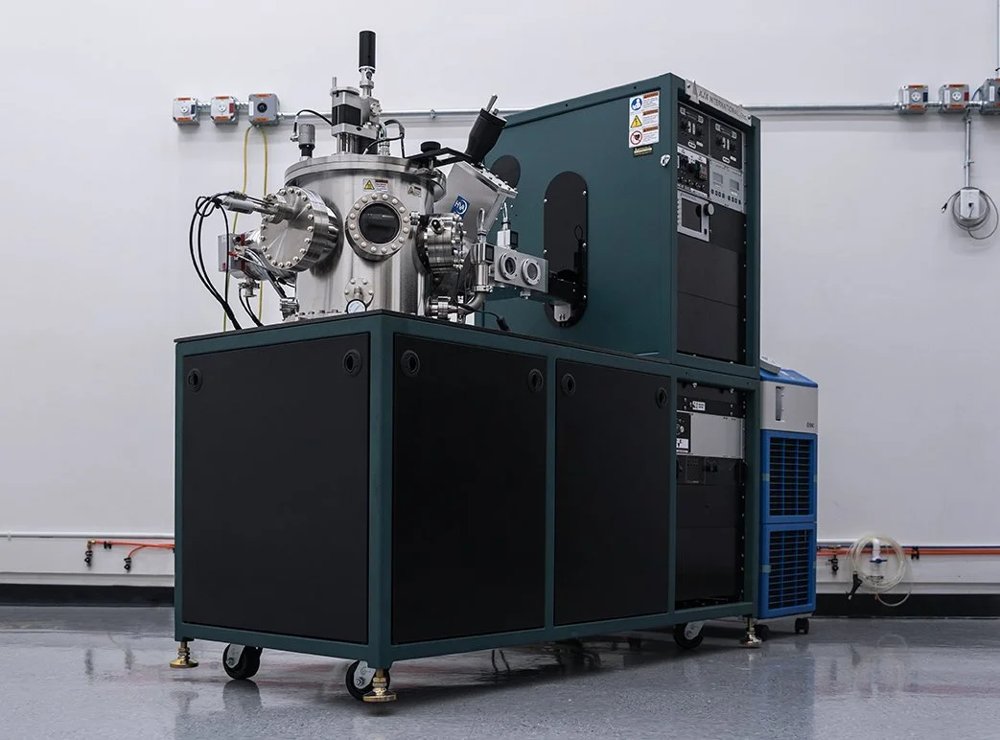 Orion Sputtering Deposition SystemsAJA International Featured
 Nion-compatible In Situ STEM Holders for Electrical BiasingHummingbird Scientific Featured
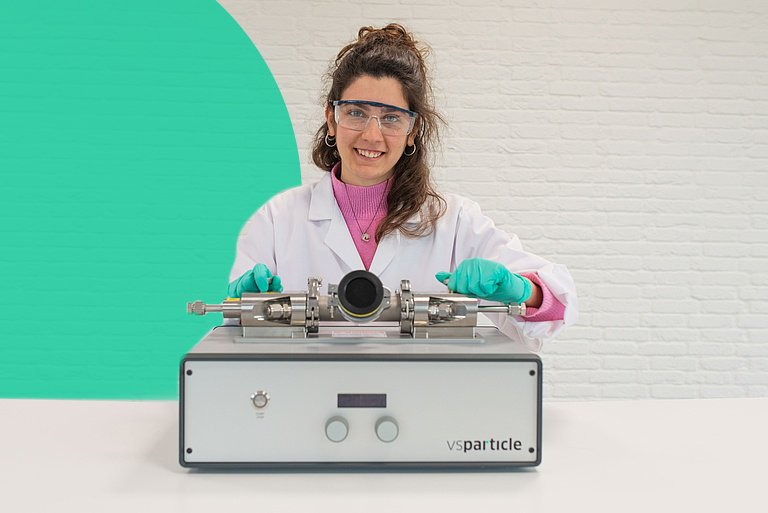 VSPARTICLE Nanoparticle Generator (G1)VSParticle
Market insights
Last 30 days: Quantum Technologies drew the most money: $3.17B.
Money raised per month