California Institute of Technology
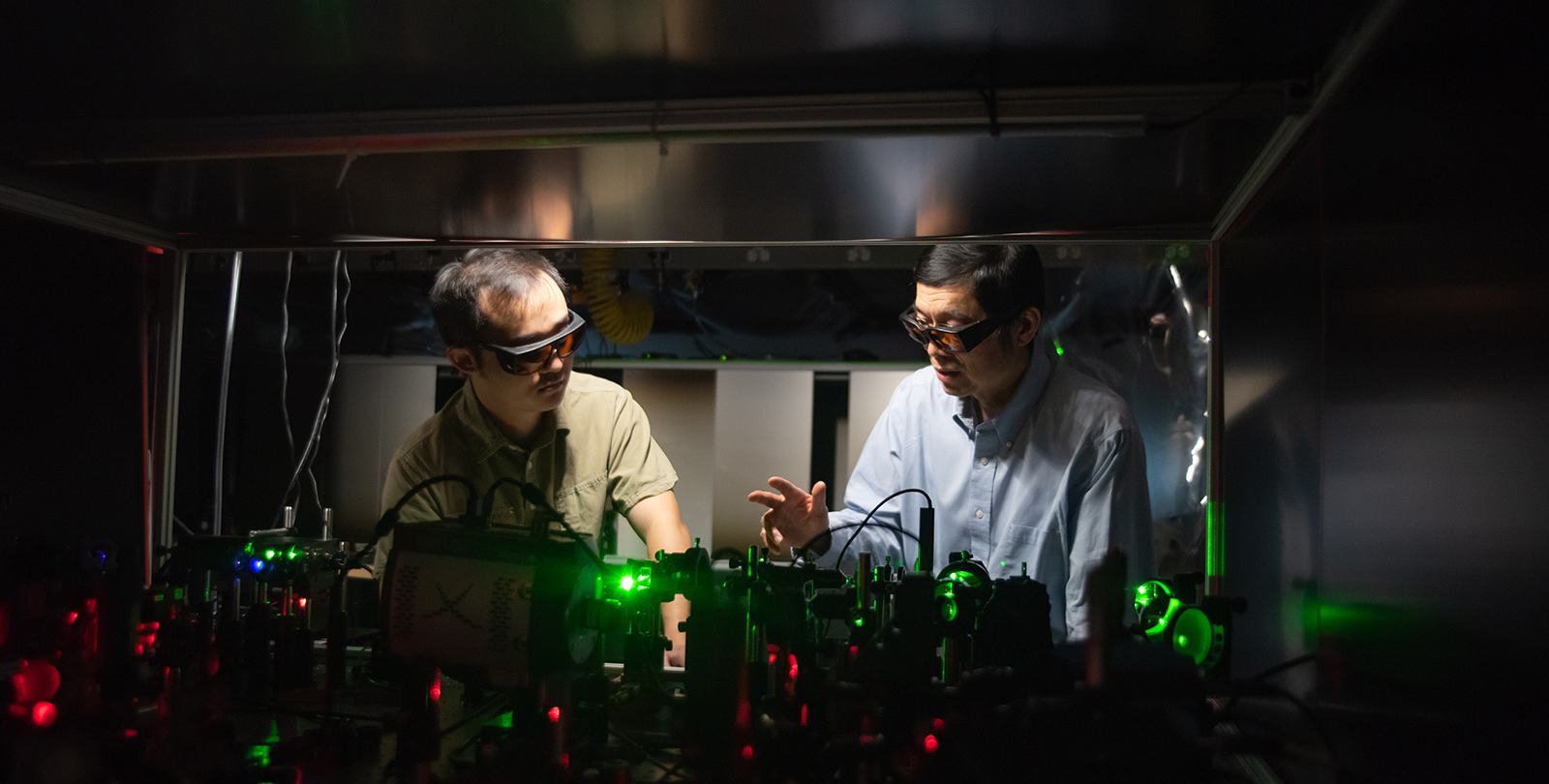
Three years after a team of Caltech scientists showed that pairs of entangled photons could double the resolution of a light microscope, the same lab has figured out a way to double down on that improvement. They have now achieved a fourfold resolution boost compared to a classical microscope, using a new optical design that sends one of the entangled photons through the microscope's optics three times rather than just once.
The work, led by Lihong Wang, the Bren Professor of Medical Engineering and Electrical Engineering and the Andrew and Peggy Cherng Medical Engineering Leadership Chair at Caltech, builds on the lab's 2023 demonstration of quantum microscopy by coincidence (QMC). The approach relies on one of those bizarre quantum-mechanical phenomena called entanglement, in which two particles are linked such that the state of one particle is intimately tied to the state of the other no matter how far apart they might be.
In QMC, entangled pairs of photons, called biphotons, are split so that one photon, called the signal photon, passes through the sample while its entangled partner, called the idler photon, travels a separate parallel path. In some ways, the pair behaves as a single particle that has twice the momentum of an individual photon. According to the laws of quantum mechanics, a particle's wavelength is inversely related to the momentum of the particle. That means that either one of the photons in a biphoton pair effectively images with a wavelength that is half that of the original light. And because microscope resolution improves as wavelength shrinks, this creates a twofold improvement in resolution.
In the new setup, the team still passes a signal photon through the object to be imaged just once. However, the idler photon is routed back through the same pair of lenses three times before it reaches the detector. This is accomplished by applying a magnetic field and using optical tools, including special beam splitters that help the scientists control a property of light called polarization, which is roughly the direction in which the electric field of a light wave travels.
The team describes the setup and experimental validation in a paper published in the journal Science Advances.
"Now we have entered a new physical regime," says Wang, who is also the executive officer for medical engineering at Caltech. "In general, people think that with a single photon pair, you can, at most, increase the resolution from the classical diffraction limit by two times. But we've gone beyond that. This is the most exciting aspect of our new paper, because it points us in a direction where we can improve even further—10 times or maybe even 100 times—down the road."
Wang and his team investigated the power of the new system by imaging a standard test target with the classical imaging setup, their previous twofold quantum configuration, and the new triple-pass configuration. When they measured the sharpness of edges and fine features of the target, they found that the twofold configuration improved resolution by about 1.8 times over classical imaging, while the new setup achieved an enhancement of roughly four times.
The work has clear biomedical applications. Standard high-resolution retinal imaging sometimes requires light that is so bright that it can temporarily affect a patient's vision. The light that reaches the imaging target in the new quantum imaging technique is much less intense and will not damage living tissue. The scientists say higher-resolution low-light imaging could eventually make it possible to see finer structures, such as cell nuclei and mitochondria, without causing damage.
It could also be useful in the inspection of semiconductor devices, where quality-control imaging sometimes entails using longer wavelengths that lead to poor resolution with classical optics. Wang says a fourfold resolution improvement at the same wavelengths could substantially enhance the detection of defects in chips.
Wang notes that while the experimental work validates the new approach, his team is still developing a theoretical model that explains the technique's ability to enhance resolution. In fact, Wang says, he originally had a hard time convincing his lab to try the approach. "Based on our previous theory, I thought this might be possible, but it was just a hunch," he says. "People felt it was risky, but eventually they started working on it. One night, one of my postdocs emailed me and said, 'It worked!' It was such a great moment. And now that we've observed this, we definitely want to push it even further."
The lead authors of the paper, titled "Above twofold quantum super-resolution microscopy enabled by multiple idler passes with entangled biphotons," are Wang lab alumnus Xin Tong (PhD '26), and former postdocs Zhe He, now at Shandong Institute of Advanced Technology in China, and Yide Zhang, now at the University of Colorado Boulder. Caltech graduate students Wenyu Liu and Chien-Ying Huang (MS '23) are also authors of the paper. The work was supported by Caltech's Center for Sensing to Intelligence, the Chan Zuckerberg Initiative DAF, the Silicon Valley Community Foundation, and the National Institutes of Health.
Reference
Above twofold quantum super-resolution microscopy enabled by multiple idler passes with entangled biphotons
Xin Tong, Zhe He, Yide Zhang, Wenyu Liu, Chien-Ying Huang, Lihong Wang
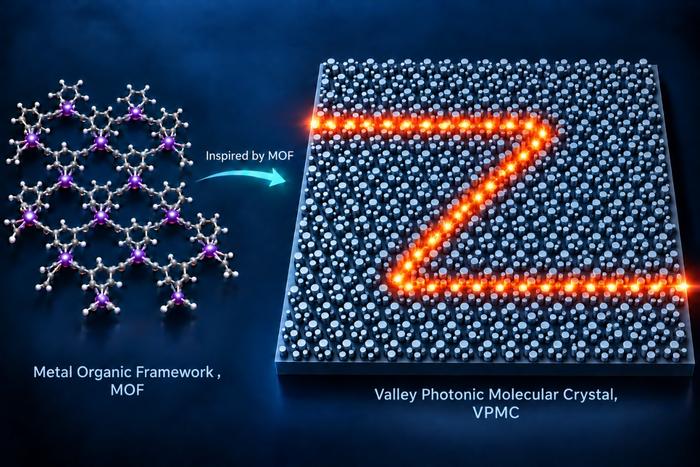
Inspired by Metal-Organic Framework based topological insulators, researchers at Tsinghua University proposed valley photonic molecular crystal (VPMC) and investigated the impact of molecular rotation on the valley-topological properties of VPMC. Credit: Tsinghua University/Xue Feng A research team led by Yidong Huang at Tsinghua University, including Xue Feng and Yongzhuo Li, has developed valley photonic molecular crystals (VPMCs) on a silicon platform. Combining theoretical modeling,...
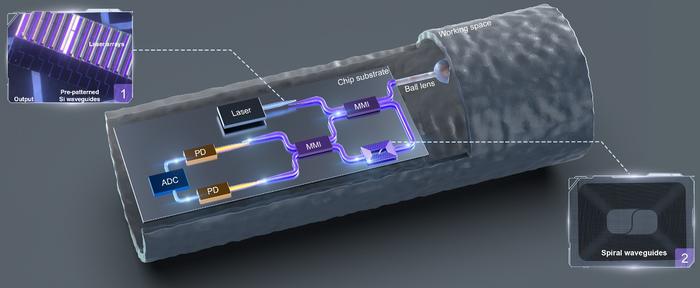
The system integrates a III-V semiconductor light source, SiN-based interferometers, Si-Ge photodetectors (PDs), and an integrated ball-lens microprobe, thereby combining the distinct advantages of multiple photonic integration platforms. The insets illustrate complementary technologies that can be incorporated to realize a miniaturized, fully integrated OCT system. Abbreviations: ADC, analog-to-digital converter. Inset 1: Foundry-scalable embedded III-V lasers on silicon-on-insulator (SOI)...

From left to right: Three photons with different quantum states enter an interferometer with three beam splitters. At each beam splitter, they can take different paths at the same time in superposition. The researchers then measured how often the three photons ended up together at the same output. Counterintuitively, it is possible to make the photons more similar to each other and at the same make them less likely to “bunch” together. AI-generated illustration, by Leonardo Novo. We usually...