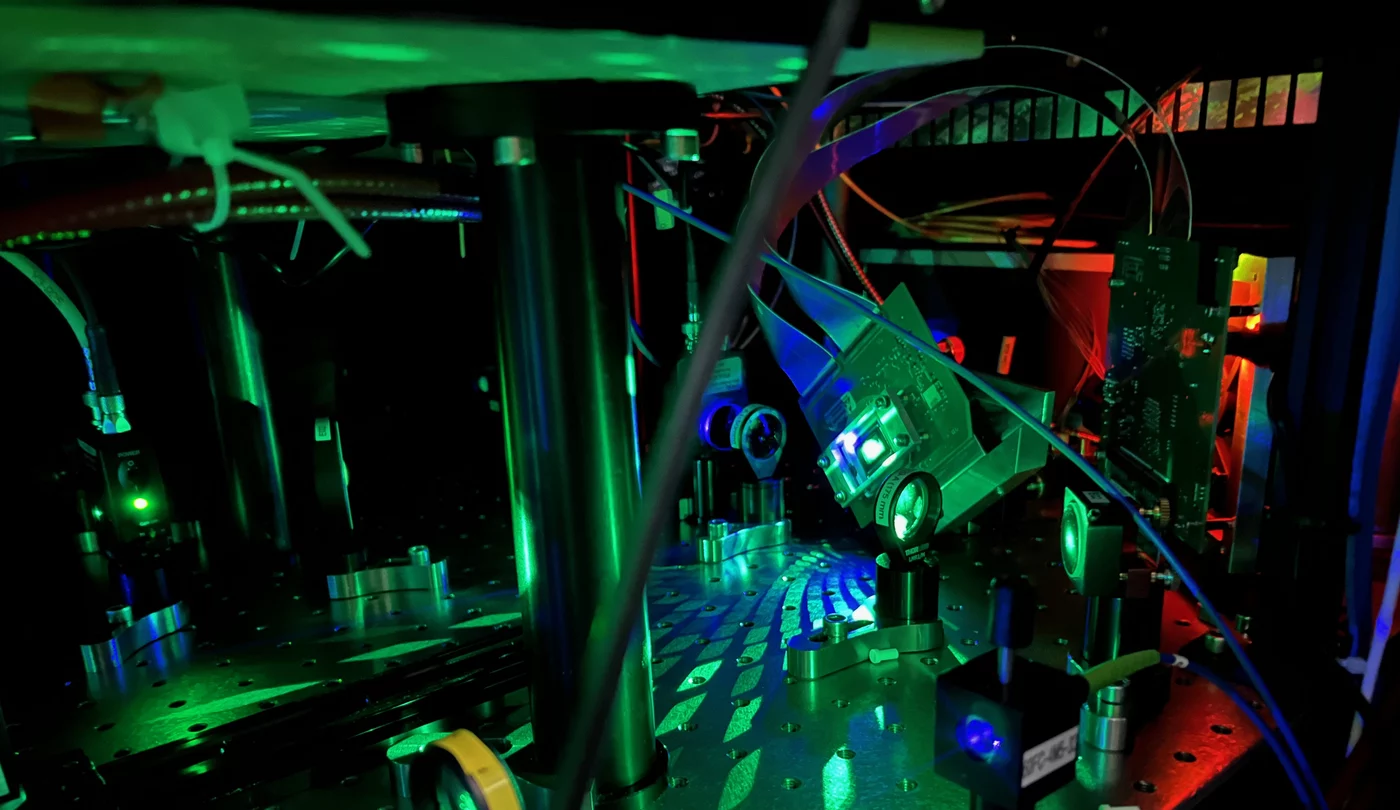
Researchers at MPQ and LMU Munich, led by Monika Aidelsburger and Immanuel Bloch, have experimentally demonstrated a strongly interacting quantum phase – known as the Mott-Meissner phase. This phase emerges from the combined influence of strong interactions and an artificial magnetic field. Using a novel platform based on a cesium quantum gas microscope, the team prepared and observed many-body states with more than 24 particles in a 48-site flux ladder. Their results mark a major breakthrough: Previous experimental studies of interacting particles in artificial magnetic fields had been limited to system sizes involving only two particles. The study opens the door to investigating other quantum phenomena, such as the fractional quantum Hall effect, with microscopic precision and control.
Among the most fascinating quantum phases are those emerging from strong interactions between a large number of particles. Such collective behaviour can give rise to exotic phenomena, including superconductivity, Mott insulators, and the fractional quantum Hall effect – phenomena that are absent in non-interacting systems. However, the intrinsic complexity of quantum many-body systems poses a significant challenge for numerical simulations, as computational resources quickly become insufficient once more than a few particles are involved. Quantum simulators based on ultracold atoms in optical lattices provide a powerful alternative approach to study many-body systems. By recreating the essential physics in a clean, highly controllable environment, they enable the precise investigation of many-body quantum phenomena.
One particularly intriguing class of many-body phases can be found in the fractional quantum Hall effect, where the interplay of strong interactions and magnetic fields leads to entirely new phases of matter. In cold atom systems, strong interactions occur naturally, but the atoms’ electrical neutrality prevents direct coupling to real magnetic fields as seen with electrons in solids. To overcome this, experimentalists employ techniques like Floquet engineering, where the optical lattice is modulated rapidly. This high-frequency shaking modifies the system’s effective properties, which can be used to create novel properties that are inaccessible in the static system – for example, an artificial magnetic field.
From two particles to twenty-four
However, the periodic 'shaking' of the system relaxes conservation of energy and atoms can absorb energy from the drive, which generally leads to heating. As a result, fragile quantum phases are quickly destroyed and the system becomes featureless. So far, experimental studies of interacting particles in artificial magnetic fields had been limited to very small systems, typically involving only two particles.
The team from LMU and MPQ made a major step forward: By leveraging their new cesium quantum gas microscope, they prepared and observed many-body states of more than 24 interacting atoms distributed over 48 sites under the influence of a synthetic magnetic field. They confined the system to a two-leg ladder geometry – a so-called flux ladder – where one of the hallmark phases is the Mott-Meissner phase. This phase is characterised by a homogeneous density due to the strong interactions (a Mott insulator), in combination with circular particle currents flowing atop the homogeneous density plateau.
Direct imaging of quantum currents
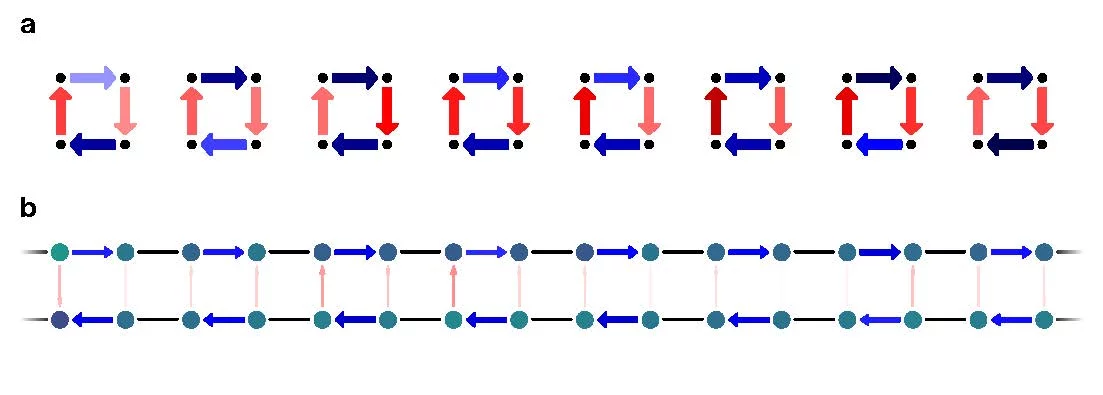
Using a recently developed method to measure local particle currents with single-site resolution, the researchers were able to directly image these circulating currents. Furthermore, by varying the interaction strength over a wide range, they probed how the currents respond to changes in interactions. Here, they found a clear distinction to a non-interacting system and good agreement with previous theoretical predictions. This allowed them to confirm that a genuine many-body regime was reached. They further benchmarked the finite temperature of their engineered many-body system – setting a new state of the art in quantum simulation of strongly-correlated phases with neutral atoms and an artificial magnetic field.
The work is set to open new avenues for the study of the exotic physics arising from the interplay of interactions and a magnetic field. This includes, for example, microscopic studies of the fractional quantum Hall effect and its properties such as anyonic excitations, long-range entanglement and topological order. These phenomena offer the potential to deepen our understanding of fundamental quantum physics while also paving the way for practical applications, for example in the field of fault-tolerant quantum computation.
Reference
Strongly interacting Meissner phases in large bosonic flux ladders
Alexander Impertro, SeungJung Huh, Simon Karch, Julian F. Wienand, Immanuel Bloch & Monika Aidelsburger
https://www.nature.com/articles/s41567-025-02890-0
Max Planck Society
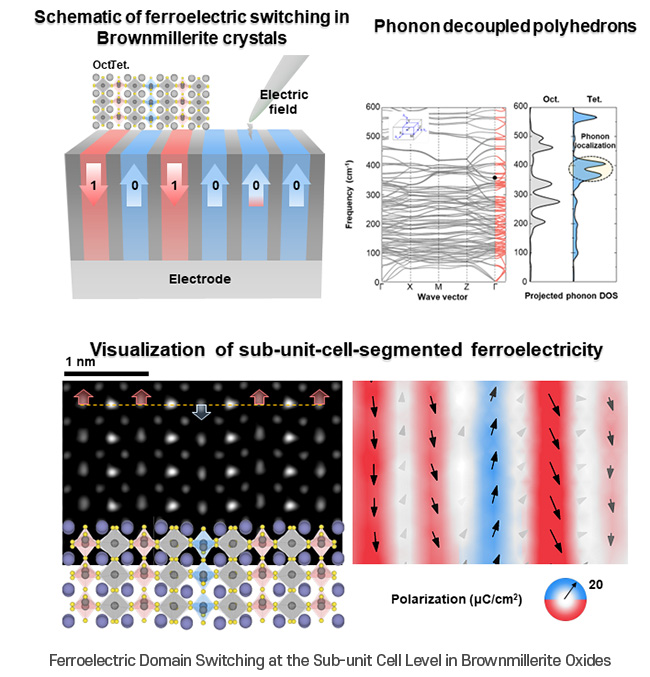
If commercialized, this technology is expected to enable the development of memory devices that are tens of times smaller and faster than current models. Consequently, the storage capacity and processing speed of smartphones and computers could be significantly improved, accelerating advancements in high-speed data processing technologies such as artificial intelligence (AI) and autonomous vehicles.
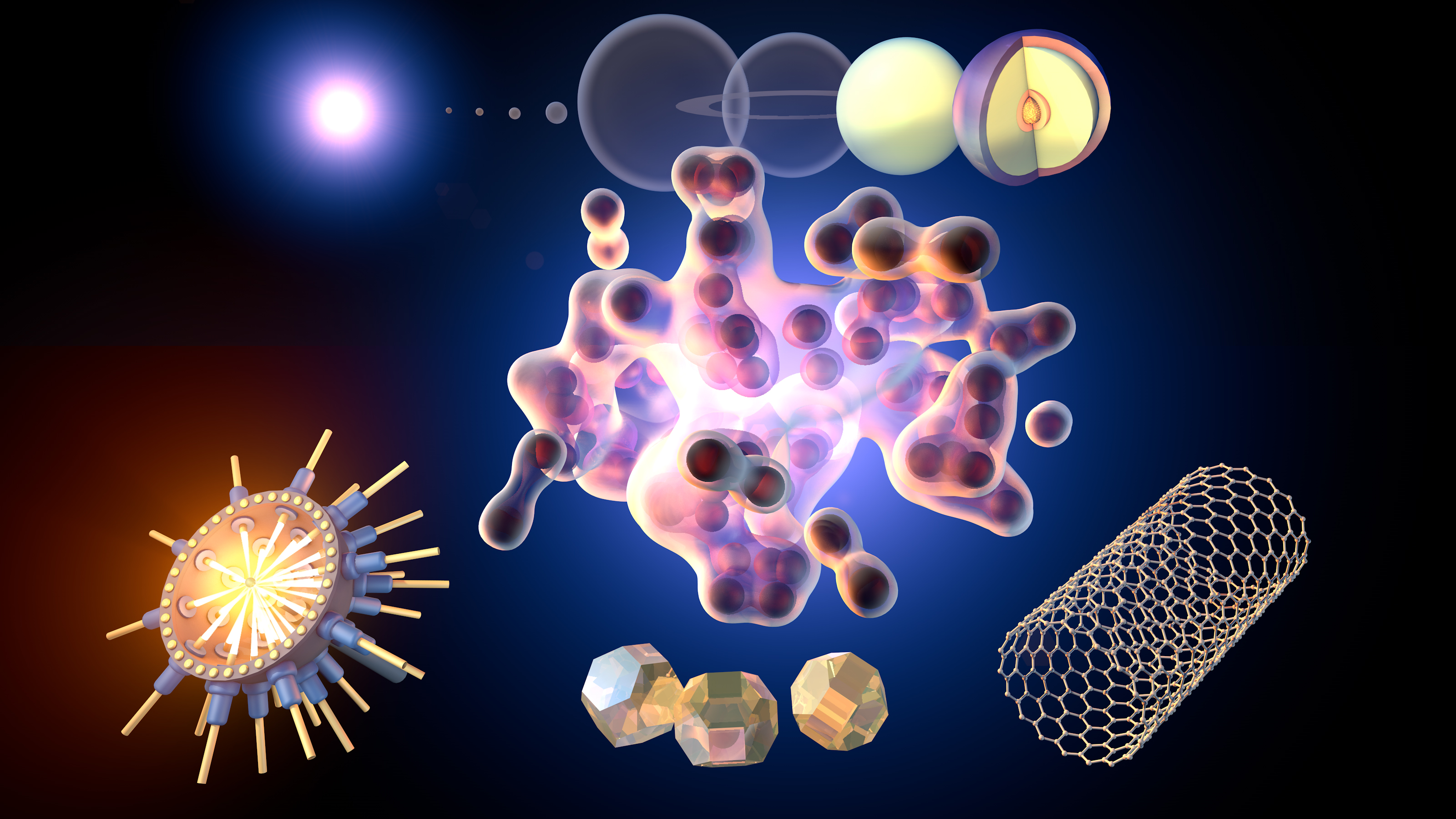
With the declared aim of measuring matter under extreme pressure, an international research collaboration including DESY researchers and headed by the University of Rostock and the Helmholtz-Zentrum Dresden-Rossendorf (HZDR) used the high-performance laser DIPOLE 100-X at the European XFEL for the first time in 2023. With spectacular results: In this initial experiment they managed to study liquid carbon – an unprecedented achievement as the researchers report in the journal Nature.

Now, writing in the journal Nature Communications, a team led by researchers at the Department of Energy’s SLAC National Accelerator Laboratory report how they used ultrafast X-rays from the Linac Coherent Light Source (LCLS), combined with recent theoretical advancements, to reveal those atomic motions on a timescale of femtoseconds, millionths of a billionth of a second. The technique could be used to observe speedy atomic motions in more complex catalysts.






