Tufts University
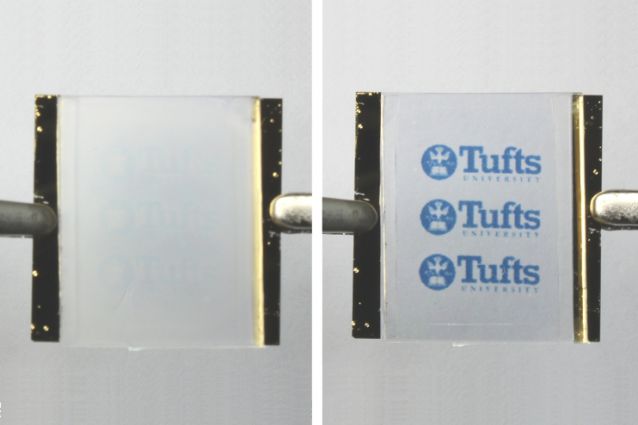
Researchers at Tufts University School of Engineering have developed silk materials that can wrinkle into highly detailed patterns - including words, textures and images as intricate as a QR code or a fingerprint. The patterns take about one second to form, are stable, but can be erased by flooding the surface of the silk with vapor, allowing the researchers to "reverse" the printing and start again. In an article published today in the Proceedings of the National Academy of Sciences, the researchers demonstrate examples of the silk wrinkle patterns, and envision a wide range of potential applications for optical electronic devices.
The smart textile takes advantage of the natural ability of silk fiber proteins - fibroin -- to undergo a change of conformation in response to external conditions, including exposure to water vapor, methanol vapor and UV radiation. Water and methanol vapor, for example, can soak into the fibers and interfere with hydrogen bond cross links in the silk fibroin, causing it to partially 'unravel' and release tension in the fiber. Taking advantage of this property, the researchers fabricated a silk surface from dissolved fibroin by depositing it onto a thin plastic membrane (PDMS). After a cycle of heating and cooling, the silk surface of the silk/PDMS bilayer folds into nanotextured wrinkles due to the different mechanical properties of the layers.
Exposing any part of that wrinkled surface to water or methanol vapor causes the fibers to relax and the wrinkles to flatten. The smooth surface transmits more than 80% of light, while the wrinkled surface only allows 20% or less through, creating a visible contrast and the perception of a printed pattern. The surface can be selectively exposed to vapor using a patterned mask, resulting in a matched pattern in the textured silk. Patterns may also be created by depositing water using inkjet printing. The resolution of this printing method is determined by the resolution of the mask itself, or the nozzle diameter of the inkjet printer.
Alternatively, use of UV creates a virtual mask, since UV exposed parts of the silk surface become less permeable to water or methanol and remain wrinkled when treated with vapor, while the parts not exposed to UV absorb the vapor and flatten out. The printed pattern reflects the pattern of UV light exposed to the silk surface.
After erasing a pattern with vapor, the textured silk can be regenerated with a cycle of heating and cooling. The authors demonstrated the ability to print patterns over at least 50 cycles, without any diminishment in contrast or resolution.
"We can print patterns of remarkably high resolution in the silk - and we even showed that we can pick up the moisture pattern left by a fingerprint," said Yu Wang, post-doctoral fellow in the Tufts University School of Engineering, and first author of the study. "But beyond the novelty of reversible printing, there are many other functional applications that the silk patterning technology could provide."
The list of potential applications that Wang points to include materials with tunable optical properties, some of which may involve the use of dopants that allow the patterned fabric to absorb or emit different wavelengths of light and energy, or exhibit patterns only from specific angles; and materials that modulate their thermal properties, changing the amount of heat they let through. Due to the biocompatibility of the silk fibers, the micropatterning material could be used in various biomedical applications.
The study also demonstrated how the patterns could be switched on and off at will by connecting the bilayer to a small electrical heating element, transitioning the silk between wrinkled and wrinkle-free states.
"Because of its versatility, and ease of manufacture, I think there may be many future applications that we and others will come up with that we have not even imagined yet," said Fiorenzo Omenetto, corresponding author and the Frank C. Doble Professor of Engineering at Tufts' School of Engineering.
Silk wrinkles: controlling structural protein conformation for dynamic, responsive, multifunctional micropatterns
Wang, Y., Beom, J.K., Peng, B., Li, W., Wang, Y., Li, M. & Omenetto, F.
Proceedings of the National Academy of Sciences, PNAS (2019)
Contact information:
Fiorenzo Omenetto
Professor of Biomedical Engineering at Tufts' School of Engineering
fiorenzo.omenetto@tufts.edu
Phone: 617-627-4972
Omenetto Lab - Silklab
Cornell and Pacific Northwest National Laboratory researchers have developed a predictive model for how crystals such as calcite incorporate silica nanoparticles, revealing that the energy needed to cross water layers at the crystal surface strongly governs uptake, and that amines rather than carboxylic acids bind best.
A polymer hydrogel that grows stronger under repeated bending and strain has been developed by chemists, who report the material survived 10,000 bending cycles in tests on a knee-like joint. Made from a biodegradable blend of sugar crystals and polyethylene glycol, the 3D printable material uses sliding cyclodextrin rings to reinforce stressed regions, mimicking collagen.
Rigaku has introduced the PhotonJetMAX-S microfocus sealed-tube X-ray source for the XtaLAB Synergy-S, delivering more than twice the diffracted intensity of the PhotonJet-S at a peak power of 50 W.
This week in nanotech
$18.9M raised
4 funding rounds · 31 deals tracked
New products
 Orion Sputtering Deposition SystemsAJA International Featured
 Ti-WCMBN Nanomaterialia Featured
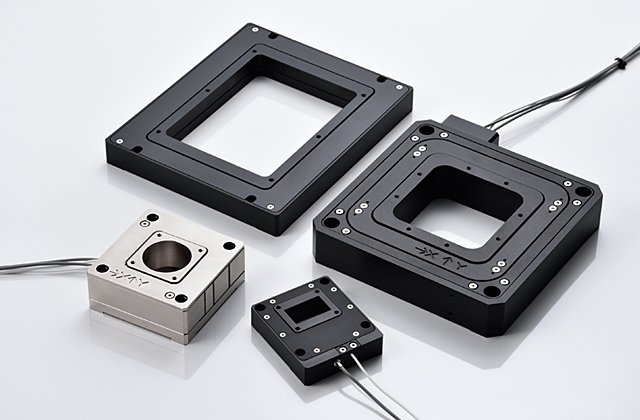 PKVH / PKVL ZAxis With an opening modelTHK PRECISION CO.,LTD.
Market insights
Last 30 days: Semiconductors & Electronics was the busiest vertical: 52 of 170 events (31%).
Money raised per month