Max Planck Institute of Microstructure Physics
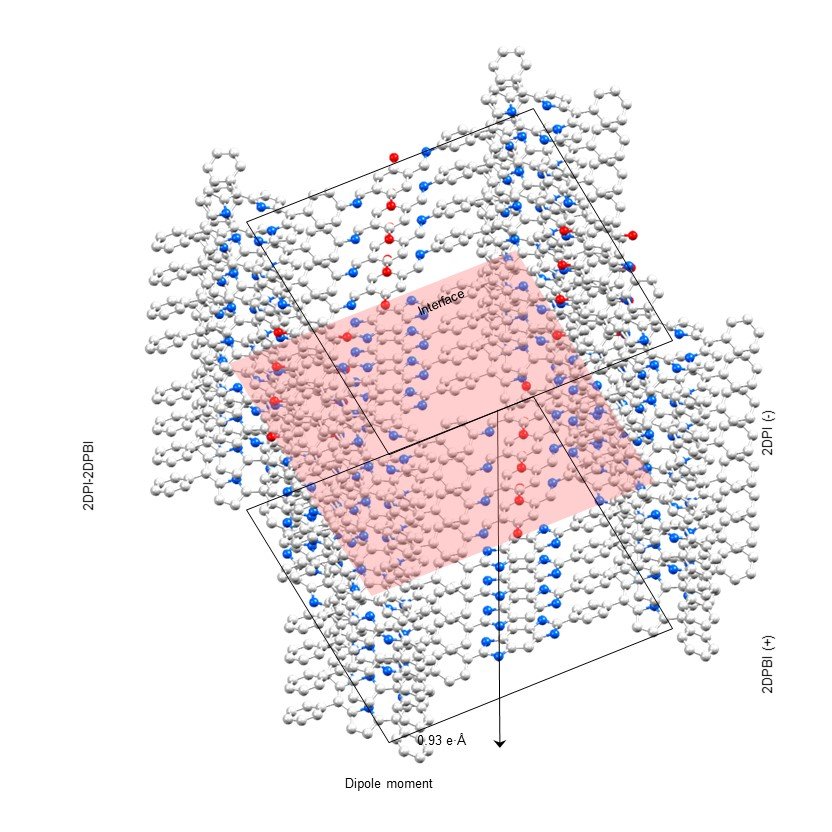
In a recent study published in Nature, an international team of researchers reports, for the first time, lattice-defined 2D vdW heterostructures for organic 2D crystals at near-zero twist. On-water surface synthesis enables sequential assembly of chemically distinct 2D polymers to be stacked with defined lattice registry, while introducing a new lattice-control knob through programmable lattice matching and mismatching from 0% to 18%. Lattice-matched 2D vdW heterostructures exhibit commensurate epitaxy and chemically sharp interfaces, whereas large lattice mismatch gives rise to moiré features and strain-relief distortions. The precisely defined interfaces further enable designed interfacial electronic coupling, band alignment and dipole formation, together with record vertical current rectification controlled by lattice registry, reaching rectification ratios above 107.
Van der Waals (vdW) heterostructures based on inorganic two-dimensional materials enable precise control over interlayer coupling and emergent electronic and optical phenomena. Extending this concept to organic 2D crystals has remained challenging because weak, non-directional interlayer interactions make defined lattice registry, particularly at or near zero twist, difficult to achieve. In a study published in Nature, researchers from the groups of Prof. Xinliang Feng at the Max Planck Institute of Microstructure Physics, Prof. Thomas Heine and Prof. Stefan Mannsfeld at Technische Universität Dresden, together with collaborators, report a bottom-up strategy for programmable lattice engineering of organic 2D vdW heterostructures. Sequential assembly using on-water surface chemistry and synthesis enables layer-by-layer stacking of chemically distinct 2D polymers with defined lattice registry, stacking sequence and thickness.
The researchers combined five structurally and electronically distinct 2D polymers—polyimine, polyimide, polybenzimidazole, polybenzothiazole and polyboronate ester—to realize ten 2D vdW heterostructures with programmable lattice mismatch from 0% to 18%. This introduces a new lattice-control knob, spanning fully lattice-matched, small-mismatch and strongly mismatched systems. Lattice-matched 2D vdW heterostructures exhibit commensurate epitaxy and chemically sharp interfaces, whereas large lattice mismatch gives rise to moiré features and strain-relief distortions.
The defined interfaces further enable designed interfacial electronic coupling, band alignment and dipole formation at a chemically sharp vdW interface. Ultrafast spectroscopy reveals efficient interfacial charge separation and photoluminescence quenching of up to 90%, while first-principles calculations show type-II band alignment, built-in electric fields and interfacial potential steps of approximately 0.3–2.1 V arising from interfacial dipole alignment. These interfacial effects translate directly into vertical electronic transport, with lattice-matched 2D vdW heterostructures exhibiting record vertical current rectification with rectification ratios exceeding 107, which systematically decrease with increasing lattice mismatch.
This breakthrough opens the door to programmable organic 2D vdW heterostructures in which lattice registry and interfacial design can be used to control electronic functionality. By linking molecular design and lattice matching or mismatching with interfacial coupling, charge separation and vertical transport, this synthetic platform enables access to quantum and electronic functionalities in organic 2D crystal based vdW heterostructures and offers opportunities to explore emergent physical phenomena, including moiré superlattices and interfacial spin physics.
Reference
Organic two-dimensional van der Waals heterostructures
Prasoon, A.; Nguyen, N. N.; Hambsch, M.; Singhvi, P.; Terres, S.; Xiao, Z.; Goyal, N.; Qi, H.; Mücke, D.; Auras, F.; Wang, Z.; Chung, S.; Položij, M.; Wang, H. I.; Cho, K.; Kaiser, U.; Chernikov, A.; Bonn, M.; Mannsfeld, S. C. B.; Heine, T.; Feng, X.
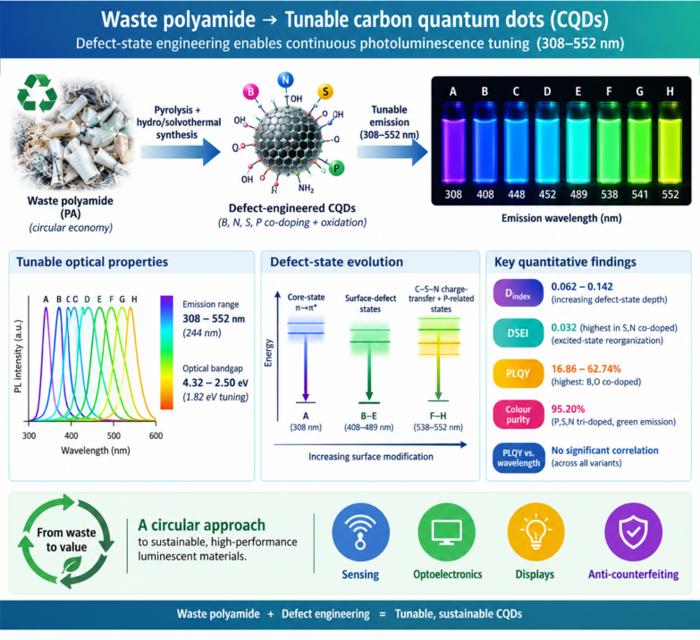
Waste polyamide-derived CQDs show continuous photoluminescence tuning from 308 to 552 nm through sequential defect-state engineering, with optical transition energies decreasing from 4.32 to 2.50 eV. @Christian Ebere Enyoh from Saitama University Carbon quantum dots (CQDs) are fluorescent carbon nanomaterials with potential applications in sensing, optoelectronics, displays, anti-counterfeiting, and environmental technologies. Their optical properties can be adjusted by modifying the carbon...
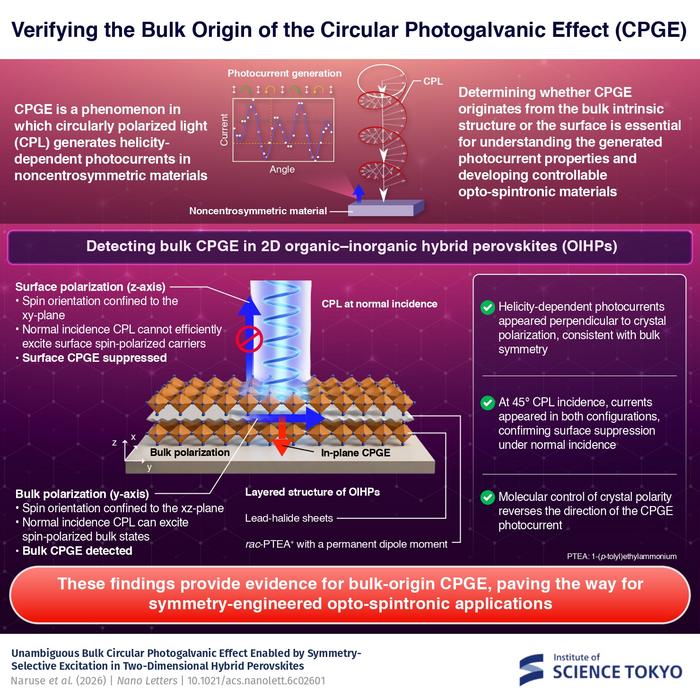
The researchers used circularly polarized light at normal incidence and found that helicity-dependent photocurrents appeared perpendicular to the crystal’s polarization but vanished when measured parallel to it, supporting a bulk origin of CPGE. @Institute of Science Tokyo The circular photogalvanic effect (CPGE), a phenomenon that generates helicity-dependent photocurrents in noncentrosymmetric materials, can originate purely from a crystal's internal structure without contribution from the...
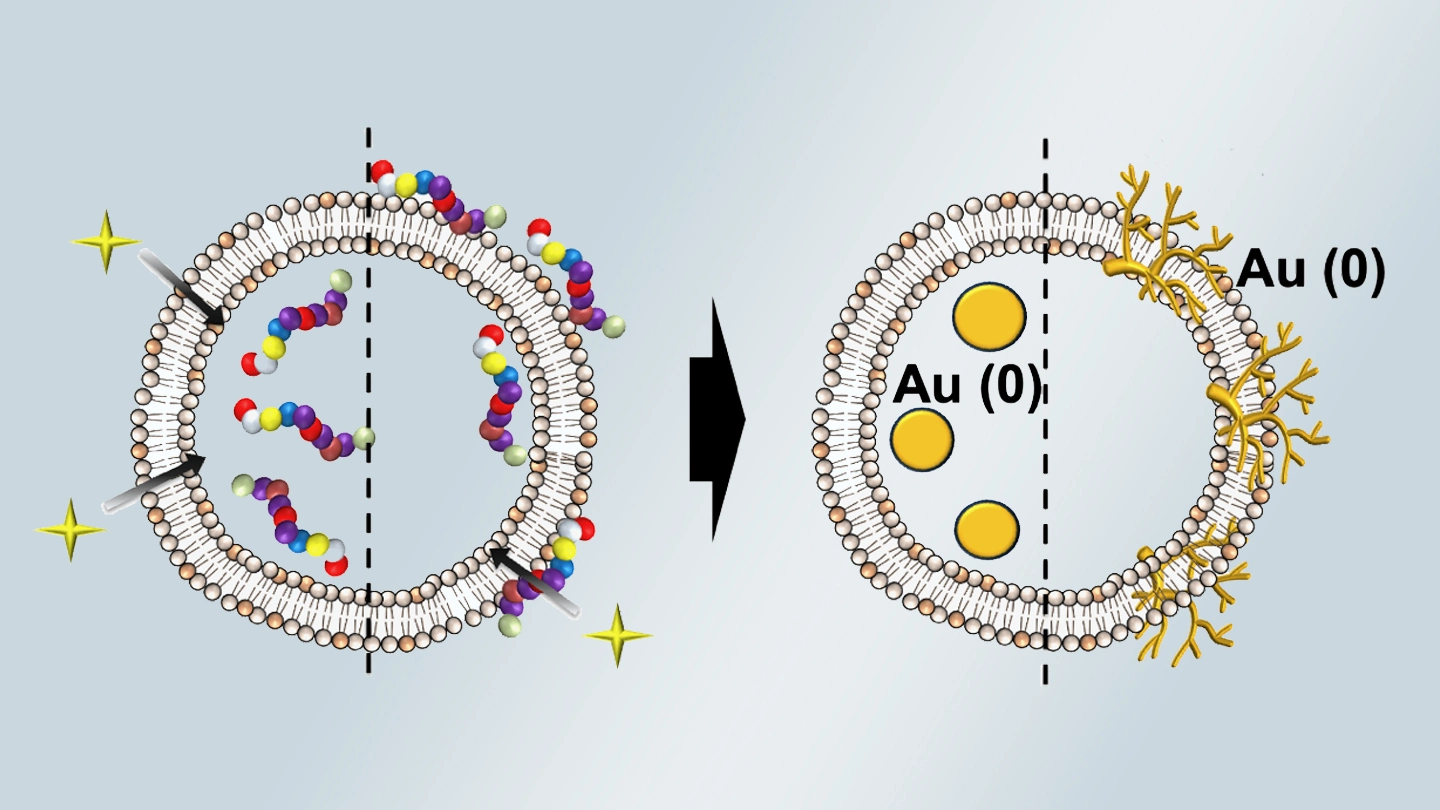
Summary of gold nanoparticle growth programming in liposome based on localization of biomineralization peptide The position of biomineralization peptides within liposomes can influence how gold nanoparticles grow, reports a research team from Institute of Science Tokyo. Peptides localized at the membrane interface promote branched structures, while those confined to the liposome interior favor spherical nanoparticles. The findings offer a new strategy for controlling nanoscale reaction...
